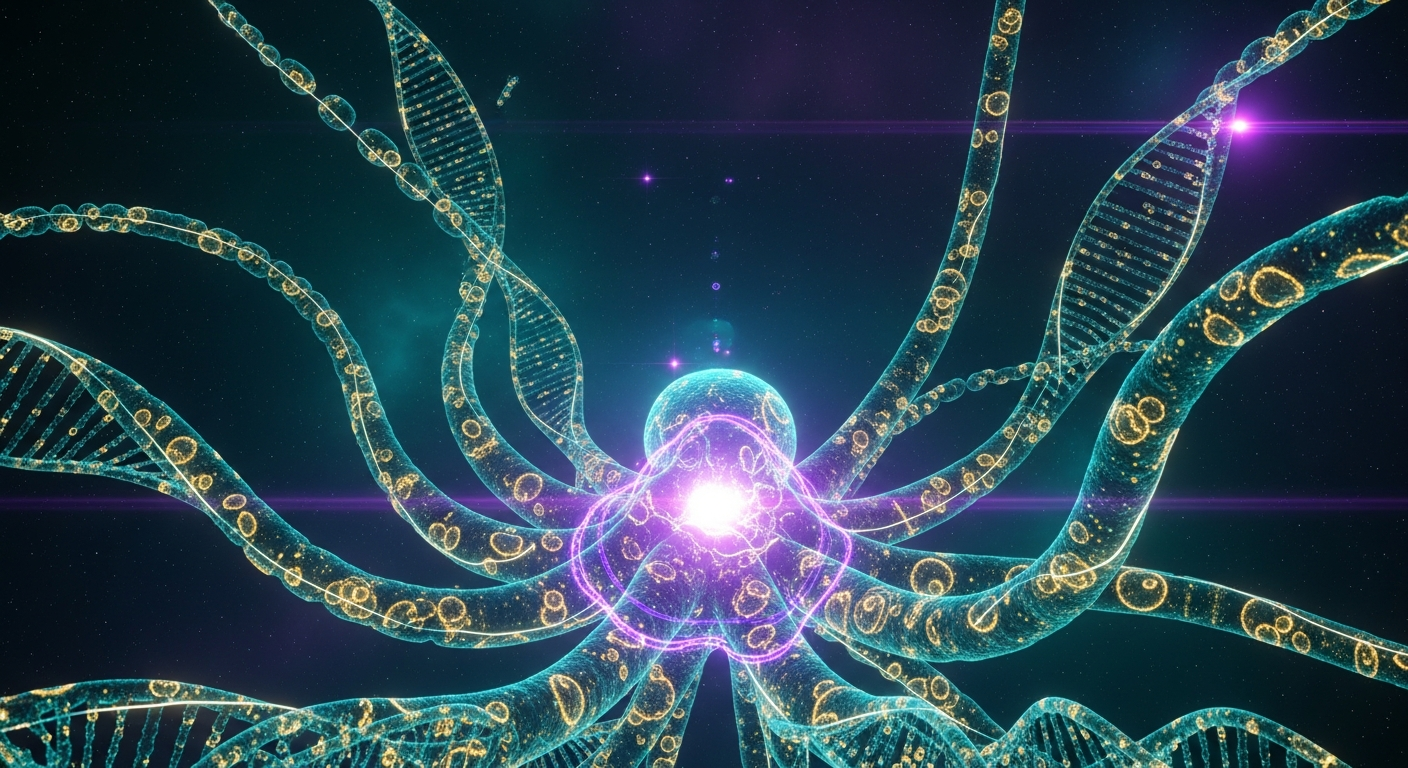
The Octopus Genome: Unlocking the Alien Biology of Earth’s Most Mysterious Creature
Introduction: Meeting Earth’s Resident Alien
If you were to search for extraterrestrial life, you might not need to look toward the stars; you only need to look into the depths of our own oceans. With their shape-shifting abilities, distributed nervous systems, and astonishing problem-solving skills, octopuses have long captivated marine biologists and evolutionary scientists alike. The late neurobiologist Martin Wells famously described the octopus as an “alien,” a sentiment that was later echoed by researchers when the first octopus genome was fully sequenced.
For decades, the biological mechanisms driving the extreme physiological and cognitive traits of cephalopods remained shrouded in mystery. How did a mollusc—a relative of the common garden snail and the mindless oyster—evolve to possess camera-like eyes, highly dexterous appendages, and a level of intelligence capable of escaping complex enclosures? The answer lies in the octopus genome. By unraveling their genetic blueprint, scientists have discovered that the biology of the octopus is not just unique; it fundamentally challenges our understanding of evolutionary biology, genetic regulation, and the pathway to high intelligence.
Decoding the Blueprint: Inside the Detailed Scientific Mechanics of the Octopus Genome
The sequencing of the California two-spot octopus (Octopus bimaculoides) genome in 2015 marked a watershed moment in genomic science. It revealed a genetic architecture that is wildly different from other invertebrates, characterized by massive gene expansions, unique neurological building blocks, and an astonishing mastery of genetic recoding.
A Genome of Mammoth Proportions
One of the most surprising discoveries about the octopus genome is its sheer size and complexity. The genome contains roughly 2.7 billion base pairs, making it nearly as large as the human genome (which has about 3 billion). However, size is only part of the story. The octopus genome contains approximately 33,000 protein-coding genes—significantly more than the 20,000 to 25,000 found in humans.
Much of this vast genetic library is dedicated to environmental interaction and cellular regulation. For instance, the octopus possesses a massive expansion of zinc-finger transcription factors—genes responsible for regulating how other genes are expressed. This vast regulatory network allows the octopus to dynamically manage its complex physiology, from its rapid color-changing chromatophores to its highly specialized sensory organs.
Protocadherins and the Decentralized Nervous System
Perhaps the most defining characteristic of the octopus is its decentralized intelligence. Of its 500 million neurons, roughly two-thirds are distributed throughout its eight arms rather than centralized in its brain. This means an octopus’s arm can “think,” taste, touch, and react independently of the main brain.
Genomic analysis revealed the biological foundation for this incredible neural architecture: a massive expansion of a gene family called protocadherins. In vertebrates, protocadherins dictate the development of the nervous system and how neurons wire together. Before the octopus genome was sequenced, it was believed that only vertebrates possessed large numbers of these genes (humans have around 50). Astoundingly, the octopus genome contains 168 protocadherin genes. This unique, independent expansion in a cephalopod explains how they are able to construct a nervous system of such unparalleled complexity outside the vertebrate lineage.
Transposons: The “Jumping Genes” Shaping Cephalopod Evolution
Another fascinating aspect of the octopus genome is its chaotic structural organization. The genome is heavily populated by transposons, often referred to as “jumping genes.” These are DNA sequences capable of moving around to different positions within the genome. While active transposons can sometimes cause harmful mutations, they are also powerful engines of evolutionary innovation.
In the octopus, the high rate of transposon activity has led to heavy genomic rearrangements. Unlike the highly structured and conserved genomes of mammals, where genes are often grouped in predictable clusters, the octopus genome looks as though it was put into a blender. This genetic shuffling has separated genes that are normally closely linked, allowing for entirely novel gene regulations and the emergence of entirely new biological traits unique to cephalopods.
The Master of RNA Editing: Overriding the DNA Blueprint
While the octopus’s DNA is deeply fascinating, its interaction with RNA is what truly cements its “alien” status. In the standard model of biology, DNA makes RNA, and RNA makes proteins. Most organisms rely on DNA mutations over millions of years to adapt to their environments. The octopus, however, takes a radical shortcut through extensive RNA editing.
Using special enzymes (ADARs), octopuses and other coleoid cephalopods actively rewrite their messenger RNA (mRNA) sequences after they have been transcribed from DNA but before they are translated into proteins. Specifically, they utilize A-to-I (adenosine to inosine) editing to alter the final protein structures. While humans utilize RNA editing for a tiny fraction of their genes, the octopus dynamically edits tens of thousands of its coding sites.
This allows the octopus to physically alter its nervous system on the fly in response to environmental changes. For example, an octopus can use RNA editing to adjust the proteins in its nerve channels to keep its brain functioning optimally in freezing Antarctic waters, and then edit them differently if the water warms.
However, this genetic superpower comes with a profound evolutionary trade-off. To maintain these RNA editing sites, the underlying DNA sequence must remain virtually unchanged. As a result, the octopus experiences an incredibly slow rate of traditional DNA evolution. They have essentially sacrificed long-term genomic evolution in favor of immediate, short-term physiological adaptability.
Conclusion: What the Octopus Teaches Us About Life’s Potential
The sequencing and subsequent studies of the octopus genome have shattered many of our preconceptions about evolutionary biology. By unveiling a sprawling genetic code filled with novel gene expansions, a decentralized neural architecture driven by protocadherins, and an unprecedented reliance on RNA editing, science has proven that there is more than one way to build an intelligent, complex organism on Earth.
The octopus represents an independent experiment in the evolution of large brains and complex behavior. Their biology diverges so drastically from the vertebrate lineage that studying them is the closest scientists can currently get to studying alien life. As genomic technologies continue to advance, the ongoing exploration of cephalopod biology will not only deepen our understanding of these magnificent creatures but could also unlock new paradigms in genetics, neurobiology, and even the development of artificial, decentralized intelligence systems. The octopus reminds us that life is incredibly malleable, and evolution’s toolkit is far more diverse than we ever imagined.


Reader Comments