The Cosmic Genome: How Deep Space Discoveries Are Rewriting the Rules of Biology

The Cosmic Genome: How Deep Space Discoveries Are Rewriting the Rules of Biology Introduction: The Dawn of a Universal Biology For centuries, the science of biology has been inherently terrestrial. Our understanding of life—how it forms, evolves, and adapts—has been entirely restricted to the biosphere of a single pale blue dot. However, the emergence of advanced astrobiology and unprecedented deep space discoveries are fundamentally shifting this paradigm. We are now entering the era of the "Cosmic Genome," a revolutionary concept suggesting that the fundamental building blocks of life are not an exclusive anomaly of Earth, but a universal property of the cosmos. Recent missions by the James Webb Space Telescope (JWST), the analysis of pristine asteroid samples from missions like Hayabusa2 and OSIRIS-REx, and multi-generational experiments aboard the International Space Station (ISS) have unveiled astonishing truths about organic chemistry in the vacuum of space. By synthesizing astrophysics, chemistry, and genetics, scientists are beginning to realize that the rules of biology are not confined to our planet. Instead, deep space is acting as a macroscopic laboratory, challenging our earthly definitions of vitality, genetic resilience, and evolutionary potential. This article delves into the profound ways deep space discoveries are actively rewriting the bedrock rules of biological science. Detailed Scientific Explanation: Decoding the Cosmic Genome Astrochemical Evolution: The Prebiotic Foundations of Space The traditional biological consensus held that the complex organic molecules necessary for life—such as amino acids, sugars, and nucleobases—were forged in the primordial soup of early Earth. Yet, deep space spectroscopy and astrochemical analyses have turned this notion on its head. Deep within freezing molecular clouds and stellar nurseries, astronomers have detected a rich tapestry of complex carbon-based molecules. The recent discovery of uracil (one of the four nucleobases in the RNA of Earthly organisms) and vitamin B3 in the pristine samples brought back from the near-Earth asteroid Ryugu proves that the synthesis of life's fundamental components occurs in the harsh radiation of deep space. These prebiotic molecules are formed on the surface of microscopic dust grains, catalyzed by cosmic rays and ultraviolet radiation. This astrochemical evolution suggests that the "Cosmic Genome"—the pre-programmed chemical pathway to life—is continuously raining down on habitable exoplanets across the universe via cometary and meteoritic bombardment. Extremophiles and the Redefinition of Biological Limits As we look outward, our understanding of where life can survive has expanded inward, deep into Earth's most hostile environments. The study of extremophiles—microorganisms that thrive in boiling hydrothermal vents, acidic lakes, and deep subterranean rock—has provided a vital analogue for extraterrestrial biology. When coupled with space exposure experiments on the ISS, the results are paradigm-shifting. Organisms such as the extremophilic bacterium Deinococcus radiodurans and microscopic animals known as tardigrades have been exposed to the absolute vacuum, microgravity, and high-ionizing radiation of low Earth orbit. Astonishingly, they not only survive but demonstrate highly efficient, previously undocumented DNA repair mechanisms. These space-biology discoveries prove that biological matter is capable of entering states of anhydrobiosis (extreme desiccation) to endure deep space conditions. By mapping the transcriptomes of these survivors, scientists are uncovering genetic pathways that rewrite the rulebook on cellular senescence and radiation resistance, which will be vital for future human deep-space exploration. Epigenetics in Microgravity: Fluid Genomes The rules of biology dictate that an organism’s environment drives its evolution over millions of years. However, spaceflight has revealed that the genome is startlingly fluid and highly responsive to extraterrestrial environments in real-time. Through comprehensive studies like the NASA Twins Study, astrobiologists have documented how microgravity and cosmic radiation induce rapid epigenetic changes. In zero-gravity environments, the physical geometry of the cell changes, which in turn alters the structural organization of chromatin within the nucleus. Spaceflight triggers significant shifts in DNA methylation and telomere length dynamics. Genes responsible for immune function, DNA repair, and bone ossification are up-regulated or down-regulated within hours of leaving Earth's gravity. These discoveries prove that terrestrial biology possesses a latent, built-in adaptability to the cosmos, suggesting that if life exists elsewhere, its genetic expression would be inextricably linked to the localized physical forces of its host planet. Re-evaluating Panspermia: Is DNA a Universal Blueprint? The accumulation of these deep space discoveries has breathed new life into the theory of Panspermia—the hypothesis that the seeds of life exist all over the universe and can be propagated through space. If nucleobases are forged in asteroids, and organisms can survive the harshness of the cosmic void, the interstellar transfer of biological material is no longer just science fiction; it is a statistical probability. This raises the ultimate question of the Cosmic Genome: Is the double-helix structure of DNA a unique evolutionary accident of Earth, or is it a universal thermodynamic inevitability? Astrobiologists now postulate that carbon-based life, driven by the universally consistent laws of physics and chemistry, may utilize similar genetic encoding across the cosmos. If RNA and DNA are the most chemically stable methods of storing complex information in this universe, astrobiology must pivot from asking "What else could life look like?" to "How universally widespread is the genetic code?" Conclusion: The Dawn of Interstellar Biology The exploration of deep space is doing far more than expanding our astronomical horizons; it is holding a mirror up to terrestrial life. By discovering complex organic building blocks in ancient asteroids, observing the resilient epigenetic adaptations of biology in microgravity, and studying extreme survival mechanisms, we are uncovering the reality of the Cosmic Genome. Biology is no longer an isolated discipline confined to the Earth's surface. It is deeply intertwined with astrophysics, planetary science, and cosmology. As we prepare for crewed missions to Mars, probe the subsurface oceans of Enceladus and Europa, and point our next-generation telescopes at the atmospheres of distant exoplanets, we must rewrite our biological textbooks. Life is not merely an inhabitant of the universe; it is a fundamental, structurally integrated expression of the cosmos itself. The rules of biology are vast, resilient, and undeniably extraterrestrial, waiting for us in the dark expanses of deep space. General

The Cosmic Genome: How Deep Space Discoveries Are Rewriting the Rules of Biology

Introduction: The Dawn of a Universal Biology

For centuries, the science of biology has been inherently terrestrial. Our understanding of life—how it forms, evolves, and adapts—has been entirely restricted to the biosphere of a single pale blue dot. However, the emergence of advanced astrobiology and unprecedented deep space discoveries are fundamentally shifting this paradigm. We are now entering the era of the “Cosmic Genome,” a revolutionary concept suggesting that the fundamental building blocks of life are not an exclusive anomaly of Earth, but a universal property of the cosmos.

Recent missions by the James Webb Space Telescope (JWST), the analysis of pristine asteroid samples from missions like Hayabusa2 and OSIRIS-REx, and multi-generational experiments aboard the International Space Station (ISS) have unveiled astonishing truths about organic chemistry in the vacuum of space. By synthesizing astrophysics, chemistry, and genetics, scientists are beginning to realize that the rules of biology are not confined to our planet. Instead, deep space is acting as a macroscopic laboratory, challenging our earthly definitions of vitality, genetic resilience, and evolutionary potential. This article delves into the profound ways deep space discoveries are actively rewriting the bedrock rules of biological science.

Detailed Scientific Explanation: Decoding the Cosmic Genome

Astrochemical Evolution: The Prebiotic Foundations of Space

The traditional biological consensus held that the complex organic molecules necessary for life—such as amino acids, sugars, and nucleobases—were forged in the primordial soup of early Earth. Yet, deep space spectroscopy and astrochemical analyses have turned this notion on its head. Deep within freezing molecular clouds and stellar nurseries, astronomers have detected a rich tapestry of complex carbon-based molecules.

The recent discovery of uracil (one of the four nucleobases in the RNA of Earthly organisms) and vitamin B3 in the pristine samples brought back from the near-Earth asteroid Ryugu proves that the synthesis of life’s fundamental components occurs in the harsh radiation of deep space. These prebiotic molecules are formed on the surface of microscopic dust grains, catalyzed by cosmic rays and ultraviolet radiation. This astrochemical evolution suggests that the “Cosmic Genome”—the pre-programmed chemical pathway to life—is continuously raining down on habitable exoplanets across the universe via cometary and meteoritic bombardment.

Extremophiles and the Redefinition of Biological Limits

As we look outward, our understanding of where life can survive has expanded inward, deep into Earth’s most hostile environments. The study of extremophiles—microorganisms that thrive in boiling hydrothermal vents, acidic lakes, and deep subterranean rock—has provided a vital analogue for extraterrestrial biology. When coupled with space exposure experiments on the ISS, the results are paradigm-shifting.

Organisms such as the extremophilic bacterium Deinococcus radiodurans and microscopic animals known as tardigrades have been exposed to the absolute vacuum, microgravity, and high-ionizing radiation of low Earth orbit. Astonishingly, they not only survive but demonstrate highly efficient, previously undocumented DNA repair mechanisms. These space-biology discoveries prove that biological matter is capable of entering states of anhydrobiosis (extreme desiccation) to endure deep space conditions. By mapping the transcriptomes of these survivors, scientists are uncovering genetic pathways that rewrite the rulebook on cellular senescence and radiation resistance, which will be vital for future human deep-space exploration.

Epigenetics in Microgravity: Fluid Genomes

The rules of biology dictate that an organism’s environment drives its evolution over millions of years. However, spaceflight has revealed that the genome is startlingly fluid and highly responsive to extraterrestrial environments in real-time. Through comprehensive studies like the NASA Twins Study, astrobiologists have documented how microgravity and cosmic radiation induce rapid epigenetic changes.

In zero-gravity environments, the physical geometry of the cell changes, which in turn alters the structural organization of chromatin within the nucleus. Spaceflight triggers significant shifts in DNA methylation and telomere length dynamics. Genes responsible for immune function, DNA repair, and bone ossification are up-regulated or down-regulated within hours of leaving Earth’s gravity. These discoveries prove that terrestrial biology possesses a latent, built-in adaptability to the cosmos, suggesting that if life exists elsewhere, its genetic expression would be inextricably linked to the localized physical forces of its host planet.

Re-evaluating Panspermia: Is DNA a Universal Blueprint?

The accumulation of these deep space discoveries has breathed new life into the theory of Panspermia—the hypothesis that the seeds of life exist all over the universe and can be propagated through space. If nucleobases are forged in asteroids, and organisms can survive the harshness of the cosmic void, the interstellar transfer of biological material is no longer just science fiction; it is a statistical probability.

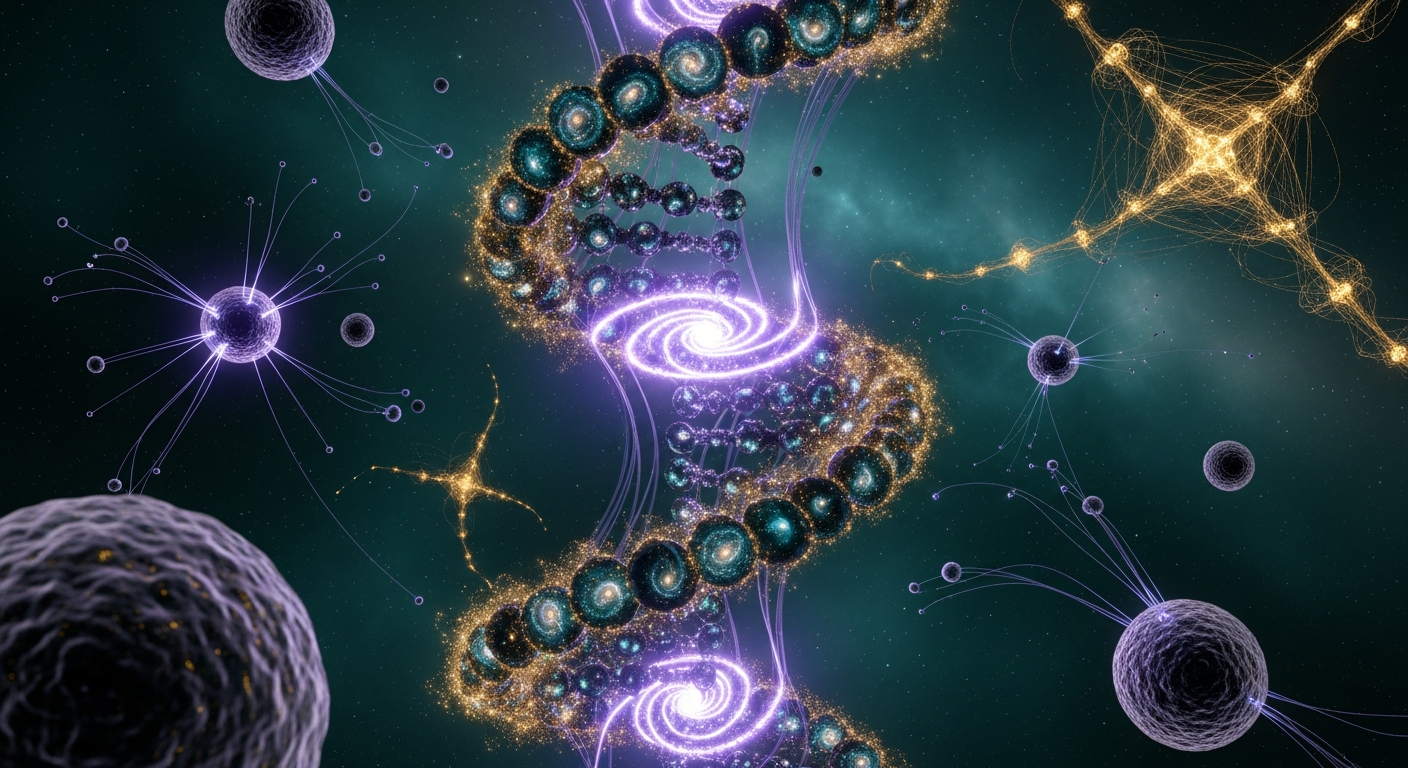
This raises the ultimate question of the Cosmic Genome: Is the double-helix structure of DNA a unique evolutionary accident of Earth, or is it a universal thermodynamic inevitability? Astrobiologists now postulate that carbon-based life, driven by the universally consistent laws of physics and chemistry, may utilize similar genetic encoding across the cosmos. If RNA and DNA are the most chemically stable methods of storing complex information in this universe, astrobiology must pivot from asking “What else could life look like?” to “How universally widespread is the genetic code?”

Conclusion: The Dawn of Interstellar Biology

The exploration of deep space is doing far more than expanding our astronomical horizons; it is holding a mirror up to terrestrial life. By discovering complex organic building blocks in ancient asteroids, observing the resilient epigenetic adaptations of biology in microgravity, and studying extreme survival mechanisms, we are uncovering the reality of the Cosmic Genome. Biology is no longer an isolated discipline confined to the Earth’s surface. It is deeply intertwined with astrophysics, planetary science, and cosmology.

As we prepare for crewed missions to Mars, probe the subsurface oceans of Enceladus and Europa, and point our next-generation telescopes at the atmospheres of distant exoplanets, we must rewrite our biological textbooks. Life is not merely an inhabitant of the universe; it is a fundamental, structurally integrated expression of the cosmos itself. The rules of biology are vast, resilient, and undeniably extraterrestrial, waiting for us in the dark expanses of deep space.


Reader Comments

Copied title and URL