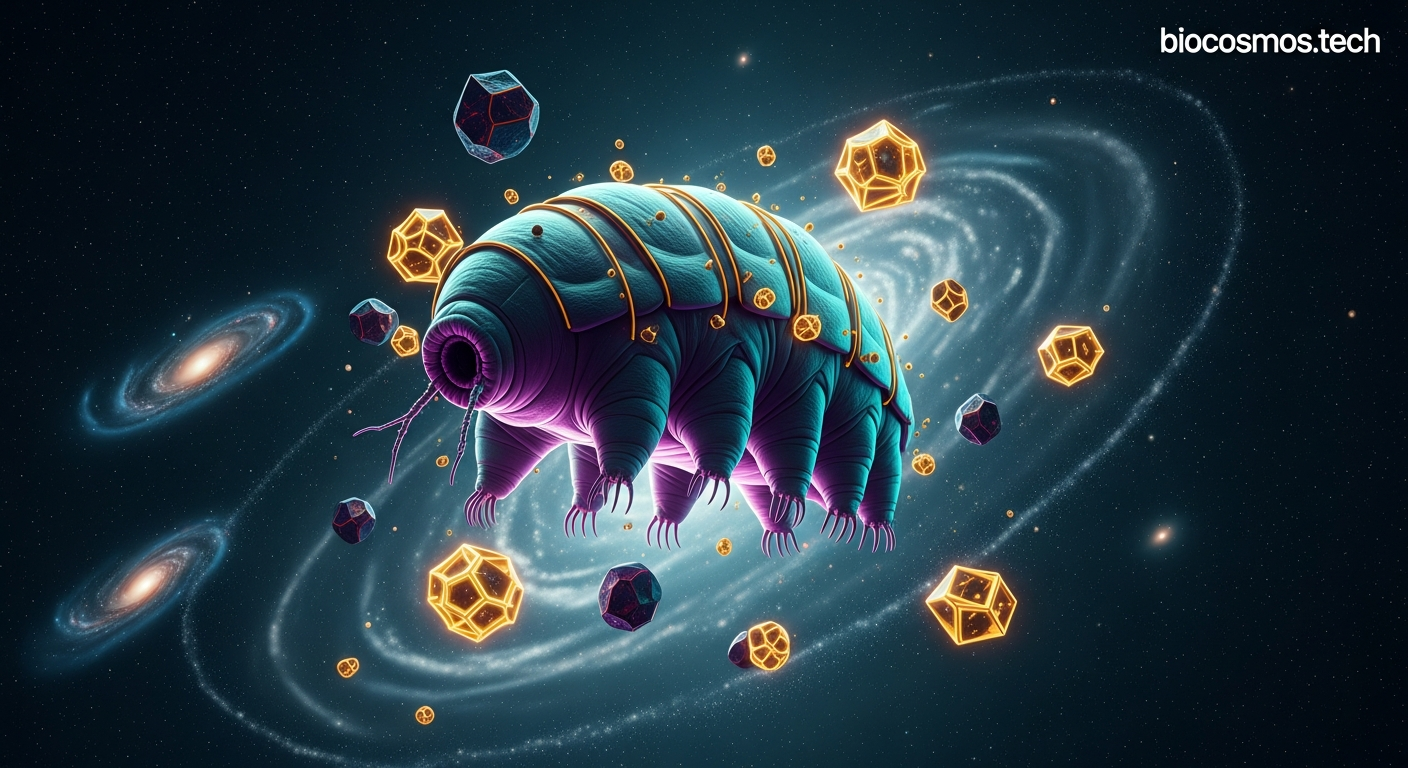
The Tardigrade Mystery: How Earth’s Toughest Organism Survives the Vacuum of Space

The Tardigrade Mystery: How Earth's Toughest Organism Survives the Vacuum of Space Introduction: Meet the Water Bear, Earth's Toughest Astronaut Space is an unforgiving environment. Beyond the protective embrace of Earth's atmosphere lies a deadly combination of absolute zero temperatures, a boundless vacuum, and a relentless barrage of ionizing solar and cosmic radiation. For the vast majority of terrestrial life forms, exposure to the vacuum of space means instantaneous, catastrophic biological failure. Yet, there is a microscopic marvel that views the cosmos not as a death sentence, but as a minor inconvenience: the tardigrade. Often affectionately referred to as "water bears" or "moss piglets," tardigrades are eight-legged, microscopic invertebrates found in nearly every ecosystem on Earth, from deep-sea trenches to the icy peaks of the Himalayas. However, their true claim to fame emerged in 2007 during the European Space Agency's FOTON-M3 mission. Scientists exposed active tardigrades directly to the open vacuum of space. Days later, upon being returned to Earth and rehydrated, these resilient extremophiles not only survived but actively reproduced. This extraordinary event sparked a massive wave of astrobiological research. How exactly does Earth's toughest organism survive the vacuum of space? The answer lies in millions of years of evolutionary adaptation resulting in unparalleled cellular engineering. The Scientific Breakdown: How Tardigrades Defy the Void To understand the secret of tardigrade space survival, we must look at the creature on a molecular level. Their resilience is not due to a single trait, but rather a complex, multi-layered biological defense mechanism that activates when the environment turns lethal. Cryptobiosis and the Indestructible "Tun" State When exposed to the extreme desiccation caused by the vacuum of space, a tardigrade does not simply dry out and die. Instead, it enters a state of suspended animation known as cryptobiosis—specifically, anhydrobiosis (life without water). The tardigrade retracts its head and eight legs, rolling into a dehydrated, microscopic sphere called a "tun." During this transition, the organism's metabolic rate plummets to less than 0.01% of normal. But the real magic happens inside the cells. In most animals, losing cellular water causes cell membranes to rupture and proteins to unfold, leading to death. Tardigrades, however, manufacture high quantities of Tardigrade-specific Intrinsically Disordered Proteins (TDPs) and, in some species, a sugar called trehalose. As water leaves the cell, these unique proteins act like a biological glass. Through a process called vitrification, they lock sensitive cellular machinery, proteins, and membranes into a stable, glass-like matrix, preventing molecular collapse until water is reintroduced. The DNA Shield: Unlocking the Secrets of the Dsup Protein Surviving the vacuum is only half the battle; the real killer in space is radiation. Ultraviolet (UV) light and ionizing cosmic rays violently shatter DNA, mutating genes beyond repair. Yet, tardigrades exhibit a radiation tolerance up to 1,000 times greater than that of humans. In 2016, researchers sequencing the genome of the tardigrade species Ramazzottius varieornatus discovered a completely unique protein, which they named Dsup (Damage Suppressor). The Dsup protein is an evolutionary masterpiece. It acts as a physical shield, binding directly to the nucleosomes—the spools around which DNA is wound. By wrapping itself around the DNA, Dsup prevents the physical cleavage of the genetic code by absorbing the impact of hydroxyl radicals generated by ionizing radiation. Remarkably, when scientists genetically engineered human cultured cells to express the tardigrade Dsup protein, the human cells instantly gained a 40% increase in X-ray radiation resistance. Resistance to Extreme Temperature and Pressure Space presents a dual threat of extreme thermal fluctuation. Tardigrades in the tun state have been proven to survive being plunged into liquid helium at -272°C (just one degree above absolute zero) and heated to a blistering 150°C (well past the boiling point of water). Their vitrified cellular structure prevents the formation of sharp ice crystals that would normally puncture cell walls in freezing conditions, while simultaneously preventing protein denaturation at high temperatures. Furthermore, the robust structural integrity of the tun allows them to withstand the zero-pressure vacuum of space just as easily as they endure pressures of up to 6,000 atmospheres—roughly six times the pressure found in the deepest part of the Mariana Trench. Conclusion: Implications for Astrobiology and Human Exploration The tardigrade is a testament to the sheer tenacity of biological life. Their ability to survive the vacuum of space fundamentally redefines the boundaries of habitability, offering profound implications for the field of astrobiology. If a terrestrial organism can survive the hostile conditions of the cosmos, it bolsters the panspermia hypothesis—the idea that the building blocks of life, or life itself, could theoretically hitchhike across the solar system on asteroids or meteorites. Furthermore, unraveling the tardigrade mystery holds vast potential for the future of human medicine and space exploration. The biochemical secrets of the Dsup protein and TDPs could eventually lead to revolutionary advancements in biotechnology. Imagine developing crops engineered to survive severe droughts, creating methods to store vaccines and human blood at room temperature indefinitely without refrigeration, or engineering protective therapies that shield human astronauts from deadly cosmic radiation during long-duration missions to Mars. Ultimately, the unassuming water bear is more than just a biological curiosity. It is a microscopic blueprint for extreme survival, proving that even in the cold, dark, radioactive vacuum of space, life finds a way to endure. General

The Tardigrade Mystery: How Earth’s Toughest Organism Survives the Vacuum of Space

Introduction: Meet the Water Bear, Earth’s Toughest Astronaut

Space is an unforgiving environment. Beyond the protective embrace of Earth’s atmosphere lies a deadly combination of absolute zero temperatures, a boundless vacuum, and a relentless barrage of ionizing solar and cosmic radiation. For the vast majority of terrestrial life forms, exposure to the vacuum of space means instantaneous, catastrophic biological failure. Yet, there is a microscopic marvel that views the cosmos not as a death sentence, but as a minor inconvenience: the tardigrade.

Often affectionately referred to as “water bears” or “moss piglets,” tardigrades are eight-legged, microscopic invertebrates found in nearly every ecosystem on Earth, from deep-sea trenches to the icy peaks of the Himalayas. However, their true claim to fame emerged in 2007 during the European Space Agency’s FOTON-M3 mission. Scientists exposed active tardigrades directly to the open vacuum of space. Days later, upon being returned to Earth and rehydrated, these resilient extremophiles not only survived but actively reproduced. This extraordinary event sparked a massive wave of astrobiological research. How exactly does Earth’s toughest organism survive the vacuum of space? The answer lies in millions of years of evolutionary adaptation resulting in unparalleled cellular engineering.

The Scientific Breakdown: How Tardigrades Defy the Void

To understand the secret of tardigrade space survival, we must look at the creature on a molecular level. Their resilience is not due to a single trait, but rather a complex, multi-layered biological defense mechanism that activates when the environment turns lethal.

Cryptobiosis and the Indestructible “Tun” State

When exposed to the extreme desiccation caused by the vacuum of space, a tardigrade does not simply dry out and die. Instead, it enters a state of suspended animation known as cryptobiosis—specifically, anhydrobiosis (life without water). The tardigrade retracts its head and eight legs, rolling into a dehydrated, microscopic sphere called a “tun.”

During this transition, the organism’s metabolic rate plummets to less than 0.01% of normal. But the real magic happens inside the cells. In most animals, losing cellular water causes cell membranes to rupture and proteins to unfold, leading to death. Tardigrades, however, manufacture high quantities of Tardigrade-specific Intrinsically Disordered Proteins (TDPs) and, in some species, a sugar called trehalose. As water leaves the cell, these unique proteins act like a biological glass. Through a process called vitrification, they lock sensitive cellular machinery, proteins, and membranes into a stable, glass-like matrix, preventing molecular collapse until water is reintroduced.

The DNA Shield: Unlocking the Secrets of the Dsup Protein

Surviving the vacuum is only half the battle; the real killer in space is radiation. Ultraviolet (UV) light and ionizing cosmic rays violently shatter DNA, mutating genes beyond repair. Yet, tardigrades exhibit a radiation tolerance up to 1,000 times greater than that of humans.

In 2016, researchers sequencing the genome of the tardigrade species Ramazzottius varieornatus discovered a completely unique protein, which they named Dsup (Damage Suppressor). The Dsup protein is an evolutionary masterpiece. It acts as a physical shield, binding directly to the nucleosomes—the spools around which DNA is wound. By wrapping itself around the DNA, Dsup prevents the physical cleavage of the genetic code by absorbing the impact of hydroxyl radicals generated by ionizing radiation. Remarkably, when scientists genetically engineered human cultured cells to express the tardigrade Dsup protein, the human cells instantly gained a 40% increase in X-ray radiation resistance.

Resistance to Extreme Temperature and Pressure

Space presents a dual threat of extreme thermal fluctuation. Tardigrades in the tun state have been proven to survive being plunged into liquid helium at -272°C (just one degree above absolute zero) and heated to a blistering 150°C (well past the boiling point of water). Their vitrified cellular structure prevents the formation of sharp ice crystals that would normally puncture cell walls in freezing conditions, while simultaneously preventing protein denaturation at high temperatures. Furthermore, the robust structural integrity of the tun allows them to withstand the zero-pressure vacuum of space just as easily as they endure pressures of up to 6,000 atmospheres—roughly six times the pressure found in the deepest part of the Mariana Trench.

Conclusion: Implications for Astrobiology and Human Exploration

The tardigrade is a testament to the sheer tenacity of biological life. Their ability to survive the vacuum of space fundamentally redefines the boundaries of habitability, offering profound implications for the field of astrobiology. If a terrestrial organism can survive the hostile conditions of the cosmos, it bolsters the panspermia hypothesis—the idea that the building blocks of life, or life itself, could theoretically hitchhike across the solar system on asteroids or meteorites.

Furthermore, unraveling the tardigrade mystery holds vast potential for the future of human medicine and space exploration. The biochemical secrets of the Dsup protein and TDPs could eventually lead to revolutionary advancements in biotechnology. Imagine developing crops engineered to survive severe droughts, creating methods to store vaccines and human blood at room temperature indefinitely without refrigeration, or engineering protective therapies that shield human astronauts from deadly cosmic radiation during long-duration missions to Mars.

Ultimately, the unassuming water bear is more than just a biological curiosity. It is a microscopic blueprint for extreme survival, proving that even in the cold, dark, radioactive vacuum of space, life finds a way to endure.

Reader Comments

Copied title and URL