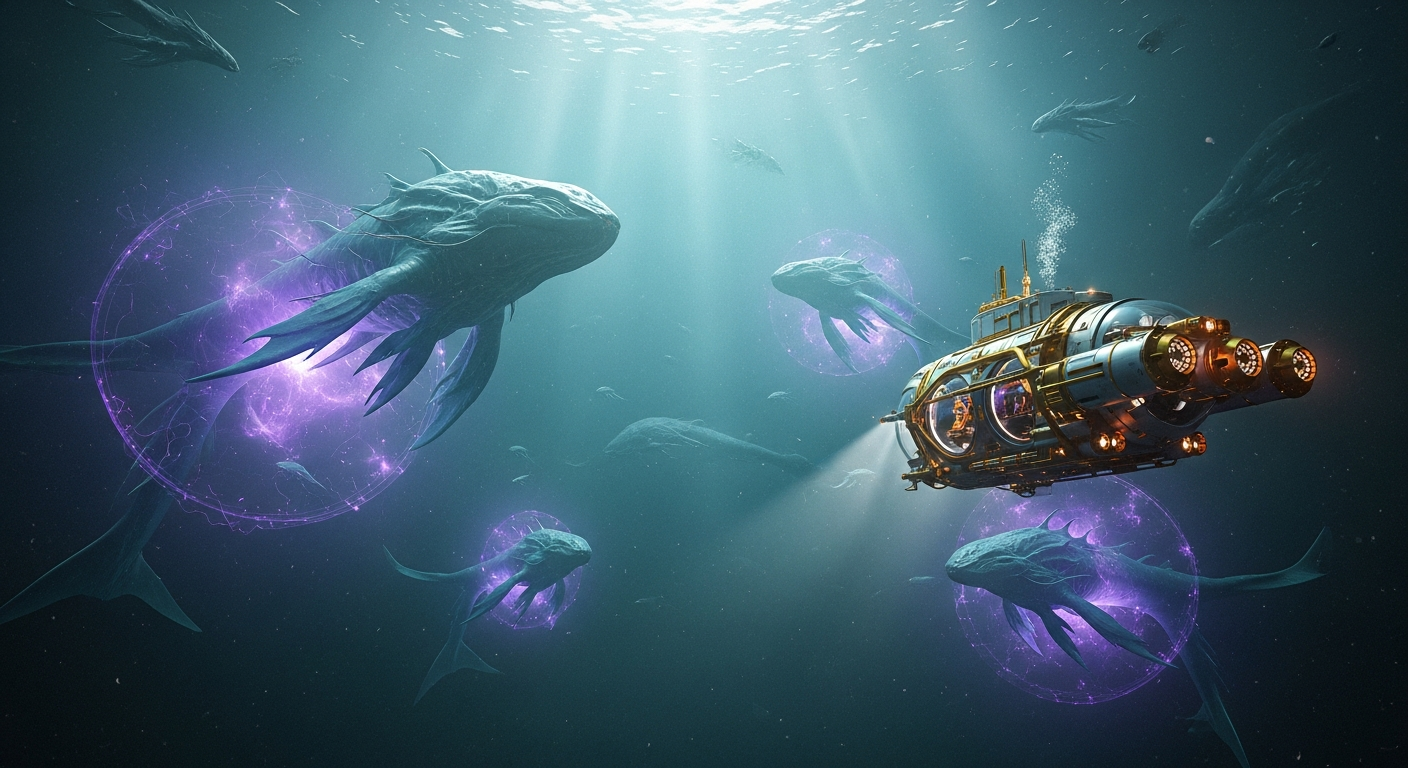
Introduction: Unveiling the Giants of the Abyss
Imagine descending thousands of meters below the ocean’s surface, leaving the sunlit world behind. As you plunge into the crushing, pitch-black depths of the abyssal zone, you encounter creatures that seem to have been pulled straight from science fiction. A squid the size of a school bus glides through the dark; a terrifyingly large crustacean, resembling a common pillbug but the size of a small dog, crawls across the seafloor; and crabs with legs spanning over three meters navigate the deep trenches. This is not the realm of monsters, but the fascinating reality of marine biology.
The phenomenon responsible for these enormous creatures is scientifically known as deep-sea gigantism (or abyssal gigantism). It is a biological mystery that has captivated evolutionary biologists and oceanographers for decades. Why do species dwelling in the most extreme, nutrient-starved, and high-pressure environments on Earth grow significantly larger than their shallow-water relatives? To answer the question of why deep-sea animals are so giant, we must dive into a complex interplay of evolutionary adaptations, thermodynamics, and the brutal survival mechanics of the deep ocean.
The Biological Mystery: What Drives Deep-Sea Gigantism?
Deep-sea gigantism is defined by the tendency of certain invertebrate and vertebrate species—such as isopods, amphipods, cephalopods, and some fishes—to achieve much larger body sizes in deep waters compared to closely related species in shallower regions. Famous examples include the Giant Isopod (Bathynomus giganteus), the Colossal Squid (Mesonychoteuthis hamiltoni), and the Japanese Spider Crab (Macrocheira kaempferi). The evolution of such massive sizes in an environment devoid of sunlight and sparse in food is counterintuitive. However, detailed scientific analysis reveals that this gigantism is actually a highly efficient survival strategy shaped by four main factors.
1. Kleiber’s Law and Metabolic Efficiency
One of the most pressing challenges of the deep sea is the severe scarcity of food. With no sunlight to support photosynthesis, deep-sea ecosystems rely primarily on “marine snow”—organic detritus falling from the upper layers of the ocean—or the occasional massive windfall of a dead whale (whale falls). In such a nutrient-poor environment, metabolic efficiency is the key to survival.
According to Kleiber’s Law, an animal’s metabolic rate scales to the ¾ power of its mass. In simpler terms, larger animals have a lower metabolic rate per unit of body mass than smaller animals. By evolving larger bodies, deep-sea creatures become highly energy-efficient. A giant body allows these animals to store immense caloric reserves, enabling them to survive for months or even years between meals. Furthermore, larger bodies allow for greater mobility, meaning these giants can travel vast, barren distances across the abyssal plain with minimal energy expenditure to scavenge for scarce food sources.
2. The Temperature-Size Rule and Cold-Water Adaptation
The deep ocean is an incredibly frigid environment, with temperatures consistently hovering just above freezing (around 2°C to 4°C). In biological terms, temperature profoundly influences growth and development. While Bergmann’s Rule dictates that warm-blooded animals (endotherms) in colder climates tend to be larger to conserve body heat, deep-sea invertebrates are cold-blooded (ectotherms).
For ectotherms, the Temperature-Size Rule applies. In extremely cold waters, cellular metabolism and growth rates slow down drastically. However, while they grow slower, their development and sexual maturity are significantly delayed. Because they spend a much longer period of their lives in a pre-reproductive growth phase, they ultimately reach much larger maximum body sizes before their growth ceases. The cold essentially removes the biological “brakes” on their final size, resulting in towering crustaceans and colossal cephalopods.
3. Increased Dissolved Oxygen in Deep, Cold Waters
Oxygen availability is a limiting factor for body size in the animal kingdom. Interestingly, cold water holds significantly more dissolved oxygen than warm surface water. The deep ocean currents that originate from the polar regions carry highly oxygenated water into the abyssal zones.
Some marine biologists hypothesize that this abundance of dissolved oxygen supports deep-sea gigantism. Large bodies require efficient oxygen distribution. For giant invertebrates like sea spiders (pycnogonids) and giant isopods, which rely on diffusion or relatively simple gill structures, the high concentration of oxygen in the surrounding cold water allows them to sustain massive biological volumes without suffocating. If they were brought to warmer, less oxygenated surface waters, their respiratory systems would fail to support their gigantic bulk.
4. Reduced Predation and Extended Lifespans
In the shallow, sunlit zones of the ocean, the evolutionary arms race is fierce. High predation rates mean that animals must reproduce quickly and in large numbers, often at the expense of a long lifespan and large body size. The deep sea, by contrast, is sparsely populated. Predators are few and far between.
This lack of intense predatory pressure leads to exceptionally long lifespans. For example, the Greenland shark, a deep-water giant, can live for over 400 years. Deep-sea tube worms and giant sponges can live for millennia. For many marine species, especially invertebrates that exhibit indeterminate growth (meaning they never truly stop growing), a longer lifespan directly correlates to a larger body size. Protected by the eternal darkness and isolation of the abyss, these creatures simply live long enough to become giants.
Conclusion: Masters of Extreme Adaptation
The biological mystery of deep-sea gigantism reveals that the deep ocean is not a realm of freaks and monsters, but a showcase of supreme evolutionary engineering. The staggering size of creatures like the Giant Squid and the Giant Isopod is a highly calculated biological response to one of the most extreme environments on our planet.
Through the brilliant interplay of metabolic efficiency (Kleiber’s Law), delayed maturity due to freezing temperatures (the Temperature-Size Rule), abundant dissolved oxygen, and prolonged lifespans free from heavy predation, nature has forged giants. As deep-sea exploration technology advances, we continue to discover more about these abyssal leviathans. Understanding why deep-sea animals are so giant not only answers a captivating biological question but also reminds us of life’s miraculous ability to adapt, survive, and even thrive in the dark, crushing depths of our ocean’s final frontier.


Reader Comments