Why Don’t Woodpeckers Get Concussions? Unraveling the Biological Mystery of Nature’s Shock-Absorbing Skulls

Why Don't Woodpeckers Get Concussions? Unraveling the Biological Mystery of Nature's Shock-Absorbing Skulls Introduction: The Astonishing Physics of the Forest If a human were to strike their head against a tree trunk at 15 miles per hour, the result would be catastrophic. A force of nearly 100 Gs (100 times the force of gravity) is typically enough to cause a severe concussion in a human being. Yet, a woodpecker slams its beak into solid wood at speeds exceeding 15 miles per hour, enduring a staggering 1,200 to 1,400 Gs of deceleration force with every strike. Striking up to 20 times per second and an estimated 12,000 times a day, these avian carpenters seemingly defy the laws of physics and biology. For decades, scientists, engineers, and biomechanics experts have been captivated by a singular question: Why don't woodpeckers get concussions? The answer lies in millions of years of evolutionary engineering. By examining the micro-anatomy of the woodpecker skull, the unique properties of their cranial structures, and the latest paradigm-shifting research in biomechanics, we can finally unravel the biological mystery behind nature's ultimate shock-absorbing heads. Detailed Scientific Explanation: Anatomy, Biomechanics, and Evolution The woodpecker's resistance to traumatic brain injury (TBI) is not due to a single magic feature, but rather a complex symphony of anatomical adaptations. From bone density to specialized muscles, every millimeter of the bird's head is optimized for high-impact forces. The Cranial Bone Structure: Spongy yet Resilient At the microscopic level, the architecture of a woodpecker's skull is vastly different from that of a human. The frontal bones of the woodpecker skull are composed of a unique form of trabecular bone—a spongy, porous bone tissue. This sponge-like structure is highly concentrated at the front and back of the skull. Traditionally, scientists believed this spongy bone acted as a microscopic crumple zone, absorbing and dissipating the kinetic energy generated by pecking before it could reach the brain tissue. Furthermore, the beak itself exhibits a clever morphological adaptation. The lower mandible is slightly longer than the upper mandible. This subtle "underbite" ensures that the immense mechanical stress of the impact is directed away from the brainpan and channeled downward into the robust neck muscles, effectively bypassing the neurocranium. The Hyoid Bone: A Built-In Safety Harness Perhaps the most bizarre and fascinating adaptation of the woodpecker is the hyoid apparatus. In humans, the hyoid is a small bone in the neck that anchors the tongue. In the woodpecker, the hyoid bone is elongated into a rigid cartilage structure that actually wraps all the way around the back of the bird's skull, over the top of its head, and anchors into the right nostril. When the woodpecker prepares to strike, muscles attached to the hyoid contract. This tightens the tongue structure around the skull like a protective seatbelt. This unique anatomical "safety harness" helps stabilize the skull and distributes the mechanical shock across a larger surface area, preventing focal point injuries to the brain. Brain Shape and Fluid Dynamics: The Anti-Slosh Mechanism In humans, concussions often occur not just from the impact itself, but from the brain "sloshing" around inside the skull—a phenomenon known as contrecoup injury. The human brain floats in a relatively large pool of cerebrospinal fluid (CSF). When the skull suddenly stops, the brain keeps moving, crashing into the inner bone. Woodpeckers circumvent this issue through two distinct adaptations. First, a woodpecker’s brain fits incredibly snugly inside its cranial cavity, with very little cerebrospinal fluid to allow for movement. Second, the brain is oriented vertically rather than horizontally, presenting a larger surface area against the front of the skull. This orientation prevents the aggressive shearing forces that tear nerve fibers and cause severe brain damage in mammals. The Modern Plot Twist: Stiff Hammers Over Shock Absorbers While the "shock-absorbing skull" theory has been the prevailing scientific narrative for decades, cutting-edge research has recently turned this concept on its head. A landmark 2022 biomechanical study analyzing high-speed video of pecking woodpeckers revealed a fascinating paradox: if the woodpecker's skull truly absorbed shock, pecking would be incredibly inefficient. Scientists discovered that the woodpecker's head actually acts less like a shock absorber and more like a stiff hammer. Any energy absorbed by the skull would be energy lost from breaking the wood. So, if the skull isn't absorbing the shock, why doesn't the brain turn to mush? The answer comes down to the physics of scaling. Because a woodpecker's brain is so small and has so little mass, the monumental G-forces do not translate into the same destructive mechanical stress that a larger, heavier human brain would experience. In short, the woodpecker's brain is naturally too small to suffer a concussion from pecking. However, recent histological studies have found accumulations of tau proteins in woodpecker brains—a marker associated with brain damage in human athletes—suggesting that woodpeckers might actually sustain micro-injuries, but have evolved a unique neurobiological tolerance to survive and thrive with them. Conclusion: What We Can Learn from Woodpecker Biology The biological mystery of the woodpecker is a masterclass in evolutionary problem-solving. Through an intricate combination of specialized trabecular bone, the seatbelt-like hyoid apparatus, snug cranial fluid dynamics, and the sheer physics of brain scaling, the woodpecker can endure a lifetime of extreme impacts without losing its cognitive function. Understanding the biomechanics of woodpeckers is far more than an academic exercise. Today, biomedical engineers and material scientists are actively utilizing biomimicry—drawing inspiration from the woodpecker's anatomy—to design revolutionary safety gear. From advanced football helmets and aviation black boxes to shock-absorbing cases for sensitive microelectronics, the structural secrets of the woodpecker skull are helping to save human lives. While recent science has shown that nature's "shock absorbers" might actually be precision-engineered "stiff hammers," the woodpecker remains one of the natural world's most spectacular marvels. It stands as a testament to the fact that sometimes, to solve our most complex engineering problems, we simply need to look up into the trees. 一般

Why Don’t Woodpeckers Get Concussions? Unraveling the Biological Mystery of Nature’s Shock-Absorbing Skulls

Introduction: The Astonishing Physics of the Forest

If a human were to strike their head against a tree trunk at 15 miles per hour, the result would be catastrophic. A force of nearly 100 Gs (100 times the force of gravity) is typically enough to cause a severe concussion in a human being. Yet, a woodpecker slams its beak into solid wood at speeds exceeding 15 miles per hour, enduring a staggering 1,200 to 1,400 Gs of deceleration force with every strike. Striking up to 20 times per second and an estimated 12,000 times a day, these avian carpenters seemingly defy the laws of physics and biology.

For decades, scientists, engineers, and biomechanics experts have been captivated by a singular question: Why don’t woodpeckers get concussions? The answer lies in millions of years of evolutionary engineering. By examining the micro-anatomy of the woodpecker skull, the unique properties of their cranial structures, and the latest paradigm-shifting research in biomechanics, we can finally unravel the biological mystery behind nature’s ultimate shock-absorbing heads.

Detailed Scientific Explanation: Anatomy, Biomechanics, and Evolution

The woodpecker’s resistance to traumatic brain injury (TBI) is not due to a single magic feature, but rather a complex symphony of anatomical adaptations. From bone density to specialized muscles, every millimeter of the bird’s head is optimized for high-impact forces.

The Cranial Bone Structure: Spongy yet Resilient

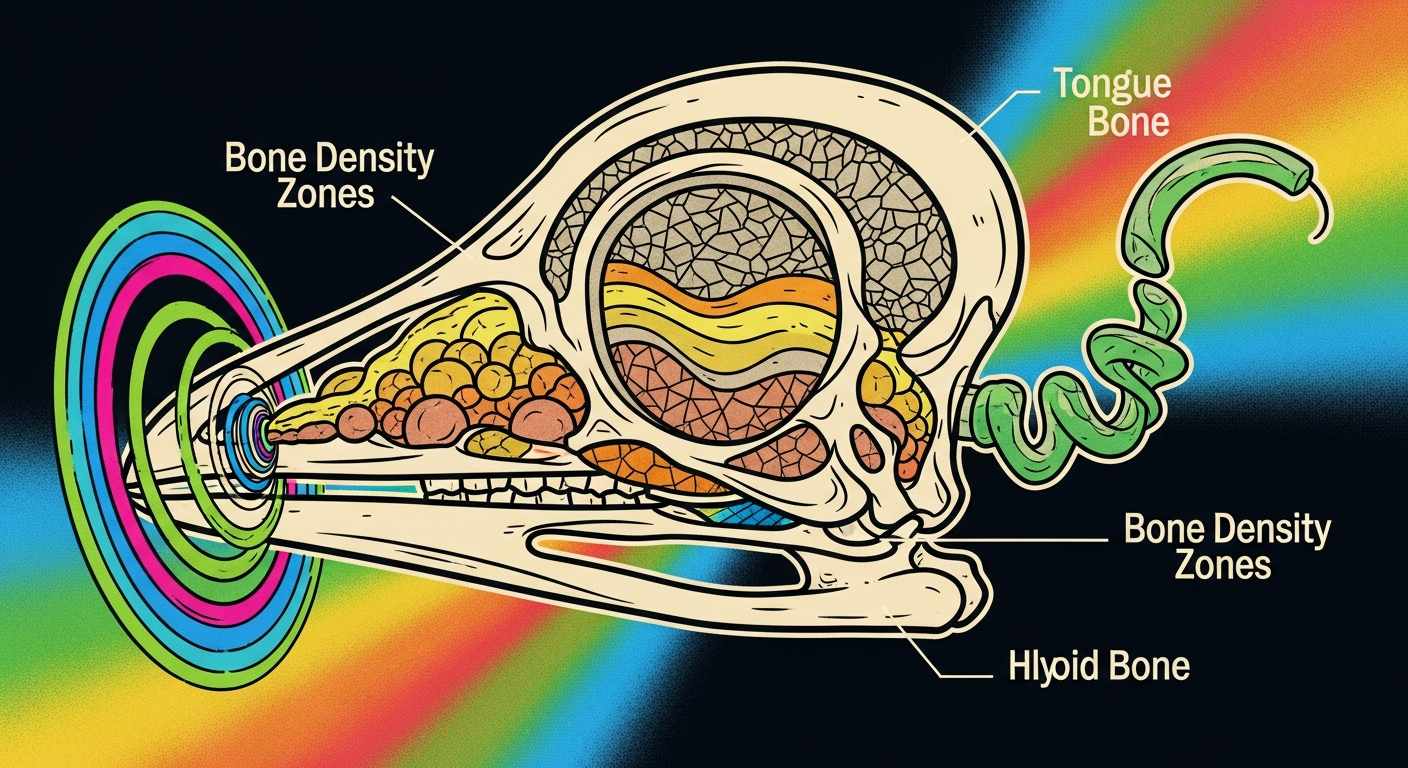
At the microscopic level, the architecture of a woodpecker’s skull is vastly different from that of a human. The frontal bones of the woodpecker skull are composed of a unique form of trabecular bone—a spongy, porous bone tissue. This sponge-like structure is highly concentrated at the front and back of the skull. Traditionally, scientists believed this spongy bone acted as a microscopic crumple zone, absorbing and dissipating the kinetic energy generated by pecking before it could reach the brain tissue.

Furthermore, the beak itself exhibits a clever morphological adaptation. The lower mandible is slightly longer than the upper mandible. This subtle “underbite” ensures that the immense mechanical stress of the impact is directed away from the brainpan and channeled downward into the robust neck muscles, effectively bypassing the neurocranium.

The Hyoid Bone: A Built-In Safety Harness

Perhaps the most bizarre and fascinating adaptation of the woodpecker is the hyoid apparatus. In humans, the hyoid is a small bone in the neck that anchors the tongue. In the woodpecker, the hyoid bone is elongated into a rigid cartilage structure that actually wraps all the way around the back of the bird’s skull, over the top of its head, and anchors into the right nostril.

When the woodpecker prepares to strike, muscles attached to the hyoid contract. This tightens the tongue structure around the skull like a protective seatbelt. This unique anatomical “safety harness” helps stabilize the skull and distributes the mechanical shock across a larger surface area, preventing focal point injuries to the brain.

Brain Shape and Fluid Dynamics: The Anti-Slosh Mechanism

In humans, concussions often occur not just from the impact itself, but from the brain “sloshing” around inside the skull—a phenomenon known as contrecoup injury. The human brain floats in a relatively large pool of cerebrospinal fluid (CSF). When the skull suddenly stops, the brain keeps moving, crashing into the inner bone.

Woodpeckers circumvent this issue through two distinct adaptations. First, a woodpecker’s brain fits incredibly snugly inside its cranial cavity, with very little cerebrospinal fluid to allow for movement. Second, the brain is oriented vertically rather than horizontally, presenting a larger surface area against the front of the skull. This orientation prevents the aggressive shearing forces that tear nerve fibers and cause severe brain damage in mammals.

The Modern Plot Twist: Stiff Hammers Over Shock Absorbers

While the “shock-absorbing skull” theory has been the prevailing scientific narrative for decades, cutting-edge research has recently turned this concept on its head. A landmark 2022 biomechanical study analyzing high-speed video of pecking woodpeckers revealed a fascinating paradox: if the woodpecker’s skull truly absorbed shock, pecking would be incredibly inefficient.

Scientists discovered that the woodpecker’s head actually acts less like a shock absorber and more like a stiff hammer. Any energy absorbed by the skull would be energy lost from breaking the wood. So, if the skull isn’t absorbing the shock, why doesn’t the brain turn to mush?

The answer comes down to the physics of scaling. Because a woodpecker’s brain is so small and has so little mass, the monumental G-forces do not translate into the same destructive mechanical stress that a larger, heavier human brain would experience. In short, the woodpecker’s brain is naturally too small to suffer a concussion from pecking. However, recent histological studies have found accumulations of tau proteins in woodpecker brains—a marker associated with brain damage in human athletes—suggesting that woodpeckers might actually sustain micro-injuries, but have evolved a unique neurobiological tolerance to survive and thrive with them.

Conclusion: What We Can Learn from Woodpecker Biology

The biological mystery of the woodpecker is a masterclass in evolutionary problem-solving. Through an intricate combination of specialized trabecular bone, the seatbelt-like hyoid apparatus, snug cranial fluid dynamics, and the sheer physics of brain scaling, the woodpecker can endure a lifetime of extreme impacts without losing its cognitive function.

Understanding the biomechanics of woodpeckers is far more than an academic exercise. Today, biomedical engineers and material scientists are actively utilizing biomimicry—drawing inspiration from the woodpecker’s anatomy—to design revolutionary safety gear. From advanced football helmets and aviation black boxes to shock-absorbing cases for sensitive microelectronics, the structural secrets of the woodpecker skull are helping to save human lives.

While recent science has shown that nature’s “shock absorbers” might actually be precision-engineered “stiff hammers,” the woodpecker remains one of the natural world’s most spectacular marvels. It stands as a testament to the fact that sometimes, to solve our most complex engineering problems, we simply need to look up into the trees.


Reader Comments

タイトルとURLをコピーしました