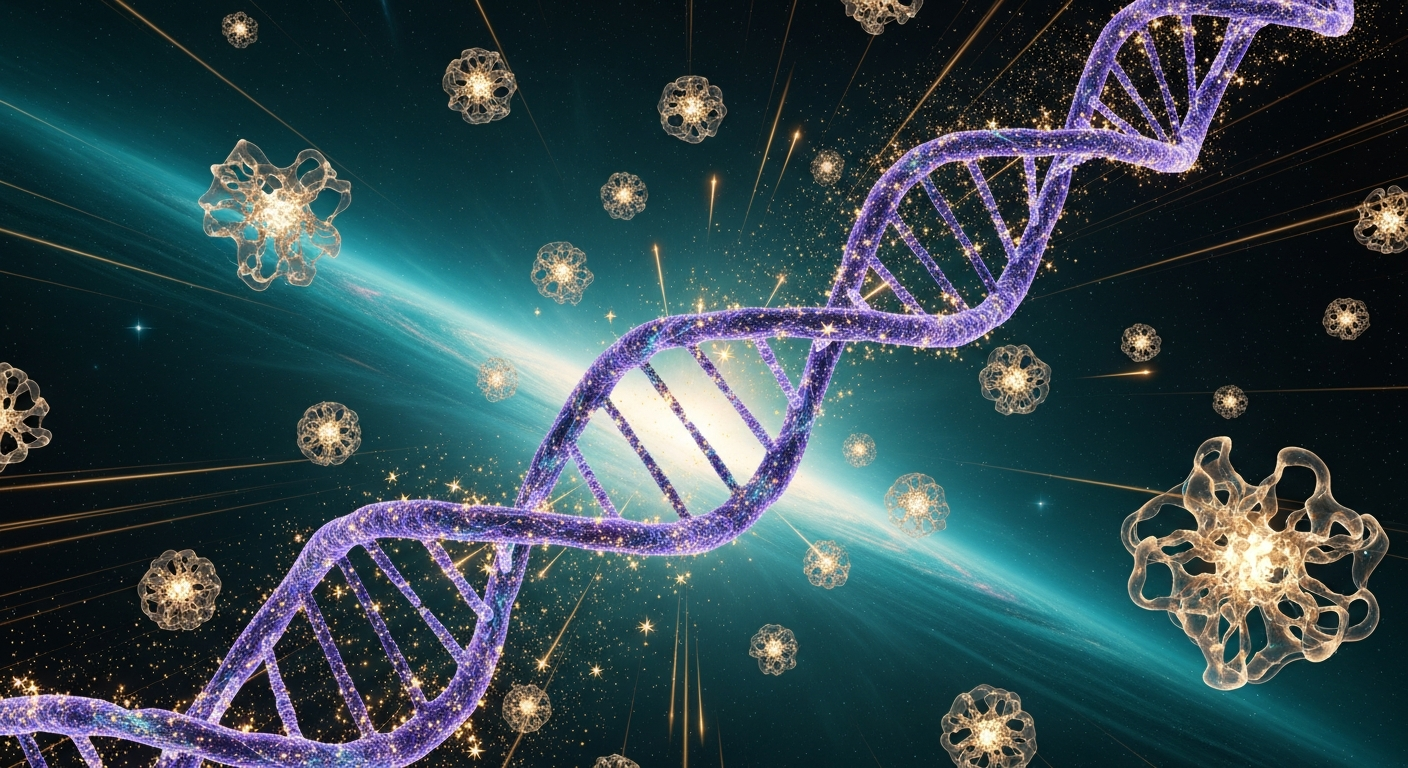
The Cosmic Origins of Life: Did Our DNA Come From Space?
Introduction: The Search for Our Cosmic Roots
For centuries, humanity has gazed at the stars and asked the ultimate question: Where do we come from? Traditionally, scientists believed that the intricate chemistry required for life began in a primordial soup right here on Earth. However, modern astrobiology is painting a vastly different, far more expansive picture. The burgeoning field studying the cosmic origins of life suggests a staggering possibility: the fundamental building blocks of our DNA may have actually come from space.
This does not necessarily mean that fully formed extraterrestrial organisms crashed into our oceans—a concept known as directed panspermia. Instead, compelling geochemical evidence points toward pseudo-panspermia, the theory that the essential organic ingredients required for life, including the precursors to DNA and RNA, were forged in the freezing depths of interstellar space. Carried by a cosmic bombardment of asteroids and comets, these organic molecules were delivered to a young Earth, seeding our planet with the chemical blueprint for life.
Detailed Scientific Explanation: Forging the Alphabet of Life in the Void
The Nucleobase Breakthrough: Finding DNA’s Alphabet in Meteorites
To understand how our DNA might have cosmic origins, we must look at what DNA is made of. The DNA double helix is constructed from a sequence of nucleobases—often referred to as the “alphabet” of life. There are five primary nucleobases across DNA and RNA: adenine (A), guanine (G), cytosine (C), thymine (T), and uracil (U).
For decades, scientists analyzing carbonaceous chondrites (organic-rich meteorites like the famous Murchison meteorite that fell in Australia in 1969) successfully identified purines: adenine and guanine. However, the pyrimidines—cytosine and thymine—remained elusive due to their delicate structures, which easily degrade during extraction. It wasn’t until a landmark breakthrough in the early 2020s, utilizing state-of-the-art cold-extraction techniques, that scientists finally detected the missing pyrimidines in pristine meteorite samples. For the first time in history, all five nucleobases of DNA and RNA were confirmed to exist in extraterrestrial rocks.
Interstellar Chemistry: The Stellar Nurseries
If these complex molecules didn’t form on Earth, how did they materialize in the desolate vacuum of space? The answer lies in giant molecular clouds—stellar nurseries where gas and dust coalesce to form new stars.
Despite the extreme cold (often near absolute zero), these clouds are hotbeds of complex chemical reactions:
- Ice Mantles: Microscopic dust grains in these clouds act as cosmic scaffolds. Simple molecules like water, carbon monoxide, and ammonia freeze onto these grains, forming icy mantles.
- Ultraviolet Photochemistry: Radiation from nearby young stars bombards these ice-coated grains. The UV light breaks molecular bonds, creating highly reactive free radicals.
- Molecular Synthesis: As these radicals recombine, they form increasingly complex organic molecules, including amino acids, sugars, and the very nucleobases that make up our genetic code.
When a solar system begins to form from a collapsing molecular cloud, much of this complex organic matter survives, eventually becoming locked inside asteroids and comets.
The Delivery Mechanism: The Late Heavy Bombardment
Synthesizing DNA precursors in space is only half the battle; delivering them safely to a planetary surface is the other. Approximately 4 billion years ago, our solar system underwent a chaotic period known as the Late Heavy Bombardment. During this epoch, Earth was relentlessly pounded by a barrage of asteroids and comets.
While this bombardment was incredibly violent, computer simulations and hypervelocity impact experiments have shown that complex organics can survive atmospheric entry. Some amino acids and nucleobases can even be synthesized by the extreme heat and pressure of an impact event. As these space rocks fragmented in the atmosphere and crashed into early Earth’s oceans, they dissolved, enriching the primordial soup with millions of tons of extraterrestrial organic material. This cosmic delivery drastically accelerated the prebiotic chemistry required to assemble the first living cells.
Conclusion: We Are Woven from Stardust
The quest to understand the cosmic origins of life has revolutionized our perspective on biology and the universe. The undeniable presence of DNA and RNA nucleobases inside ancient meteorites provides robust evidence that the universe is teeming with the ingredients for life. Our genetic code did not simply emerge from isolated terrestrial geology; it was likely assembled from a vast, interstellar supply chain.
This revelation carries profound implications for the search for extraterrestrial life. If the chemical seeds of DNA were delivered to Earth, they were surely delivered to Mars, the icy oceans of Europa, and countless exoplanets across the Milky Way. As we continue to explore the cosmos, we do so knowing that the barrier to life might be much lower than we once thought. In the truest scientific sense, we are not just residents of the universe; we are fundamentally made of it. Our DNA is a living chemical record of ancient stellar processes, proving that the story of life on Earth begins among the stars.
Reader Comments