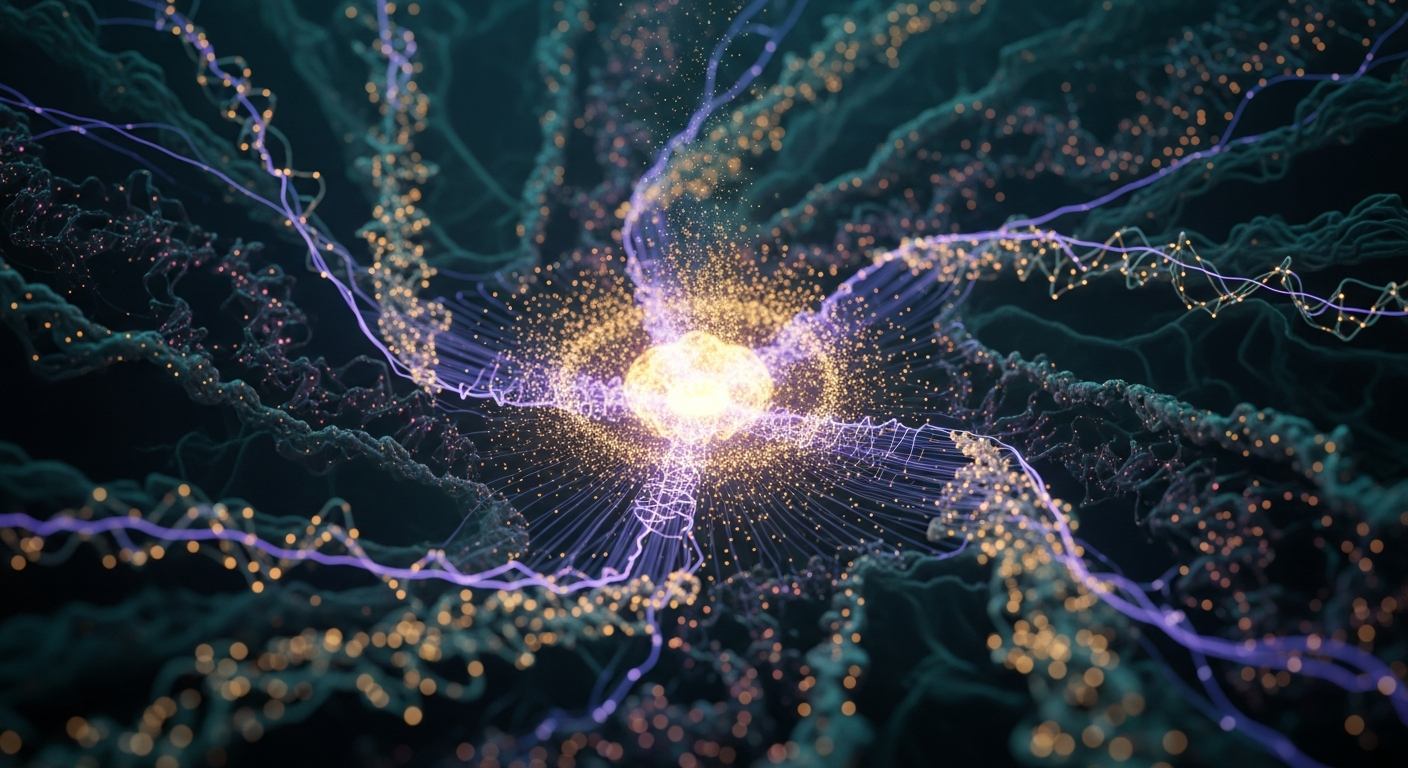
生命の量子交響曲:生物学の素粒子レベルの神秘を解読する

The Quantum Symphony of Life: Decoding the Subatomic Mysteries of Biology Introduction: The Unlikely Marriage of Two Worlds For over a century, the disciplines of biology and quantum physics have occupied vastly different domains. Biology has traditionally been viewed through the lens of classical mechanics—a world of macroscopic, deterministic processes where molecules bounce, collide, and interact in a "warm, wet, and noisy" environment. Quantum mechanics, on the other hand, is the mathematical framework governing the bizarre, probabilistic realm of the ultra-small. It describes a fragile reality where particles can exist in multiple states simultaneously (superposition), pass through impenetrable barriers (tunneling), and share mysterious, instantaneous connections (entanglement). Until recently, physicists largely agreed that quantum effects could only be sustained in highly controlled, ultra-cold vacuums, completely isolated from the chaotic thermal noise of biological environments. However, a revolutionary paradigm shift is underway. Enter Quantum Biology: a rapidly accelerating field revealing that life has not merely survived the strange laws of the subatomic realm, but has actively evolved to harness them. From the vivid green canopy of a rainforest to the unerring navigational compass of migratory birds, nature conducts a breathtaking quantum symphony. Decoding the Subatomic Mechanisms Quantum Coherence in Photosynthesis Perhaps the most robust evidence for quantum biology lies in the fundamental process that sustains almost all life on Earth: photosynthesis. Plants, algae, and some bacteria capture photons from the sun and transfer this energy to reaction centers to be converted into chemical energy. This energy transfer is almost 100% efficient—a feat that classical physics struggles to explain. Researchers investigating the Fenna-Matthews-Olson (FMO) complex in green sulfur bacteria discovered that the captured energy packet, known as an exciton, does not travel to the reaction center via a single, random classical path. Instead, it utilizes quantum coherence. The exciton behaves as a quantum wave, existing in a superposition of states that allows it to simultaneously explore all possible pathways through the molecular network. Once the most efficient route is "found," the wave collapses into that specific path, preventing energy loss as heat. Nature, it seems, has engineered a biological quantum computer optimized for energy harvesting. The Avian Compass and Quantum Entanglement Every year, the European robin embarks on an epic migration across continents, navigating with pinpoint accuracy. Behavioral studies have long shown that these birds navigate using Earth's remarkably weak magnetic field. But how can a biological organism detect a force so faint? The answer lies in a phenomenon known as the Radical Pair Mechanism, centered around a light-sensitive protein called cryptochrome located in the bird's retina. When a photon of blue light strikes this protein, it knocks an electron to a neighboring molecule, creating a "radical pair"—two molecules, each with an unpaired electron. Crucially, these two electrons are quantumly entangled. The magnetic spins of these entangled electrons oscillate rapidly between two states (singlet and triplet). Because these spin states are highly sensitive to the inclination of the Earth's magnetic field, the proportion of singlet to triplet products alters the chemical output of the cell, ultimately translating a subatomic quantum effect into a neurological signal. The bird literally "sees" the magnetic field through the lens of quantum entanglement. Quantum Tunneling in Enzyme Catalysis Enzymes are the biological catalysts that make life possible, accelerating chemical reactions by millions of times. Classically, a chemical reaction requires a certain amount of activation energy—a "hill" that molecules must climb over to react. However, some biological reactions occur far too rapidly to be explained by classical thermodynamics alone. Scientists have discovered that enzymes employ quantum tunneling to achieve these astonishing speeds. In the subatomic world, particles like electrons and protons act as waves. If a barrier is thin enough, the wave function extends through it, meaning there is a finite probability that the particle will simply materialize on the other side without ever acquiring the energy to climb the hill. Enzymes are perfectly sculpted by evolution to hold molecules in precise alignments that maximize the probability of proton tunneling, effectively allowing essential biochemical reactions to cheat classical physics. The Vibrational Theory of Olfaction While still fiercely debated, quantum effects are also thought to play a role in the sense of smell. The traditional "shape-theory" of olfaction suggests that odorant molecules fit into olfactory receptors like a key into a lock. However, this fails to explain why molecules with vastly different shapes can smell identical, or why molecules with the exact same shape but completely different isotopes (like substituting hydrogen with deuterium) can smell different. The Quantum Vibration Theory proposes that our olfactory receptors act as quantum spectrometers. When a molecule binds to a receptor, an electron quantum-tunnels across the receptor. This tunneling only occurs if the odorant molecule oscillates at a specific vibrational frequency that perfectly matches the energy gap required for the electron to cross. In this model, our noses are literally detecting the quantum mechanical vibrations of chemical bonds. Conclusion: The Bizarre and Beautiful Reality of Life The emergence of quantum biology fundamentally alters our understanding of what life is. We are discovering that biological systems are not just macroscopic bags of classical chemicals; they are highly refined, nanomolecular machines operating at the very edge of physical reality. Rather than being destroyed by the "warm, wet, and noisy" environment of the cell, evolution has discovered ways to filter that thermal noise, using it to drive quantum effects that make biological processes hyper-efficient. Decoding the quantum symphony of biology holds profound implications for the future. By mimicking the way plants maintain quantum coherence at room temperature, we may unlock the secrets to hyper-efficient solar cells and revolutionary, robust quantum computers. By understanding quantum enzymology and receptor tunneling, we stand on the precipice of a new era in pharmacology and medicine. Ultimately, quantum biology teaches us a deeply philosophical truth: the macroscopic pulse of life is inextricably linked to the strange, probabilistic dance of the subatomic cosmos. We are, at our very core, quantum creatures. 一般

生命の量子交響曲:生物学の素粒子レベルの神秘を解読する

はじめに:二つの世界の意外な結婚

1世紀以上にわたり、生物学と量子物理学という分野は、大きく異なる領域を占めてきました。生物学は伝統的に、古典力学を通して見られてきました。これは、分子が「暖かく、湿っており、騒がしい」環境で跳ねたり、衝突したり、相互作用したりする、巨視的で決定論的なプロセスで構成される世界です。一方、量子力学は、超小型の奇妙で確率的な領域を支配する数学的枠組みです。それは、粒子が同時に複数の状態(重ね合わせ)に存在したり、侵入不可能な障壁を通過したり(トンネル効果)、不思議で瞬時のつながり(エンタングルメント)を共有したりできる、壊れやすい現実を記述します。.

最近まで、物理学者は、量子効果は、生物学的環境の混沌とした熱ノイズから完全に隔離された、高度に制御された極低温真空中でしか維持できないという点で、ほぼ意見が一致していました。しかし、革命的なパラダイムシフトが進行中です。そこで登場するのが 量子生物学急速に加速しつつあるこの分野は、生命が単に素粒子の奇妙な法則を生き抜いただけではなく、それらを活用するように積極的に進化してきたことを明らかにしつつある。熱帯雨林の鮮やかな緑の樹冠から、渡り鳥の確かな航法コンパスまで、自然は息をのむような量子交響曲を奏でている。.

素粒子のメカニズムを解読する

光合成における量子コヒーレンス

おそらく、量子生物学の最も強固な証拠は、地球上のほぼすべての生命を支える基本的なプロセス、すなわち光合成にあります。植物、藻類、一部の細菌は、太陽からの光子を捉え、そのエネルギーを反応中心に転送して化学エネルギーに変換します。このエネルギー移動は、古典物理学では説明が困難な偉業である、ほぼ100% の効率で行われます。.

緑色硫黄(YOS、Y)細菌におけるフェンナ・マシューズ・オルソン(FMO)複合体を研究している研究者たちは、励起子として知られる捕捉されたエネルギーパケットは、単一のランダムな古典経路を介して反応中心に移動するのではないことを発見しました。代わりに、それは 量子コヒーレンス. 励起子は量子波として振る舞い、分子ネットワーク内のあらゆる可能な経路を同時に探求できる状態の重ね合わせに存在します。最も効率的な経路が「見つかる」と、波はその特定の経路に収縮し、熱としてのエネルギー損失を防ぎます。自然は、エネルギーハーベスティングに最適化された生物学的量子コンピュータを設計したようです。.

鳥のコンパスと量子もつれ

毎年、ヨーロッパコマドリは大陸を横断する壮大な渡りを、驚くほどの正確さでナビゲートします。行動学的研究では、これらの鳥が地球の驚くほど弱い磁場を使ってナビゲートすることが長い間示されてきました。しかし、生物有機体はこれほど微弱な力をどのように検出できるのでしょうか?

答えは、〜として知られる現象にあります。 ラジカルペア機構, 鳥の網膜にあるクリプトクロムという光感受性タンパク質を中心に展開されます。青色光の光子がこのタンパク質に当たると、電子が隣接する分子に弾き出され、「ラジカルペア」と呼ばれる、それぞれ不対電子を持つ2つの分子が生成されます。 決定的に重要なのは、これら2つの電子が 量子もつれ. これらの絡み合った電子のスピンは、2つの状態(一重項と三重項)の間を高速で振動します。これらのスピン状態は地球の磁場の傾斜に非常に敏感であるため、一重項と三重項の生成物の比率が細胞の化学的出力に影響を与え、最終的にサブ原子の量子効果を神経信号に変換します。鳥は文字通り、量子もつれのレンズを通して磁場を「見て」います。.

酵素触媒における量子トンネル効果

酵素は、生命を可能にする生体触媒であり、化学反応を数百万倍加速します。古典的には、化学反応には、分子が反応するために乗り越えなければならない「山」である、ある程度の活性化エネルギーが必要です。しかし、一部の生体反応は、古典熱力学だけでは説明できないほど急速に起こります。.

科学者たちは、酵素が〜を利用していることを発見しました 量子トンネル効果 これらの驚異的な速度を達成するために。素粒子の世界では、電子や陽子のような粒子は波として振る舞います。障壁が十分に薄ければ、波動関数はそれを通り抜け、粒子が丘を登るのに十分なエネルギーを獲得することなく、単に反対側に出現する有限の確率があることを意味します。酵素は進化によって完璧に彫刻され、分子を正確な配置に保持し、陽子トンネルの確率を最大化し、本質的な生化学反応が古典物理学を回避することを可能にします。.

嗅覚の振動説

いまだ激しく議論されているものの、量子効果も嗅覚において役割を果たしていると考えられています。従来の「形状理論」では、嗅覚受容体に臭気分子が鍵穴に鍵がはまるように適合すると示唆されています。しかし、これでは形状が大きく異なる分子がなぜ同じ匂いがするのか、あるいは形状が全く同じでも同位体(水素を重水素に置き換えるなど)が異なれば匂いが異なるのかを説明できません。.

量子振動理論 我々の嗅覚受容体が量子分光器として機能すると提唱している。分子が受容体に結合すると、電子が受容体を横切って量子トンネルする。このトンネルは、嗅化分子が、電子が横断するために必要なエネルギーギャップと完全に一致する特定の振動数で振動する場合にのみ発生する。このモデルでは、我々の鼻は文字通り化学結合の量子力学的な振動を検出していることになる。.

結論:人生の奇妙で美しい現実

量子生物学の出現は、生命とは何かについての私たちの理解を根本的に変えるものです。私たちは、生物システムが単なる古典的な化学物質の巨大な袋ではなく、物理的現実のまさに最先端で動作する、高度に洗練されたナノ分子機械であることを発見しています。細胞の「暖かく、湿って、騒がしい」環境によって破壊されるのではなく、進化は、その熱雑音をフィルタリングする方法を発見し、それを利用して量子効果を駆動することで、生物学的プロセスを極めて効率的にしています。.

生物学の量子交響曲を解読することは、未来に深遠な影響を与える。植物が室温で量子コヒーレンスを維持する方法を模倣することで、超効率的な太陽電池や革新的で堅牢な量子コンピュータの秘密を解き明かすかもしれない。量子酵素学と受容体トンネリングを理解することで、私たちは薬理学と医学の新時代の入り口に立っている。.

最終的に、量子生物学は私たちに非常に哲学的な真理を教えてくれます。それは、生命のマクロな鼓動は、サブアトミック宇宙の奇妙で確率的なダンスに切り離せないほど結びついているということです。私たちは、その本質において、量子的な生き物なのです。.

Reader Comments

タイトルとURLをコピーしました