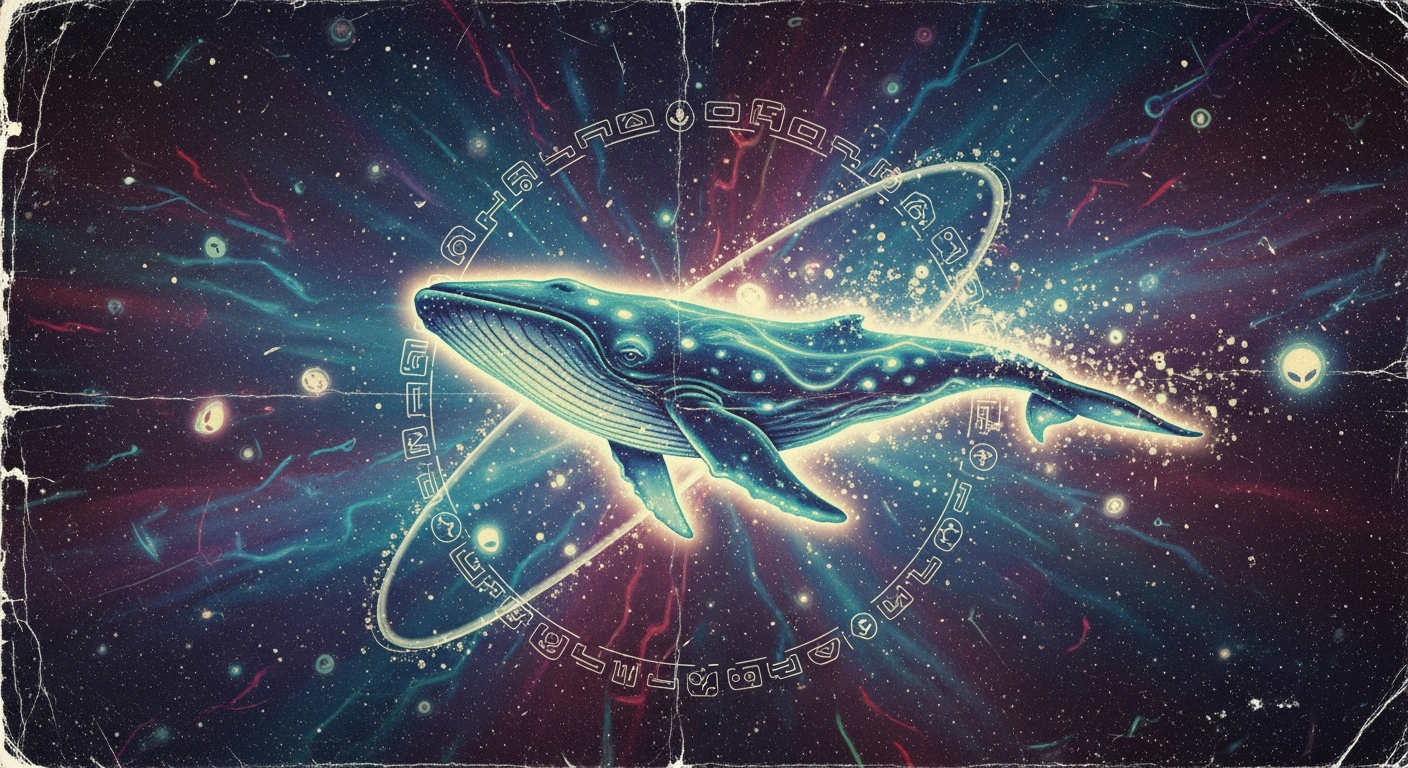
What Earth’s Singing Whales Can Teach Us About Talking to Aliens
Introduction: The Aliens in Our Own Backyard
Have you ever looked up at the night sky and wondered, “Is anyone out there?” For decades, scientists have been pointing giant radio telescopes at the stars, hoping to catch a message from extraterrestrial life. But what if the secret to communicating with aliens is hiding right here on our own planet? To learn how to speak to beings from another world, we first need to practice with the “aliens” in our own oceans: singing whales.
Whales live in an environment totally different from ours. While we rely on our eyes to see the world, whales live in the dark, deep ocean where light doesn’t travel far. Instead, they “see” and communicate using sound. Their complex songs and clicks are a type of non-human language. By studying how whales talk to each other, scientists in the fields of marine biology and astrobiology are developing the tools we will need if we ever get a phone call from outer space.
The Detailed Science: Decoding a Non-Human Language
The Science of Sound: How Whales “Talk”
Unlike humans, who use words formed by lips and vocal cords, whales have evolved entirely different ways to share information. Humpback whales are famous for their beautiful, complex melodies that can last for hours. These songs have themes, choruses, and verses, much like human music. On the other hand, sperm whales communicate using patterns of clicks called “codas.” It sounds a bit like Morse code or a fast drumbeat.
Because their brains are massive and highly developed, scientists believe these sounds are not just random noises. They are sharing information about their identity, their family, and their environment. But because they are not human, their language is entirely alien to us. If we cannot understand a highly intelligent creature sharing our own planet, how could we possibly understand an alien from a planet millions of light-years away?
Information Theory: Finding the Math in the Message
This is where space scientists come in. Researchers from SETI (the Search for Extraterrestrial Intelligence) have teamed up with animal experts to study whale songs using something called Information Theory. This is a type of mathematics used to measure how much actual information is hidden inside a signal.
Think of it this way: if you bang on a piano keyboard with your fists, the sound is random and chaotic. But if you play a classical song, there are rules, patterns, and rhythms. Mathematics can detect these rules. Scientists are feeding recordings of whale songs into powerful Artificial Intelligence (AI) computers. The AI looks for patterns in the whale sounds. If we one day receive strange radio waves from space, we will use these exact same computer programs to check if the signal is just random space weather, or an intelligent alien language!
Practicing for “First Contact”
Recently, scientists conducted an incredible experiment that was basically a practice run for an alien encounter. They traveled to the ocean and played a recording of a humpback whale greeting call through an underwater speaker. Amazingly, a wild humpback whale named “Twain” swam up to the boat and answered back!
For 20 minutes, the scientists and the whale had a “conversation.” When the scientists played the sound quickly, Twain answered quickly. When they waited a few minutes before playing the sound, Twain waited too. They were matching each other’s rhythm. In the science of communication, this is called conversational turn-taking. It proved that even if we don’t know the exact meaning of the “words,” we can still establish a connection with an alien intelligence by finding shared rules of communication.
Conclusion: Understanding Earth to Understand the Universe
The quest to find alien life is one of the most exciting adventures in human history. But the science of communicating with extraterrestrials starts in the salty waters of our own oceans. Earth’s singing whales are the perfect practice partners for first contact.
By using advanced mathematics, artificial intelligence, and a lot of patience, scientists are slowly learning how to say “hello” across the species barrier. This teaches us a very beautiful lesson: to prepare for the wonders of the universe, we must first learn to appreciate, protect, and listen to the incredible, intelligent life that already shares our home. The next time you hear the hauntingly beautiful song of a whale, remember—you might just be listening to the practice run for our first conversation with the stars.


Reader Comments