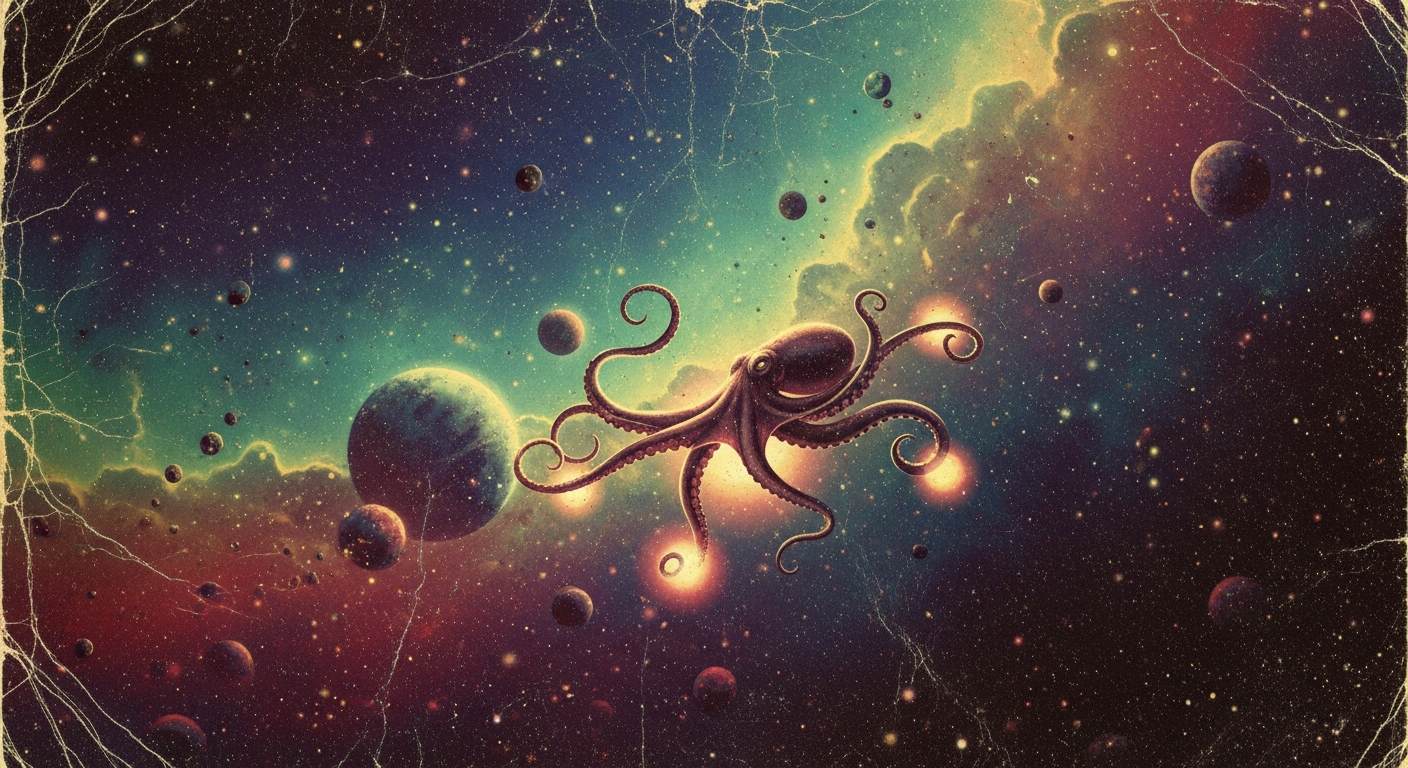
Could an Octopus Survive on Mars? How Deep Ocean Secrets Teach Us About Alien Life
Introduction: A Deep-Sea Mystery Meets Outer Space
Have you ever looked at an octopus and thought it looked a little bit like an alien? With their squishy bodies, eight suction-cup-covered arms, and giant, highly intelligent eyes, octopuses seem like they belong on another planet. This makes many people wonder: Could an octopus survive on Mars?
While sending an octopus to the Red Planet sounds like a fun idea for a sci-fi movie, the real answer gives us incredible clues about alien life. To understand what kind of life might exist in outer space, scientists don’t just look up at the stars through telescopes. Instead, they look down—deep into Earth’s oceans. By exploring the darkest, coldest, and most extreme environments on our own planet, astrobiologists (scientists who study life in the universe) are learning the secrets of how life might survive on Mars and beyond.
Let’s take a deep dive into the fascinating science of the deep ocean, the harsh reality of Mars, and what our eight-legged friends can teach us about extraterrestrial life!
Detailed Scientific Explanation: Exploring Extreme Worlds
What is Mars Really Like?
Before we can pack an octopus’s bags for Mars, we need to know what the weather is like there. Mars is not a friendly place for ocean creatures. It is a giant, freezing desert. Here are the main challenges:
- No Liquid Water: Mars has ice at its poles, but because the atmosphere is so thin, liquid water on the surface would instantly boil away or freeze solid.
- Freezing Temperatures: The average temperature on Mars is about minus 81 degrees Fahrenheit (minus 62 degrees Celsius). That is colder than Antarctica!
- Toxic Air and Radiation: Mars has almost no oxygen. Its air is mostly carbon dioxide, and without a thick atmosphere or a magnetic field to protect it, the planet is blasted with harmful radiation from the sun.
The Superpowers of the Deep-Sea Octopus
Now, let’s look at the deep ocean. Places like the bottom of the Mariana Trench are also incredibly extreme. It is pitch black, freezing cold, and the weight of the water creates a crushing pressure that would flatten a normal submarine.
Yet, deep-sea octopuses thrive there! How do they do it? They have amazing biological “superpowers.” For example, some deep-sea and Antarctic octopuses have blue blood. Instead of using iron to carry oxygen like human blood (which makes it red), octopus blood uses a special copper-based protein called hemocyanin. This special blue blood keeps them alive in freezing, oxygen-poor water. They also lack bones, which means they don’t get crushed by the heavy ocean pressure!
The Verdict: Could Our Eight-Legged Friend Survive on the Red Planet?
So, could an octopus use its superpowers to live on Mars? The short answer is no.
Even with their incredible blue blood and squishy bodies, octopuses are marine animals. They absolutely need liquid water to breathe through their gills. If we placed an octopus on the surface of Mars, it would dry out, freeze, and be exposed to dangerous radiation. Without a high-tech spacesuit filled with seawater, an octopus wouldn’t last a minute on the Red Planet.
What Earth’s Deep Oceans Teach Us About Alien Life
If an octopus can’t survive on Mars, why do scientists care so much about the deep ocean when searching for aliens? It all comes down to tiny, tough organisms called extremophiles (creatures that love extreme conditions).
At the bottom of Earth’s oceans, there are underwater volcanoes called hydrothermal vents. Down there, there is absolutely no sunlight. For a long time, scientists thought all life needed sunlight to survive (through a process called photosynthesis, which plants use). But at these vents, life uses chemosynthesis. Tiny bacteria eat the toxic chemicals bubbling out of the Earth’s crust and turn them into energy. These bacteria become food for deep-sea snails, crabs, and yes, even octopuses!
This was a massive discovery! It taught scientists a huge lesson: Life does not need sunlight to exist. It just needs water, energy, and the right chemicals.
Because of this, scientists now believe that if we find alien life on Mars, it won’t be little green men or space octopuses. Instead, it might be tiny, hardy bacteria hiding deep underground, where ice might melt into small pools of salty liquid water, safe from the sun’s radiation. Furthermore, this deep-ocean science makes us very excited about other places in our solar system, like Jupiter’s moon Europa or Saturn’s moon Enceladus. These moons are covered in thick ice, but they have huge, deep, liquid oceans underneath—just like the bottom of Earth’s oceans!
Conclusion: The Search for Life Continues
While our beloved octopus cannot survive on the dry, freezing surface of Mars, the secrets of how it survives in Earth’s deep oceans are helping scientists solve the mysteries of the universe. By exploring the darkest, deepest parts of our own planet, we are actually practicing for outer space.
The deep sea has taught us that life is tough, adaptable, and can survive in places we once thought were totally dead. So, the next time you look at an octopus, remember: you are looking at a master of extreme survival. And who knows? Because of the lessons we’ve learned from Earth’s oceans, we might one day find tiny, alien microbes swimming in a dark, hidden ocean on a distant moon. The search for alien life starts right here at home!
Mars may indeed not be a hospitable place for octopuses. However, if the presence of liquid water is confirmed, the existence of octopuses could offer a powerful clue regarding life on Mars.


Reader Comments
https://shorturl.fm/xX8jR