How Termites Could Teach Astronauts to Build Houses on Mars

How Termites Could Teach Astronauts to Build Houses on Mars Introduction: The Red Planet Housing Problem Imagine packing your bags for a trip to Mars. You would need food, water, spacesuits, and of course, a place to live. But there is a huge problem: going to space is incredibly expensive. Every single pound of cargo costs thousands of dollars to launch on a rocket. We cannot simply pack bricks, wood, steel, and glass into a spaceship to build astronaut houses. If we want to build a Mars habitat, astronauts will have to use what is already there—mostly red dirt and rocks. But how do you build a safe, warm, and breathable house out of dry dirt? To solve this puzzle, space scientists and engineers are not looking at modern skyscrapers. Instead, they are looking down at the ground, right at tiny insects on Earth: termites. By copying the way these brilliant bugs build their homes, we might just learn how to survive on another planet! The Detailed Science: How Bugs Inspire Space Architecture When scientists look to nature to solve human problems, it is called biomimicry (bio = life, mimicry = copying). Termites are the ultimate master builders of the animal kingdom. Here is the detailed science of how their tiny mounds are inspiring giant leaps in space exploration. 1. Building with Local Dirt (Regolith) In places like Africa and Australia, termites build giant towers—sometimes over 20 feet (6 meters) tall! They do not use fancy tools. They simply mix local dirt with their own sticky saliva to create a super-strong, concrete-like material. Mars is covered in a dusty soil called regolith. Scientists plan to use giant 3D printers that act just like giant termites. These 3D printing robots will scoop up Martian regolith, mix it with a special binding glue (the "saliva"), and squeeze out thick layers of strong mud to print tall, sturdy houses. This means we do not have to bring heavy building materials from Earth. 2. Swarm Robotics: No Boss Needed! If you look at a human construction site, there is always a boss telling everyone what to do. But in a termite mound, millions of blind insects work together perfectly without any manager giving orders. This is called swarm intelligence. Each termite just follows simple rules based on what the termite next to it is doing. NASA and other space agencies want to use this same science for Mars exploration. Instead of sending one giant, heavy robot that might break, we can send a "swarm" of dozens of tiny, dog-sized robots. These little robots will communicate with each other, scurrying around and 3D-printing the Mars habitat together. If one robot breaks, the rest of the swarm just keeps working. It is teamwork at its finest! 3. "Breathing" Walls for Air Conditioning Mars has extreme weather. It can be freezing cold at night and warmer during the day. Termites face the exact same problem in the hot desert! To survive, termites build a clever system of tiny tunnels, chimneys, and air pockets inside their mounds. As the wind blows outside, it pulls hot air out of the mound and pushes fresh, cool air inside. This is called passive ventilation. Space architects want to 3D print Mars houses with hollow, sponge-like walls, just like the inside of a termite mound. These special walls will help trap warm air when it is cold, and let heat escape when it is hot, keeping astronauts perfectly comfortable without using electricity for heavy air conditioners. 4. Thick Shields Against Space Radiation Because Mars does not have a thick atmosphere like Earth, dangerous invisible rays from the sun and space (called radiation) constantly hit the planet's surface. Termite mounds have incredibly thick outer walls to protect the colony from hungry animals and harsh weather. By copying this design, our 3D-printed termite-style Mars houses will have very thick outer shells made of Martian rock. This thick shell acts as a giant shield, keeping the dangerous space radiation away from the astronauts sleeping safely inside. Conclusion: From Tiny Insects to Giant Leaps Building a home on a totally alien planet is one of the biggest challenges humans have ever faced. However, we do not have to start from scratch. Nature has already spent millions of years figuring out how to build incredibly strong, perfectly heated homes out of nothing but dirt. By studying termite mounds and using biomimicry, scientists have realized that the best Mars habitats probably will not look like normal Earth houses. Instead, they will look like beautiful, alien bug mounds! So, the next time you see a tiny bug crawling in the dirt, remember: that little insect's secrets might be the key to helping humans live among the stars. biological

How Termites Could Teach Astronauts to Build Houses on Mars

Introduction: The Red Planet Housing Problem

Imagine packing your bags for a trip to Mars. You would need food, water, spacesuits, and of course, a place to live. But there is a huge problem: going to space is incredibly expensive. Every single pound of cargo costs thousands of dollars to launch on a rocket. We cannot simply pack bricks, wood, steel, and glass into a spaceship to build astronaut houses.

If we want to build a Mars habitat, astronauts will have to use what is already there—mostly red dirt and rocks. But how do you build a safe, warm, and breathable house out of dry dirt? To solve this puzzle, space scientists and engineers are not looking at modern skyscrapers. Instead, they are looking down at the ground, right at tiny insects on Earth: termites. By copying the way these brilliant bugs build their homes, we might just learn how to survive on another planet!

The Detailed Science: How Bugs Inspire Space Architecture

When scientists look to nature to solve human problems, it is called biomimicry (bio = life, mimicry = copying). Termites are the ultimate master builders of the animal kingdom. Here is the detailed science of how their tiny mounds are inspiring giant leaps in space exploration.

1. Building with Local Dirt (Regolith)

In places like Africa and Australia, termites build giant towers—sometimes over 20 feet (6 meters) tall! They do not use fancy tools. They simply mix local dirt with their own sticky saliva to create a super-strong, concrete-like material. Mars is covered in a dusty soil called regolith.

Scientists plan to use giant 3D printers that act just like giant termites. These 3D printing robots will scoop up Martian regolith, mix it with a special binding glue (the “saliva”), and squeeze out thick layers of strong mud to print tall, sturdy houses. This means we do not have to bring heavy building materials from Earth.

2. Swarm Robotics: No Boss Needed!

If you look at a human construction site, there is always a boss telling everyone what to do. But in a termite mound, millions of blind insects work together perfectly without any manager giving orders. This is called swarm intelligence. Each termite just follows simple rules based on what the termite next to it is doing.

NASA and other space agencies want to use this same science for Mars exploration. Instead of sending one giant, heavy robot that might break, we can send a “swarm” of dozens of tiny, dog-sized robots. These little robots will communicate with each other, scurrying around and 3D-printing the Mars habitat together. If one robot breaks, the rest of the swarm just keeps working. It is teamwork at its finest!

3. “Breathing” Walls for Air Conditioning

Mars has extreme weather. It can be freezing cold at night and warmer during the day. Termites face the exact same problem in the hot desert! To survive, termites build a clever system of tiny tunnels, chimneys, and air pockets inside their mounds. As the wind blows outside, it pulls hot air out of the mound and pushes fresh, cool air inside. This is called passive ventilation.

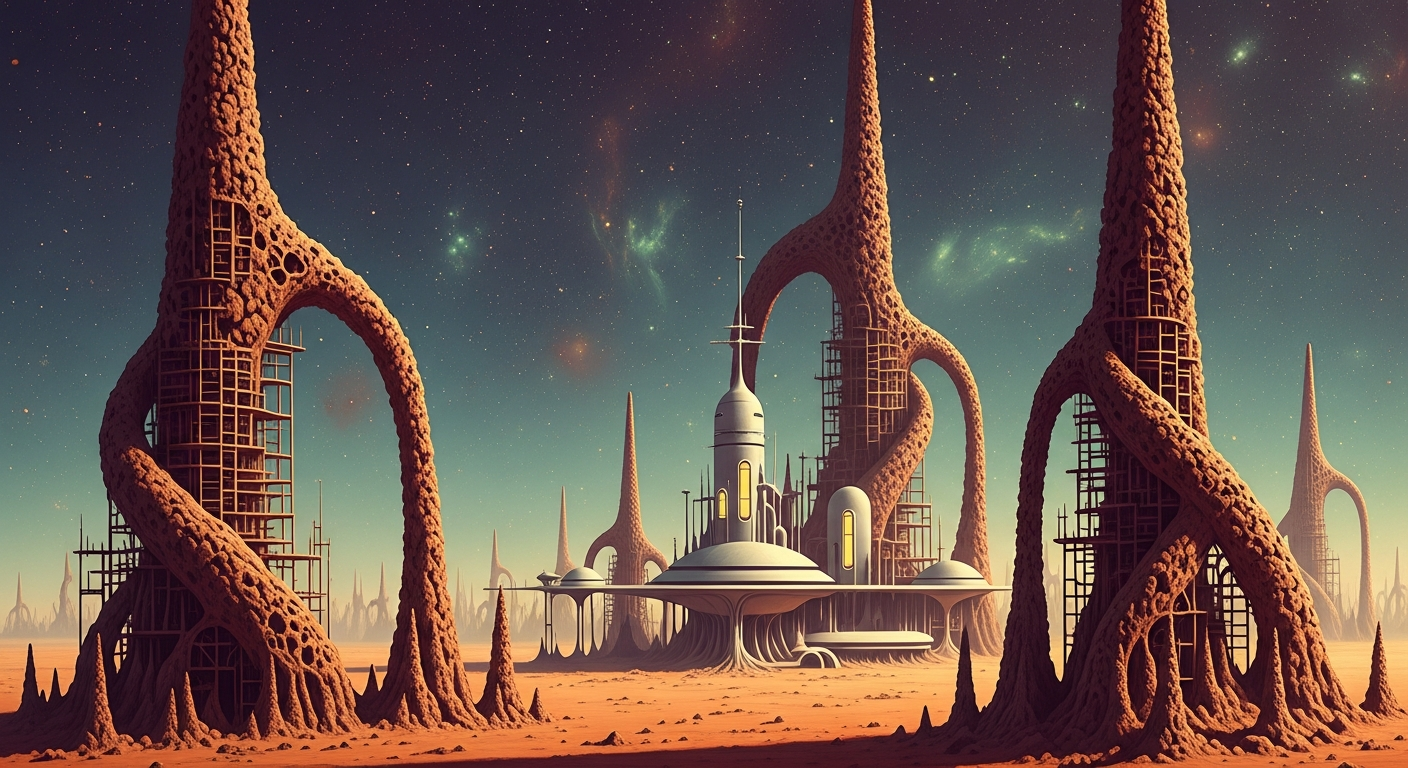
Space architects want to 3D print Mars houses with hollow, sponge-like walls, just like the inside of a termite mound. These special walls will help trap warm air when it is cold, and let heat escape when it is hot, keeping astronauts perfectly comfortable without using electricity for heavy air conditioners.

4. Thick Shields Against Space Radiation

Because Mars does not have a thick atmosphere like Earth, dangerous invisible rays from the sun and space (called radiation) constantly hit the planet’s surface. Termite mounds have incredibly thick outer walls to protect the colony from hungry animals and harsh weather. By copying this design, our 3D-printed termite-style Mars houses will have very thick outer shells made of Martian rock. This thick shell acts as a giant shield, keeping the dangerous space radiation away from the astronauts sleeping safely inside.

Conclusion: From Tiny Insects to Giant Leaps

Building a home on a totally alien planet is one of the biggest challenges humans have ever faced. However, we do not have to start from scratch. Nature has already spent millions of years figuring out how to build incredibly strong, perfectly heated homes out of nothing but dirt.

By studying termite mounds and using biomimicry, scientists have realized that the best Mars habitats probably will not look like normal Earth houses. Instead, they will look like beautiful, alien bug mounds! So, the next time you see a tiny bug crawling in the dirt, remember: that little insect’s secrets might be the key to helping humans live among the stars.


Reader Comments

Copied title and URL