Could Bees Build a Honeycomb on Mars? The Secret Math of Space Insects

Could Bees Build a Honeycomb on Mars? The Secret Math of Space Insects Introduction: Meet the Astronaut Bees Imagine you are an astronaut stepping onto the dusty, red surface of Mars. You look inside your futuristic greenhouse, and what do you hear? A soft, familiar buzzing sound. If humans are ever going to live on Mars and grow their own food, we might need to bring our most important little helpers with us: bees. But this brings up a fascinating question. How would these tiny space insects build their homes on another planet? Could bees build a perfect honeycomb on Mars? To answer this, we need to uncover the amazing hidden math of nature and figure out how gravity works for bugs. Detailed Scientific Explanation: The Math and Magic of Martian Bees The Secret Math of Earth Bees: Why Hexagons? Before we send bees to space, we have to look at why their honeycombs are so special right here on Earth. Have you ever noticed that a honeycomb is made of perfect, six-sided shapes called hexagons? This is not an accident! Making beeswax takes a lot of energy. A bee has to eat about eight ounces of honey just to make one ounce of wax! Because wax is so hard to make, bees need a shape that holds the most honey while using the least amount of wax. For thousands of years, scientists wondered what the best shape was. Circles leave empty gaps. Triangles and squares fit together perfectly, but their corners take up extra wax. Finally, in 1999, a mathematician named Thomas Hales proved the Honeycomb Conjecture. He proved that the hexagon is the absolute best shape in the universe for saving space and materials. Without ever taking a math class, bees have been using perfect geometry for millions of years! The Gravity Problem: How Do Bees Know Which Way is Up? Math is the same on Mars as it is on Earth, so bees would still want to build hexagons. But there is a huge challenge: gravity. When bees build their comb, they always build it straight up and down. How do they know perfectly which way is down in the pitch-black darkness of a beehive? They have a secret tool! Bees have tiny, special organs on their necks covered in sensitive hairs. These act just like the "spirit level" a carpenter uses to build a straight wall. The weight of the bee's own head pulling down on these hairs tells its brain exactly where gravity is. This helps them line up their beautiful, perfectly straight honeycomb walls. Building on the Red Planet: A Low-Gravity Honeycomb Now, let us put our bees on Mars. The gravity on Mars is only about 38% as strong as Earth's gravity. If you weighed 100 pounds on Earth, you would only weigh 38 pounds on Mars! This means a bee's head would feel much lighter. Would their built-in gravity sensors still work? Scientists have actually tested how bees build in space! In 1984, an experiment called "Challenger STS-41C" sent thousands of bees into microgravity (almost zero gravity) on the Space Shuttle. At first, the bees were very confused. Without Earth's strong gravity pulling on their neck hairs, they could not figure out which way was "down." Instead of building straight, flat combs, they built strange, messy, wavy shapes. However, Mars is not zero gravity. It has some gravity. Because insects are incredibly adaptable, scientists believe that after a little bit of confusion, Martian bees would get used to the lighter gravity. Their bodies would learn to feel the gentle Martian pull. They might build honeycombs that are slightly thicker or curved at first, but soon, their mathematical instincts would take over. They would still use their secret math—the hexagon—to create efficient, space-saving homes to store their honey. Conclusion: Life, Math, and the Final Frontier So, could bees build a honeycomb on Mars? The answer is a resounding yes! While the lower gravity of the Red Planet might make their built-in gravity sensors a little wobbly at first, the secret math of space insects is simply too strong to fail. Nature's incredible geometry—the brilliant hexagon—does not depend on the planet you are on. It is a universal rule. As we look to the stars and plan our future space missions, it is amazing to think that the same little insects that pollinate the flowers in your backyard today could one day be the tiny, buzzing architects of tomorrow's Martian greenhouses. It shows us that with a little bit of math, and a lot of adaptability, life can find a home anywhere in the universe! biological

Could Bees Build a Honeycomb on Mars? The Secret Math of Space Insects

Introduction: Meet the Astronaut Bees

Imagine you are an astronaut stepping onto the dusty, red surface of Mars. You look inside your futuristic greenhouse, and what do you hear? A soft, familiar buzzing sound. If humans are ever going to live on Mars and grow their own food, we might need to bring our most important little helpers with us: bees. But this brings up a fascinating question. How would these tiny space insects build their homes on another planet? Could bees build a perfect honeycomb on Mars? To answer this, we need to uncover the amazing hidden math of nature and figure out how gravity works for bugs.

Detailed Scientific Explanation: The Math and Magic of Martian Bees

The Secret Math of Earth Bees: Why Hexagons?

Before we send bees to space, we have to look at why their honeycombs are so special right here on Earth. Have you ever noticed that a honeycomb is made of perfect, six-sided shapes called hexagons? This is not an accident!

Making beeswax takes a lot of energy. A bee has to eat about eight ounces of honey just to make one ounce of wax! Because wax is so hard to make, bees need a shape that holds the most honey while using the least amount of wax. For thousands of years, scientists wondered what the best shape was. Circles leave empty gaps. Triangles and squares fit together perfectly, but their corners take up extra wax.

Finally, in 1999, a mathematician named Thomas Hales proved the Honeycomb Conjecture. He proved that the hexagon is the absolute best shape in the universe for saving space and materials. Without ever taking a math class, bees have been using perfect geometry for millions of years!

The Gravity Problem: How Do Bees Know Which Way is Up?

Math is the same on Mars as it is on Earth, so bees would still want to build hexagons. But there is a huge challenge: gravity.

When bees build their comb, they always build it straight up and down. How do they know perfectly which way is down in the pitch-black darkness of a beehive? They have a secret tool! Bees have tiny, special organs on their necks covered in sensitive hairs. These act just like the “spirit level” a carpenter uses to build a straight wall. The weight of the bee’s own head pulling down on these hairs tells its brain exactly where gravity is. This helps them line up their beautiful, perfectly straight honeycomb walls.

Building on the Red Planet: A Low-Gravity Honeycomb

Now, let us put our bees on Mars. The gravity on Mars is only about 38% as strong as Earth’s gravity. If you weighed 100 pounds on Earth, you would only weigh 38 pounds on Mars! This means a bee’s head would feel much lighter. Would their built-in gravity sensors still work?

Scientists have actually tested how bees build in space! In 1984, an experiment called “Challenger STS-41C” sent thousands of bees into microgravity (almost zero gravity) on the Space Shuttle. At first, the bees were very confused. Without Earth’s strong gravity pulling on their neck hairs, they could not figure out which way was “down.” Instead of building straight, flat combs, they built strange, messy, wavy shapes.

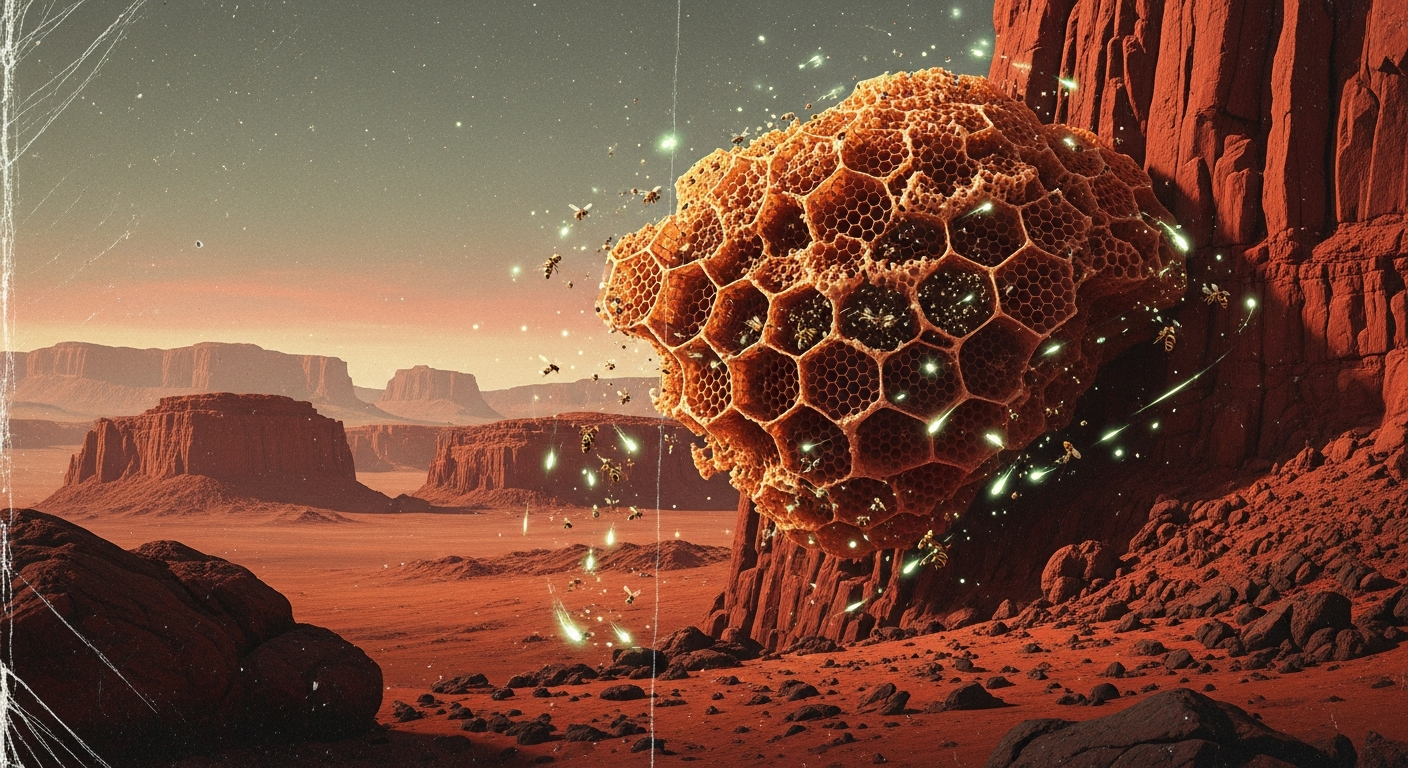
However, Mars is not zero gravity. It has some gravity. Because insects are incredibly adaptable, scientists believe that after a little bit of confusion, Martian bees would get used to the lighter gravity. Their bodies would learn to feel the gentle Martian pull. They might build honeycombs that are slightly thicker or curved at first, but soon, their mathematical instincts would take over. They would still use their secret math—the hexagon—to create efficient, space-saving homes to store their honey.

Conclusion: Life, Math, and the Final Frontier

So, could bees build a honeycomb on Mars? The answer is a resounding yes! While the lower gravity of the Red Planet might make their built-in gravity sensors a little wobbly at first, the secret math of space insects is simply too strong to fail. Nature’s incredible geometry—the brilliant hexagon—does not depend on the planet you are on. It is a universal rule.

As we look to the stars and plan our future space missions, it is amazing to think that the same little insects that pollinate the flowers in your backyard today could one day be the tiny, buzzing architects of tomorrow’s Martian greenhouses. It shows us that with a little bit of math, and a lot of adaptability, life can find a home anywhere in the universe!


Reader Comments

Copied title and URL