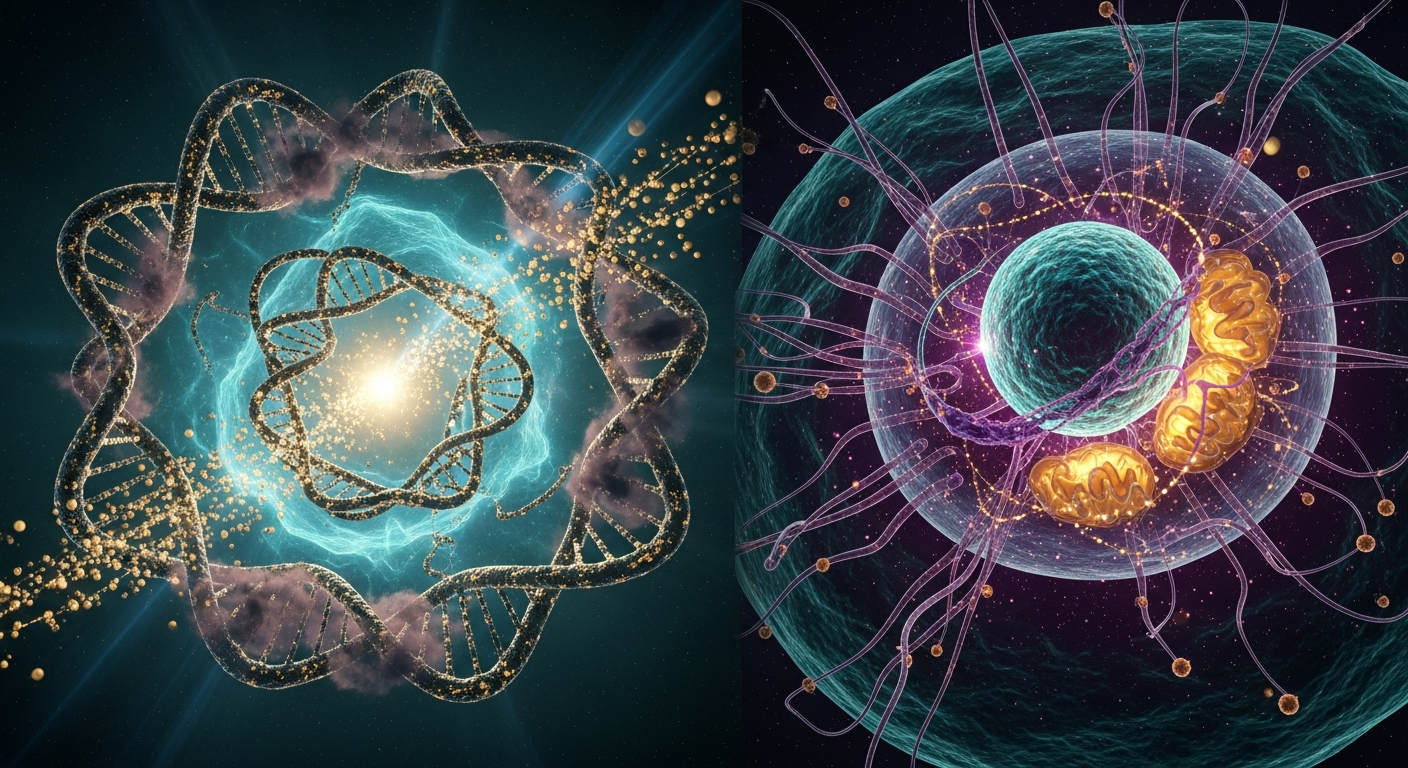
The Quantum Symphony of Life: Decoding the Subatomic Secrets of Biology
Introduction: Bridging the Macroscopic and the Subatomic
For over a century, the scientific community operated under a fundamental dichotomy: biology was the science of the macroscopic, characterized by warm, wet, and inherently messy systems, while quantum mechanics was the physics of the microscopic, requiring pristine, ultra-cold, and perfectly isolated environments to manifest. The idea that the delicate, counterintuitive rules of the subatomic realm—such as superposition, entanglement, and tunneling—could survive in the chaotic cellular soup of a living organism was long considered heretical. Yet, as our instruments have grown more precise, a profound paradigm shift has emerged. We are now discovering that life is not merely a chemical machine; it is a meticulously orchestrated quantum symphony.
Welcome to the frontier of quantum biology. This interdisciplinary field posits that natural selection, operating over billions of years, has learned to harness the bizarre phenomena of the quantum world to optimize the fundamental processes of life. Far from destroying quantum states, the bustling, noisy environment of a living cell may actively sustain them, utilizing subatomic secrets to achieve efficiencies that classical physics cannot explain. From the leaves of trees to the navigation systems of migratory birds, quantum mechanics is silently directing the rhythms of the natural world.
Detailed Scientific Explanation: Decoding the Mechanisms
The Quantum Maestro of Photosynthesis: Superposition and Coherence
One of the most astonishing discoveries in quantum biology involves the very foundation of Earth’s food chain: photosynthesis. When a photon of sunlight strikes a photosynthetic organism, its energy is absorbed by a light-harvesting complex, creating an energized packet called an exciton. This exciton must travel through a dense forest of chlorophyll molecules to reach a reaction center where its energy can be converted into chemical fuel. Classical physics models this journey as a “random walk”—a drunken stumble from molecule to molecule. However, calculations show that this classical hopscotch is too slow and inefficient; much of the energy should be lost as heat. Yet, photosynthetic efficiency approaches an astounding 99%.
The secret lies in quantum coherence. Spectroscopic studies on the Fenna-Matthews-Olson (FMO) complex in green sulfur bacteria have revealed that the exciton behaves not as a classical particle, but as a quantum wave. Through quantum superposition, the exciton explores all possible pathways to the reaction center simultaneously. It effectively “feels” out the most efficient route, collapsing into the optimal path without losing energy to its surroundings. Life has essentially engineered a room-temperature quantum computer dedicated exclusively to energy routing.
Entanglement on the Wing: The Avian Quantum Compass
Every year, millions of birds, such as the European robin, migrate thousands of miles across the globe with pinpoint accuracy, guided by Earth’s weak magnetic field. For decades, the mechanism behind this “magnetoreception” baffled biologists. The magnetic field is orders of magnitude too weak to physically tug on microscopic iron crystals in the bird’s brain. The answer, it turns out, is hidden in their eyes, relying on the spooky action of quantum entanglement.
Scientists have isolated a light-sensitive protein in the avian retina called cryptochrome. When a photon of blue light enters the bird’s eye, it knocks an electron out of its typical orbit within cryptochrome, creating a “radical pair”—two molecules, each with an unpaired electron. Crucially, these two electrons are quantumly entangled. Because they are entangled, the spin states of these electrons are highly sensitive to external magnetic fields, no matter how weak. As the bird changes its orientation relative to Earth’s magnetic field, the ratio of chemical products generated by these radical pairs changes. This shifting chemical output creates a biological signal, essentially allowing the bird to “see” the magnetic lines of the planet.
Tunneling Through the Barriers of Life: Enzymatic Catalysis and DNA
Beyond energy transfer and navigation, the subatomic world governs the fundamental biochemical reactions that keep organisms alive. Enzymes are the biological catalysts that accelerate chemical reactions, making life possible. However, some reactions occur much faster than classical thermodynamics allows. The energy barriers required to move protons (hydrogen nuclei) or electrons from one molecule to another are simply too high for the ambient thermal energy to overcome.
To solve this, enzymes utilize quantum tunneling. In the quantum realm, a particle does not always need to climb over an energy barrier; it has a non-zero probability of simply passing straight through it, like a ghost walking through a wall. Enzymes are structured to hold molecules in precise alignments that maximize the probability of proton tunneling. Furthermore, this phenomenon has profound implications for genetics. The hydrogen bonds holding the two strands of DNA together rely on the position of protons. If a proton tunnels across the biological barrier at the exact moment the DNA is unzipped for replication, it can cause a tautomeric shift, leading to a spontaneous mutation. Thus, quantum mechanics may be a silent driver of evolutionary change.
Conclusion: A New Paradigm for Life
The emergence of quantum biology fundamentally alters our understanding of what it means to be alive. The classical view of life as a complex arrangement of ball-and-stick molecules governed by Newtonian mechanics is no longer sufficient. Underneath the cellular machinery, life operates as a quantum symphony, where superposition, entanglement, and tunneling play vital roles in sustaining biological function.
The implications of decoding these subatomic secrets are staggering. By studying how plants maintain quantum coherence at room temperature, engineers may finally crack the code to building robust, scalable quantum computers without the need for absolute zero cooling. Understanding the enzymatic harnessing of quantum tunneling could revolutionize the design of industrial catalysts and novel pharmaceuticals. Most importantly, unraveling the quantum mechanics of biology bridges the ultimate gap in human knowledge, proving that the strange, ethereal rules of the subatomic universe do not just shape the cosmos—they are woven intimately into the very fabric of life itself.


Reader Comments