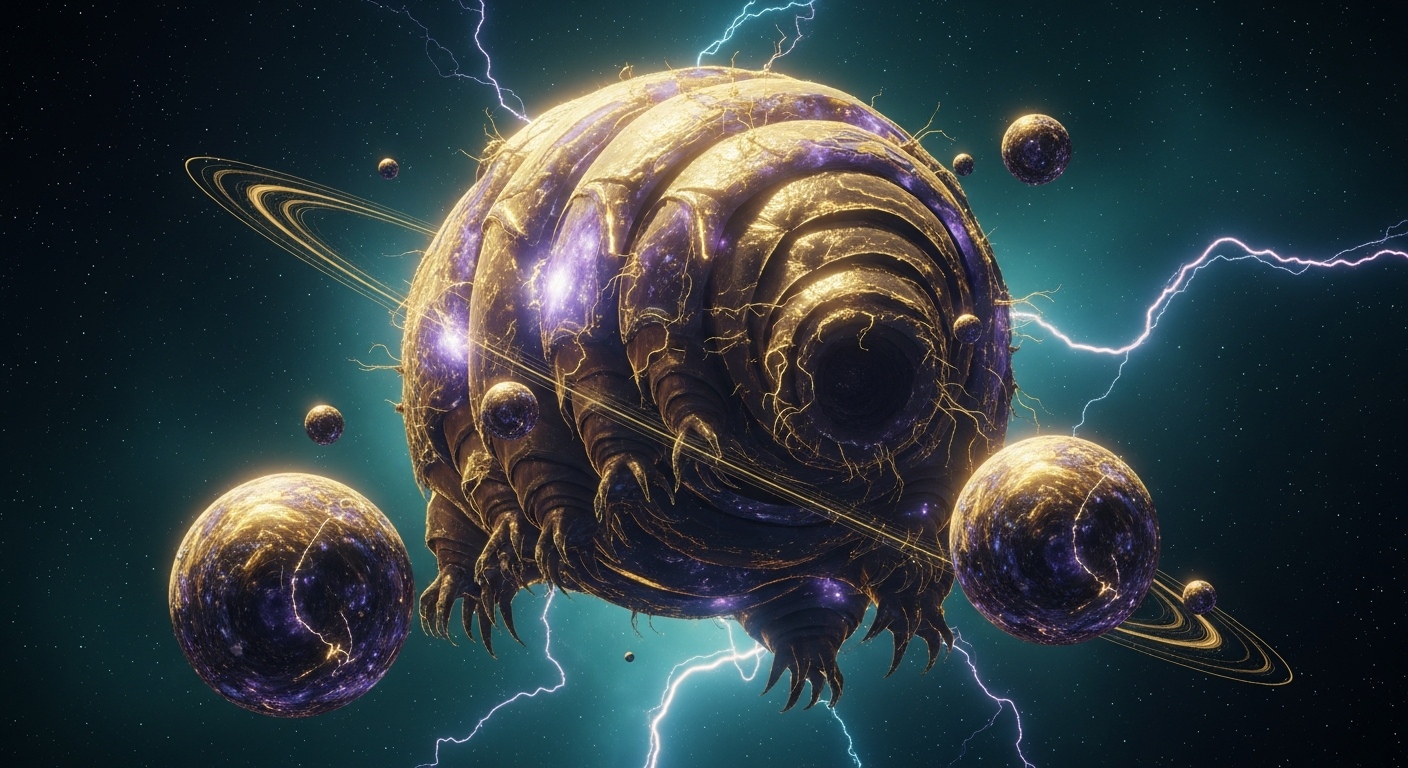
How Tardigrades Survive Space: Unlocking the Biological Secrets of Earth’s Toughest Creature
Introduction: The Microscopic Astronauts
Space is an unforgiving void. It is a realm characterized by an absolute vacuum, fatal doses of cosmic radiation, and temperature fluctuations that oscillate between the boiling heat of unfiltered starlight and the near-absolute zero of deep shadow. For almost all known forms of life, unprotected exposure to the vacuum of space means instantaneous death. Yet, there is a microscopic anomaly that defies this universal rule: the tardigrade.
Affectionately known as “water bears” or “moss piglets,” tardigrades are eight-legged, microscopic invertebrates typically measuring no more than half a millimeter in length. Despite their unassuming appearance and aquatic nature, these extremophiles hold the prestigious title of Earth’s toughest creature. In 2007, the European Space Agency’s TARDIS (Tardigrades in Space) mission exposed live tardigrades directly to the vacuum and radiation of space for ten days. Astoundingly, upon returning to Earth and being rehydrated, a significant portion of them survived and even successfully reproduced. To understand how tardigrades survive space, we must dive deep into their evolutionary biology and unlock the genetic secrets that make them practically indestructible.
Unlocking the Biological Secrets: A Detailed Scientific Explanation
The ability of tardigrades to survive the extreme conditions of outer space is not the result of a single biological quirk, but rather a complex, multi-layered defense mechanism. Their survival relies on a combination of extreme metabolic suspension, unique proteins, and advanced cellular preservation strategies.
Cryptobiosis: The Magic of the “Tun” State
At the core of the tardigrade’s survivability is a process known as cryptobiosis—specifically, anhydrobiosis (life without water). When a tardigrade senses fatal environmental changes, such as the complete desiccation brought on by the vacuum of space, it initiates a radical physical transformation. The creature retracts its eight legs, curls its head inward, and expels up to 97% of the water in its body. This transforms the tardigrade into a shriveled, pill-like structure called a tun.
In the tun state, the tardigrade’s metabolism drops to less than 0.01% of its normal rate. Because biological processes fundamentally require water as a solvent, the absence of water essentially halts biological time for the creature. It is neither truly alive nor dead, existing in a state of suspended animation that can last for decades. Without water in its cells, the vacuum of space cannot cause the creature’s bodily fluids to boil, nor can freezing temperatures cause ice crystals to form and rupture cellular membranes.
Vitrification: Turning Cells into Glass
Expelling water is only half the battle; the remaining cellular structure must be protected from collapsing. When tardigrades dehydrate, they produce special molecules to replace the lost water. Historically, scientists believed a sugar called trehalose was responsible, but recent discoveries point to a unique set of proteins known as Tardigrade-specific Intrinsically Disordered Proteins (TDPs).
Unlike standard proteins that have a rigid 3D structure, TDPs are floppy and shapeless. As the tardigrade dries out, these proteins encapsulate the animal’s delicate molecular machinery and vitrify—meaning they turn the cellular fluid into a protective, glass-like matrix. This bioglass suspends proteins, DNA, and RNA in a frozen lattice, preventing them from denaturing or unfolding under the extreme thermal stress of space.
The Dsup Protein: An Evolutionary Marvel Against Radiation
Perhaps the most lethal threat in outer space is ionizing cosmic radiation, which shatters the DNA of ordinary organisms, leading to immediate cellular death or catastrophic mutations. Tardigrades, however, can withstand doses of radiation hundreds of times higher than the lethal dose for a human. The secret lies in a highly specialized protein found in certain tardigrade species (like Ramazzottius varieornatus) known as Dsup (Damage Suppressor).
The Dsup protein acts as a physical shield for the tardigrade’s genome. It binds directly to the nucleosomes (the structures around which DNA is coiled) and forms a protective cloud. When high-energy X-rays or cosmic rays pass through the cell, they split water molecules to create highly reactive hydroxyl radicals that normally tear DNA apart. The Dsup protein absorbs this damage, effectively deflecting the radical attack and preventing the DNA strands from fracturing. Furthermore, tardigrades possess highly aggressive DNA repair mechanisms that rapidly stitch together any genomic breaks the moment the creature is rehydrated.
Conclusion: What Earth’s Toughest Creature Means for Humanity
The tardigrade’s ability to endure the vacuum, extreme temperatures, and lethal radiation of outer space makes it a true biological marvel. Through the mechanisms of cryptobiosis, the vitrification enabled by TDPs, and the radiation-shielding properties of the Dsup protein, Earth’s toughest creature proves that life can engineer solutions to the most hostile environments imaginable.
Unlocking the biological secrets of the water bear is not just an exercise in extreme zoology; it holds profound implications for the future of humanity. By understanding how tardigrades stabilize their cells without water, scientists are currently developing ways to store life-saving human medicines, vaccines, and blood cells without the need for refrigeration. Furthermore, integrating tardigrade-derived proteins like Dsup into human cells could one day protect astronauts from cosmic radiation during deep-space missions to Mars and beyond. Ultimately, by studying the microscopic astronauts beneath our feet, we may secure our own future among the stars.

Reader Comments