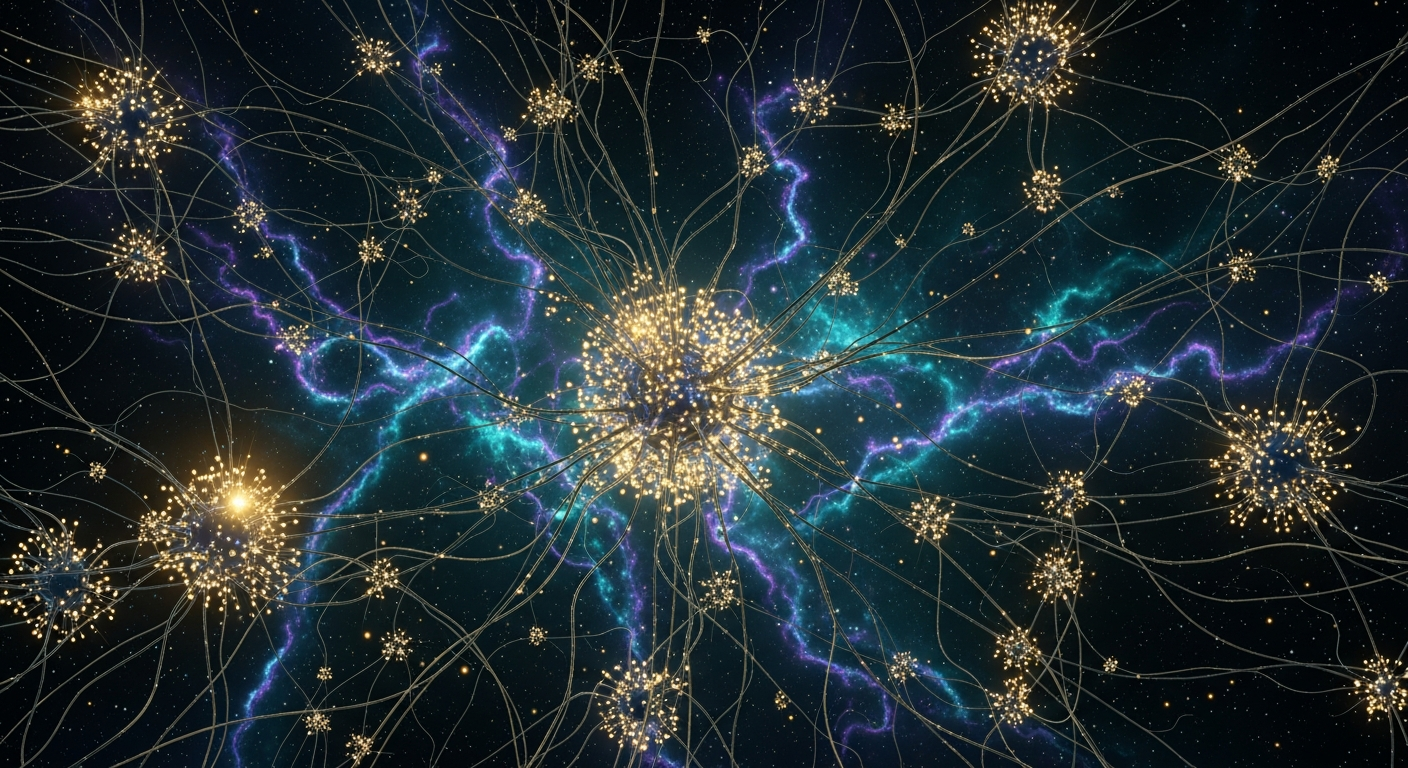
The Cosmic Web: Why the Structure of the Universe Mirrors the Human Brain

The Cosmic Web: Why the Structure of the Universe Mirrors the Human Brain Introduction: The Ultimate Cosmic Coincidence? For centuries, humanity has gazed up at the night sky and wondered about our place in the cosmos. Philosophers and poets have long suggested that we are a microcosm of the universe, but recent scientific discoveries have taken this poetic metaphor and transformed it into a staggering empirical reality. The structural similarities between the cosmic web—the large-scale architecture of the universe—and the neuronal networks of the human brain are so profound that they have captivated both astrophysicists and neuroscientists alike. How is it possible that the sprawling, billions-of-light-years-wide structure of the cosmos mirrors the microscopic, millimeter-scale wiring inside our heads? At first glance, the comparison seems absurd. A difference in scale of 27 orders of magnitude separates the universe from the human brain. Yet, when analyzed through the lens of network theory, physics, and information entropy, the universe and the brain exhibit a striking morphological symmetry. In this article, we delve deep into the science behind why the structure of the universe mirrors the human brain, exploring the quantitative data, network topology, and the physical laws of complex systems that bind the macrocosm and the microcosm. Detailed Scientific Explanation: Decoding the Architectures of Nature The Vazza-Feletti Study: Bridging Astrophysics and Neuroscience The definitive quantitative comparison between these two complex systems was published in a landmark 2020 study in Frontiers in Physics by astrophysicist Franco Vazza and neurosurgeon Alberto Feletti. Rather than relying on simple visual similarities—which can be misleading due to human pattern recognition bias (pareidolia)—the researchers employed rigorous network analysis and quantitative morphometry. They discovered that the physical forces shaping the universe and the biological processes guiding brain development, despite being entirely different in nature, result in statistically identical network architectures. By the Numbers: A Tale of Two Complex Networks To understand why the universe mirrors the human brain, we must first look at the raw data. The structural compositions of both systems share an eerie numerical alignment: Nodes of the Network: The human cerebellum and cerebral cortex contain approximately 86 billion neurons. Remarkably, the observable universe contains an estimated 100 billion to 200 billion galaxies. In both systems, these entities act as the "nodes" of a vast network. Filamentous Connections: Neurons are connected by an intricate web of axons and dendrites, while galaxies are bound together by colossal threads of dark matter and visible gas, known as the cosmic web. The "Passive" Majority: One of the most fascinating parallels lies in what isn't part of the active network. In the human brain, roughly 77% of its mass is composed of water, which serves as a passive medium. In the cosmos, roughly 72% of the mass-energy density is composed of Dark Energy, a mysterious force driving the universe's expansion but playing no active role in the structural web of galaxies. In both systems, the active network constitutes only about 25% to 30% of the total mass-energy budget. Network Topology: Spectral Density and Clustering The true depth of the cosmic-brain connection is found in their network topology. Vazza and Feletti utilized a technique called power spectrum analysis to measure the density of structural fluctuations across both systems. The power spectrum calculates how many connections a node has and how those connections cluster together. When the researchers plotted the degree of centrality and the clustering coefficient (a measure of how tightly nodes bundle together), they found that the brain's neuronal network and the cosmic web exhibited overlapping distributions. When zoomed in at a scale of 1 micrometer to 0.1 millimeters for the brain, and 10 million to 100 million light-years for the universe, the structural patterns were mathematically indistinguishable. Furthermore, both systems are classified as complex, self-organizing networks that balance the need for efficient information (or matter) transfer with the minimization of energy expenditure. They are not entirely random, nor are they rigid grids; they exist in a highly optimized state known as the "edge of chaos." The Physics of Complex Systems: Why Do They Look Alike? If galaxies are shaped by gravity, dark matter, and cosmic expansion, and neurons are shaped by genetics, biochemical signaling, and evolution, why do they look the same? The answer lies in the fundamental physics of complex systems and fractal geometry. Nature inherently seeks efficiency. Whether it is gravity pulling cosmic gas into filaments, or a brain mapping the most efficient pathways for neurotransmitters, the underlying mathematical principles of energy minimization and optimal network routing are universal. This phenomenon is known as universality in statistical physics. Systems that are completely different in their physical makeup can exhibit the same phase transitions and structural evolutions if they are governed by similar systemic constraints. Both the cosmic web and the human brain grew outward from initial fluctuations—quantum fluctuations in the early universe, and embryonic cellular divisions in the brain. Over time, both systems evolved to maximize connectivity while minimizing the energy required to sustain those connections, resulting in the iconic web-like structure we observe. Conclusion: A Universe of Connections The discovery that the structure of the universe mirrors the human brain is far more than a visual coincidence; it is a profound testament to the underlying mathematical and physical laws that govern our reality. Through the rigorous network analysis conducted by Vazza, Feletti, and others, we now know that the macroscopic architecture of the cosmos and the microscopic wiring of our minds share deep, quantitative similarities in node count, passive material ratios, and network topology. This revelation bridges the gap between astrophysics and neuroscience, suggesting that the dynamics of complex systems transcend scale and origin. It reminds us that humanity is fundamentally woven into the fabric of nature. The next time you look up at the intricate tapestry of the night sky, remember that you are looking at a reflection of the very organ that allows you to perceive it. We are not merely observers of the universe; we are the universe, structurally and functionally, experiencing itself. 一般

The Cosmic Web: Why the Structure of the Universe Mirrors the Human Brain

Introduction: The Ultimate Cosmic Coincidence?

For centuries, humanity has gazed up at the night sky and wondered about our place in the cosmos. Philosophers and poets have long suggested that we are a microcosm of the universe, but recent scientific discoveries have taken this poetic metaphor and transformed it into a staggering empirical reality. The structural similarities between the cosmic web—the large-scale architecture of the universe—and the neuronal networks of the human brain are so profound that they have captivated both astrophysicists and neuroscientists alike.

How is it possible that the sprawling, billions-of-light-years-wide structure of the cosmos mirrors the microscopic, millimeter-scale wiring inside our heads? At first glance, the comparison seems absurd. A difference in scale of 27 orders of magnitude separates the universe from the human brain. Yet, when analyzed through the lens of network theory, physics, and information entropy, the universe and the brain exhibit a striking morphological symmetry. In this article, we delve deep into the science behind why the structure of the universe mirrors the human brain, exploring the quantitative data, network topology, and the physical laws of complex systems that bind the macrocosm and the microcosm.

Detailed Scientific Explanation: Decoding the Architectures of Nature

The Vazza-Feletti Study: Bridging Astrophysics and Neuroscience

The definitive quantitative comparison between these two complex systems was published in a landmark 2020 study in Frontiers in Physics by astrophysicist Franco Vazza and neurosurgeon Alberto Feletti. Rather than relying on simple visual similarities—which can be misleading due to human pattern recognition bias (pareidolia)—the researchers employed rigorous network analysis and quantitative morphometry.

They discovered that the physical forces shaping the universe and the biological processes guiding brain development, despite being entirely different in nature, result in statistically identical network architectures.

By the Numbers: A Tale of Two Complex Networks

To understand why the universe mirrors the human brain, we must first look at the raw data. The structural compositions of both systems share an eerie numerical alignment:

  • Nodes of the Network: The human cerebellum and cerebral cortex contain approximately 86 billion neurons. Remarkably, the observable universe contains an estimated 100 billion to 200 billion galaxies. In both systems, these entities act as the “nodes” of a vast network.
  • Filamentous Connections: Neurons are connected by an intricate web of axons and dendrites, while galaxies are bound together by colossal threads of dark matter and visible gas, known as the cosmic web.
  • The “Passive” Majority: One of the most fascinating parallels lies in what isn’t part of the active network. In the human brain, roughly 77% of its mass is composed of water, which serves as a passive medium. In the cosmos, roughly 72% of the mass-energy density is composed of Dark Energy, a mysterious force driving the universe’s expansion but playing no active role in the structural web of galaxies. In both systems, the active network constitutes only about 25% to 30% of the total mass-energy budget.

Network Topology: Spectral Density and Clustering

The true depth of the cosmic-brain connection is found in their network topology. Vazza and Feletti utilized a technique called power spectrum analysis to measure the density of structural fluctuations across both systems. The power spectrum calculates how many connections a node has and how those connections cluster together.

When the researchers plotted the degree of centrality and the clustering coefficient (a measure of how tightly nodes bundle together), they found that the brain’s neuronal network and the cosmic web exhibited overlapping distributions. When zoomed in at a scale of 1 micrometer to 0.1 millimeters for the brain, and 10 million to 100 million light-years for the universe, the structural patterns were mathematically indistinguishable.

Furthermore, both systems are classified as complex, self-organizing networks that balance the need for efficient information (or matter) transfer with the minimization of energy expenditure. They are not entirely random, nor are they rigid grids; they exist in a highly optimized state known as the “edge of chaos.”

The Physics of Complex Systems: Why Do They Look Alike?

If galaxies are shaped by gravity, dark matter, and cosmic expansion, and neurons are shaped by genetics, biochemical signaling, and evolution, why do they look the same? The answer lies in the fundamental physics of complex systems and fractal geometry.

Nature inherently seeks efficiency. Whether it is gravity pulling cosmic gas into filaments, or a brain mapping the most efficient pathways for neurotransmitters, the underlying mathematical principles of energy minimization and optimal network routing are universal. This phenomenon is known as universality in statistical physics. Systems that are completely different in their physical makeup can exhibit the same phase transitions and structural evolutions if they are governed by similar systemic constraints.

Both the cosmic web and the human brain grew outward from initial fluctuations—quantum fluctuations in the early universe, and embryonic cellular divisions in the brain. Over time, both systems evolved to maximize connectivity while minimizing the energy required to sustain those connections, resulting in the iconic web-like structure we observe.

Conclusion: A Universe of Connections

The discovery that the structure of the universe mirrors the human brain is far more than a visual coincidence; it is a profound testament to the underlying mathematical and physical laws that govern our reality. Through the rigorous network analysis conducted by Vazza, Feletti, and others, we now know that the macroscopic architecture of the cosmos and the microscopic wiring of our minds share deep, quantitative similarities in node count, passive material ratios, and network topology.

This revelation bridges the gap between astrophysics and neuroscience, suggesting that the dynamics of complex systems transcend scale and origin. It reminds us that humanity is fundamentally woven into the fabric of nature. The next time you look up at the intricate tapestry of the night sky, remember that you are looking at a reflection of the very organ that allows you to perceive it. We are not merely observers of the universe; we are the universe, structurally and functionally, experiencing itself.


Reader Comments

タイトルとURLをコピーしました