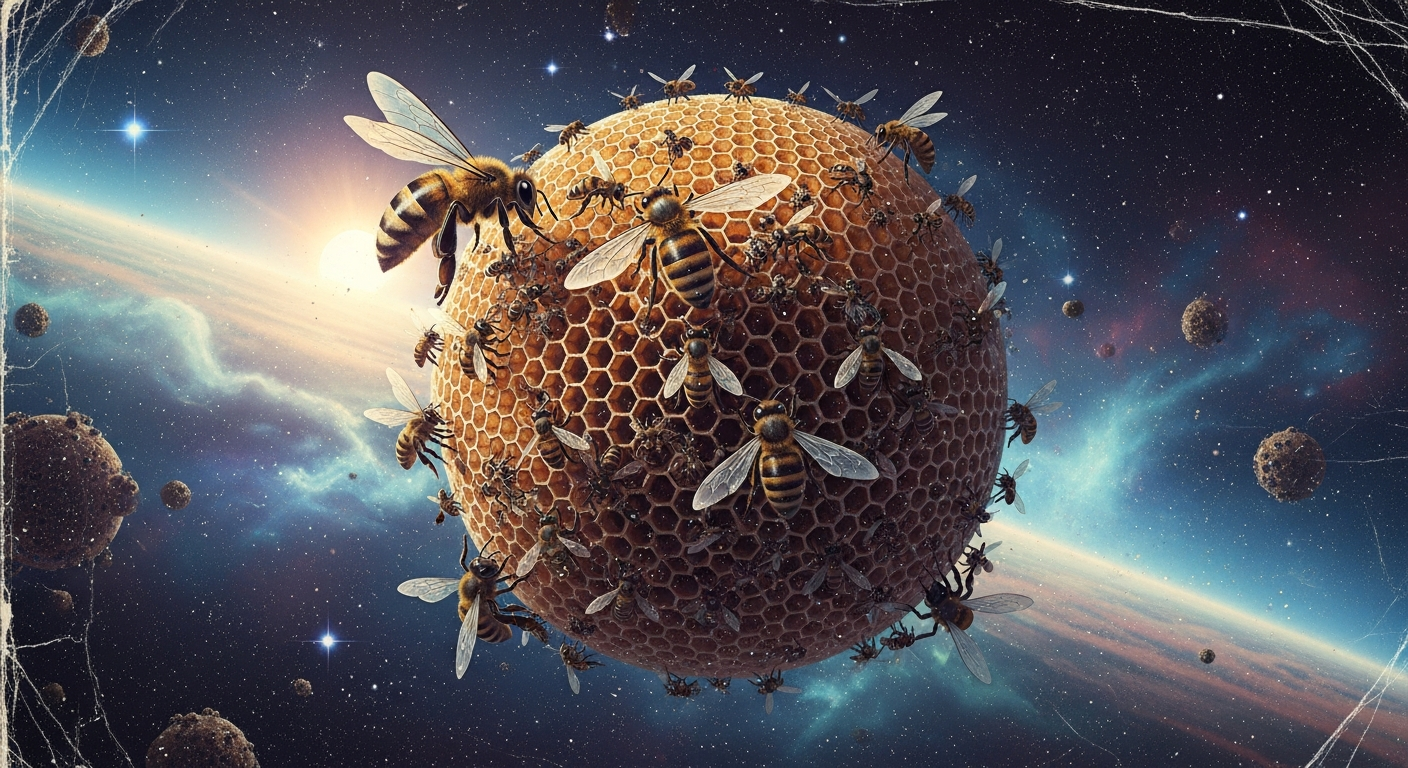
Space Architecture: Could Earth’s Bees Build Perfect Honeycombs in Zero Gravity?

Space Architecture: Could Earth's Bees Build Perfect Honeycombs in Zero Gravity? Imagine wearing a tiny spacesuit and floating inside a giant rocket. If you do a somersault, you just keep spinning without ever falling! Now, imagine you are a honeybee trying to do your most important job: building a home. On Earth, bees are nature's greatest architects. They build stunning, perfect honeycombs to store their sweet food and raise their young. But what happens when you take these tiny builders into space? Could Earth's bees build perfect honeycombs in zero gravity? This is exactly what NASA scientists and a clever high school student wanted to find out. In a fascinating experiment, they sent a buzzing crew of "astronaut bees" into orbit. The results proved that bees are incredible space engineers, but their cosmic creations came with one very surprising twist! Decoding the Microgravity Hive: A Detailed Scientific Explanation 3,400 Tiny Astronauts Take Flight In April 1984, the Space Shuttle Challenger blasted off into space carrying a very special box called the Bee Enclosure Module. Inside this box were 3,400 worker bees and one queen bee. Scientists wanted to see how the insects would handle microgravity, which is the scientific word for the floating feeling of zero gravity. At first, the bees were very confused. Without gravity pulling them down, they didn't know which way was up! They tumbled around and bumped into the walls of their box. But bees are incredibly smart and adaptable. After just a few days, they stopped fighting the floating feeling. They learned to glide gracefully from place to place, adjusting to their new space home just like human astronauts do. Nature’s Perfect Geometry: The Hexagon Once they figured out how to fly, the bees got to work on their space architecture. On Earth, bees build their honeycombs using six-sided shapes called hexagons. Why hexagons? Because they fit perfectly together like puzzle pieces, leaving no empty spaces, and they use the smallest amount of wax to hold the largest amount of honey. It is a mathematical masterpiece! The big question was: would they forget this math in space? The answer was a resounding "No!" The astronaut bees successfully built about 200 square centimeters of honeycomb in orbit. When scientists measured the space-combs, they found that the thickness of the walls, the depth of the cells, and the perfect hexagonal shapes were almost exactly identical to the ones built on Earth. This proved that a bee's brain contains a permanent blueprint for the hexagon that works perfectly, even without gravity. The Surprising Twist: The Missing Tilt However, scientists discovered one fascinating difference in the space honeycomb. To understand this, think about holding a bowl of soup. If you want to keep the soup from spilling, you have to hold the bowl flat or tilt it slightly up. On Earth, bees are smart enough to tilt their honeycomb cells slightly upward (about 9 to 14 degrees) so the sticky, liquid nectar doesn't drip out. They use Earth's gravity as an invisible compass to know exactly which way is "down" so they can tilt their cells "up." In zero gravity, there is no "up" or "down." Because the bees lost their gravity compass, they got confused about how to tilt their cells. Some cells pointed up, some pointed down, and some pointed sideways! The bees built the perfect hexagon shape, but without gravity to guide them, they couldn't figure out the right angle to place them. This showed scientists that while the shape of the honeycomb is programmed into the bees' DNA, they still rely on the physics of gravity as a tool to finish the job correctly. Conclusion: What Space Bees Teach Us About the Future The 1984 NASA bee experiment was a massive success. It taught us that honeybees are highly adaptable creatures and brilliant engineers. They can learn to fly in zero gravity and still create their beautiful, complex space architecture. Even though the lack of gravity caused a little confusion with the tilting of their honeycombs, they successfully completed their mission as master builders. This is wonderful news for the future of space exploration. If humans ever build giant greenhouses on the Moon or Mars, we will need bees to pollinate our space-grown fruits and vegetables. Thanks to this amazing experiment, we know that if we ever invite Earth's bees on a cosmic journey, these brilliant buzzing architects will feel right at home among the stars. biological

Space Architecture: Could Earth’s Bees Build Perfect Honeycombs in Zero Gravity?

Imagine wearing a tiny spacesuit and floating inside a giant rocket. If you do a somersault, you just keep spinning without ever falling! Now, imagine you are a honeybee trying to do your most important job: building a home. On Earth, bees are nature’s greatest architects. They build stunning, perfect honeycombs to store their sweet food and raise their young. But what happens when you take these tiny builders into space? Could Earth’s bees build perfect honeycombs in zero gravity?

This is exactly what NASA scientists and a clever high school student wanted to find out. In a fascinating experiment, they sent a buzzing crew of “astronaut bees” into orbit. The results proved that bees are incredible space engineers, but their cosmic creations came with one very surprising twist!

Decoding the Microgravity Hive: A Detailed Scientific Explanation

3,400 Tiny Astronauts Take Flight

In April 1984, the Space Shuttle Challenger blasted off into space carrying a very special box called the Bee Enclosure Module. Inside this box were 3,400 worker bees and one queen bee. Scientists wanted to see how the insects would handle microgravity, which is the scientific word for the floating feeling of zero gravity.

At first, the bees were very confused. Without gravity pulling them down, they didn’t know which way was up! They tumbled around and bumped into the walls of their box. But bees are incredibly smart and adaptable. After just a few days, they stopped fighting the floating feeling. They learned to glide gracefully from place to place, adjusting to their new space home just like human astronauts do.

Nature’s Perfect Geometry: The Hexagon

Once they figured out how to fly, the bees got to work on their space architecture. On Earth, bees build their honeycombs using six-sided shapes called hexagons. Why hexagons? Because they fit perfectly together like puzzle pieces, leaving no empty spaces, and they use the smallest amount of wax to hold the largest amount of honey. It is a mathematical masterpiece!

The big question was: would they forget this math in space? The answer was a resounding “No!” The astronaut bees successfully built about 200 square centimeters of honeycomb in orbit. When scientists measured the space-combs, they found that the thickness of the walls, the depth of the cells, and the perfect hexagonal shapes were almost exactly identical to the ones built on Earth. This proved that a bee’s brain contains a permanent blueprint for the hexagon that works perfectly, even without gravity.

The Surprising Twist: The Missing Tilt

However, scientists discovered one fascinating difference in the space honeycomb. To understand this, think about holding a bowl of soup. If you want to keep the soup from spilling, you have to hold the bowl flat or tilt it slightly up. On Earth, bees are smart enough to tilt their honeycomb cells slightly upward (about 9 to 14 degrees) so the sticky, liquid nectar doesn’t drip out. They use Earth’s gravity as an invisible compass to know exactly which way is “down” so they can tilt their cells “up.”

In zero gravity, there is no “up” or “down.” Because the bees lost their gravity compass, they got confused about how to tilt their cells. Some cells pointed up, some pointed down, and some pointed sideways! The bees built the perfect hexagon shape, but without gravity to guide them, they couldn’t figure out the right angle to place them. This showed scientists that while the shape of the honeycomb is programmed into the bees’ DNA, they still rely on the physics of gravity as a tool to finish the job correctly.

Conclusion: What Space Bees Teach Us About the Future

The 1984 NASA bee experiment was a massive success. It taught us that honeybees are highly adaptable creatures and brilliant engineers. They can learn to fly in zero gravity and still create their beautiful, complex space architecture. Even though the lack of gravity caused a little confusion with the tilting of their honeycombs, they successfully completed their mission as master builders.

This is wonderful news for the future of space exploration. If humans ever build giant greenhouses on the Moon or Mars, we will need bees to pollinate our space-grown fruits and vegetables. Thanks to this amazing experiment, we know that if we ever invite Earth’s bees on a cosmic journey, these brilliant buzzing architects will feel right at home among the stars.


Reader Comments

タイトルとURLをコピーしました