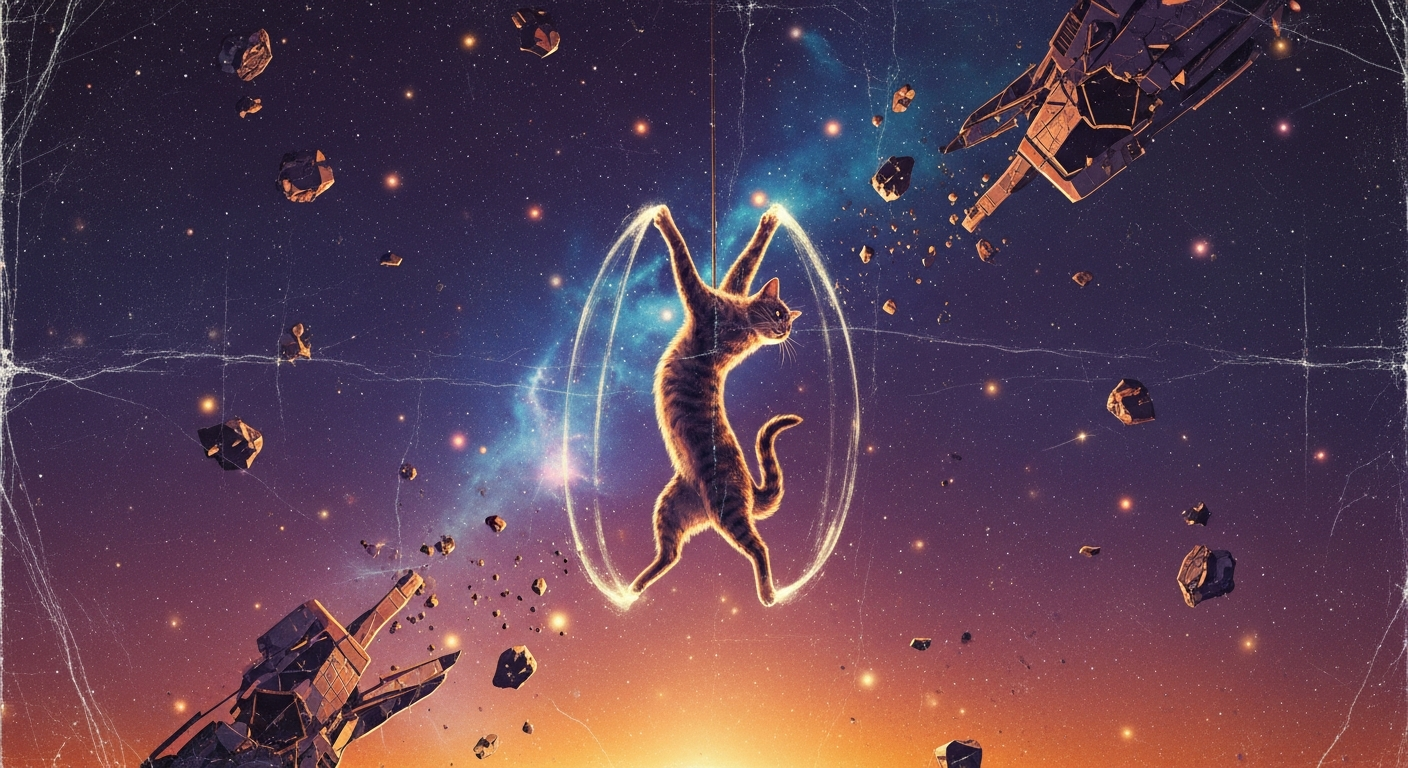
Do Cats Land on Their Feet in Space? The Ninja Acrobatics and Secret Biology of Zero-Gravity Pets
Introduction: The Mystery of the Falling Feline
Have you ever watched a cat leap off a high wall or slip from a tree branch? No matter how clumsy the fall begins, they almost always land perfectly on their paws. This amazing superpower makes them look like furry little ninjas! For centuries, scientists and pet lovers alike have marveled at this ability, known as the cat righting reflex.
But this Earth-bound superpower brings up a fascinating, out-of-this-world question: do cats land on their feet in space? What happens to our feline friends when you take away gravity and put them in a zero-gravity environment?
To solve the mystery of space pets and microgravity acrobatics, we have to put on our science hats, zoom deep into feline biology, and learn a little bit of rocket physics. Get ready for a journey into the secret, gravity-defying life of cats!
Detailed Scientific Explanation: The Biology of the Earth-Bound Ninja
The Built-In GPS: How Cats Know Which Way is “Down”
Before we launch our imaginary cat into space, we need to understand how they perform their magic tricks here on Earth. The secret lies hidden deep inside their heads.
Inside a cat’s inner ear is an amazing piece of biology called the vestibular system. You have one too! It acts like a biological compass or a built-in GPS. Inside this system are tiny fluid-filled tubes and microscopic crystals called otoliths (which is just a fancy science word for “ear stones”). Gravity pulls down on these tiny stones, touching sensitive hairs that send a lightning-fast message to the cat’s brain: “Hey! Down is this way!”
The “Bend and Twist” Magic: A Flexible Feline Spine
Once the brain knows which way the ground is, the cat’s body goes to work in a split second. Cats have a unique skeleton that allows them to twist like a rubber band:
- No Rigid Collarbone: Unlike humans, cats don’t have hard collarbones connecting their shoulders. This allows their front legs to move freely.
- Super Spine: Cats have 30 vertebrae (spine bones), which is more than humans have. This makes their back incredibly flexible.
When falling, a cat uses a physics trick called the conservation of angular momentum. Imagine an ice skater spinning on the ice. When they pull their arms in, they spin faster. When they stretch their arms out, they slow down. A falling cat pulls its front legs in and twists the front half of its body, while stretching its back legs out. Then, it does the exact reverse to bring its back legs around. Snap! In less than a second, the cat is facing the ground, ready to land safely.
What Happens When Cats Go to Zero-Gravity?
Losing the Gravity Compass
Now, let’s blast off into space! When astronauts orbit the Earth in the International Space Station, they experience microgravity (often called zero-gravity). In this environment, everything floats because there is no strong pull of gravity pulling things to a floor.
So, what happens to the cat’s built-in inner-ear GPS? Without gravity pulling on those tiny ear stones, the stones just float around inside the fluid. The cat’s brain stops receiving the “down is this way” signal. Suddenly, the cat’s biological compass is completely broken. To a space cat, there is no up, no down, no left, and no right!
The Real-Life Space Cat Experiments
You might be surprised to learn that scientists actually tested this! In 1947, the United States Air Force took two cats on a special airplane ride known as the “Vomit Comet.” This airplane flies in huge roller-coaster-like loops (parabolas) to create temporary zero-gravity.
When weightlessness hit, the cats’ righting reflexes kicked in on instinct. Their brains panicked, and they frantically twisted their flexible spines, kicking their legs to try and flip their feet toward the “floor.” But because they were floating, there was no floor to fall toward! The cats turned into adorable, spinning furballs, performing wild ninja acrobatics in mid-air. Instead of landing gracefully, they just bumped softly into the walls or floated upside down.
The Scientific Verdict: Because there is no “down” in space, cats cannot technically land on their feet. Their Earth-bound superpower is useless without gravity to push against!
Conclusion: Earth is the Purr-fect Home for Cats
So, do cats land on their feet in space? The answer is a resounding no. While cats are absolute masters of physics and biology on Earth, their incredible ninja skills require the invisible pull of gravity to work.
Without gravity pulling on the tiny stones in their inner ear, a cat simply doesn’t know where the ground is. And while it is incredibly fun to imagine floating space pets doing slow-motion flips in a spaceship, the truth is that cats are much happier here on solid ground.
Next time you see your cat jump off a couch and stick a perfect landing, you can appreciate the hidden science at work. From their flexible spines to their built-in ear stones, cats are perfectly designed for life on our beautiful, gravity-filled planet Earth!


Reader Comments