Space Spaghetti: What Actually Happens When You Fall Into a Black Hole?
Introduction: The Ultimate Cosmic Rollercoaster
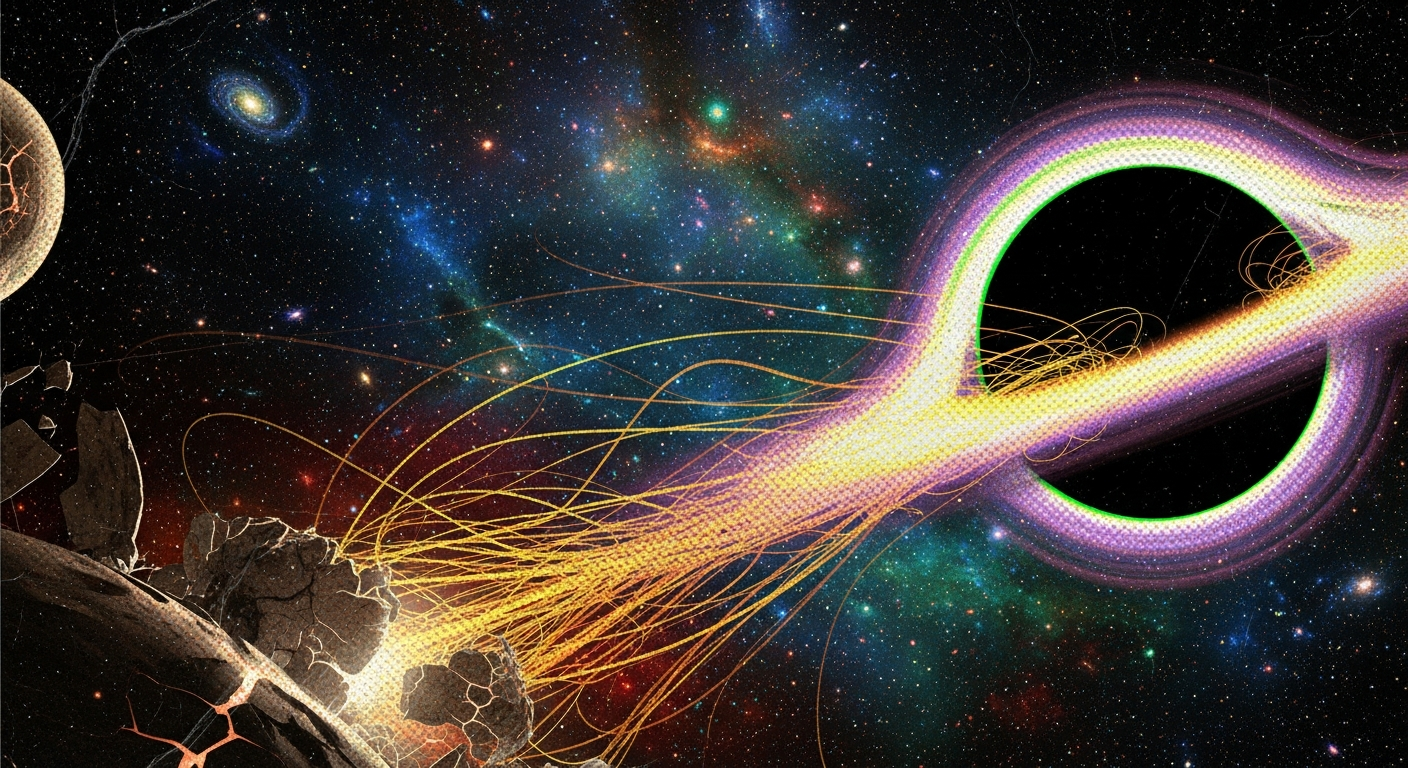
Imagine you are a brave astronaut floating in the darkest, most mysterious depths of the universe. You are looking out the window of your spaceship, and suddenly, you see it: a perfect, pitch-black circle in the sky, surrounded by a glowing ring of swirling starlight. You have just found a black hole.
Black holes are the universe’s ultimate vacuum cleaners, but they are not actually empty holes. They are huge amounts of matter packed into a space so tiny that their gravity becomes unbelievably strong. The gravitational pull is so powerful that nothing in the universe—not even a beam of light—can escape it. But a fascinating question has puzzled scientists and stargazers for decades: What actually happens when you fall into a black hole?
Get ready for a wild ride, because the answer involves frozen time, bending light, and a mind-boggling scientific process known as Spaghettification (yes, that is the real scientific word!). Let us dive into the ultimate cosmic rollercoaster.
Detailed Scientific Explanation: Journey to the Center of the Dark
1. The Anatomy of a Cosmic Monster
Before we take the plunge, we need to understand what we are falling into. Black holes are created when massive stars run out of fuel and collapse under their own weight. This collapse creates an object with a gravitational pull so intense it bends the very fabric of space and time.
Think of space like a giant trampoline. If you place a bowling ball in the middle, the trampoline sags, and any marbles nearby will roll toward it. A black hole is like an infinitely heavy bowling ball that creates a bottomless pit in the trampoline of space.
2. The Event Horizon: The Point of No Return
As you drift closer to the black hole, you will cross an invisible boundary called the Event Horizon. This is the ultimate “point of no return.” Think of it like a waterfall. If you are swimming in a river above a waterfall, you can still swim back upstream to safety. But once you slip over the edge, the current is too strong, and there is no going back.
If your friends are watching you from a safe spaceship far away, they will witness something truly bizarre. Because immense gravity bends time, to them, your fall will seem to slow down. As you get closer to the Event Horizon, you will look like a frozen picture, slowly turning red and fading into the darkness. But for you, time feels completely normal as you plunge deeper into the abyss.
3. The Noodle Effect: What is Spaghettification?
Now comes the wildest part of the journey. As you fall feet-first toward the center of the black hole, gravity plays a terrifying magic trick on your body.
Because the black hole’s gravity is so incredibly strong, the pull on your feet (which are closer to the black hole) is much, much stronger than the pull on your head (which is farther away). This difference in gravitational pull is called a tidal force.
In a normal environment, like on Earth, tidal forces are barely noticeable. But inside a black hole, this force is extreme. The gravity will pull your feet down faster than your head, stretching your body out like a rubber band. At the same time, the gravity pulls your sides inward. You are stretched longer and squeezed thinner, turning into a long, thin string of atomic pasta. Scientists call this incredible stretching process Spaghettification!
Eventually, the tidal forces become so overwhelming that your body is stretched down to individual molecules, and then atoms, creating a stream of “space spaghetti” spiraling into the dark.
4. The Singularity: The Mysterious Center
What happens to the atomic space spaghetti? It travels all the way down to the very center of the black hole, known as the Singularity.
The Singularity is a tiny, infinitely small dot where all the matter that ever fell into the black hole is crushed together. It is infinitely dense, and it is a place where all the laws of physics and math that we know simply break down. Does the matter stay there forever? Does it pop out into another universe through a “white hole”? Right now, the Singularity remains one of the greatest unsolved mysteries in science.
Conclusion: The Wonders of Extreme Physics
Falling into a black hole is a one-way trip that results in the most spectacular and strange physical transformation imaginable: Spaghettification. While turning into a string of cosmic space spaghetti might not sound like a fun weekend activity, understanding how black holes work helps scientists unlock the deepest secrets of gravity, space, and time.
Black holes remind us that the universe is far weirder and more wonderful than anything we can imagine. Even though we cannot safely travel into a black hole to see the Singularity for ourselves, brilliant astronomers and astrophysicists are using powerful telescopes and complex mathematics to study these dark giants from afar. So, the next time you look up at the starry night sky, remember the incredible cosmic monsters hiding in the dark, quietly stretching the limits of science—and maybe a few unlucky stars—into spaghetti.


Reader Comments