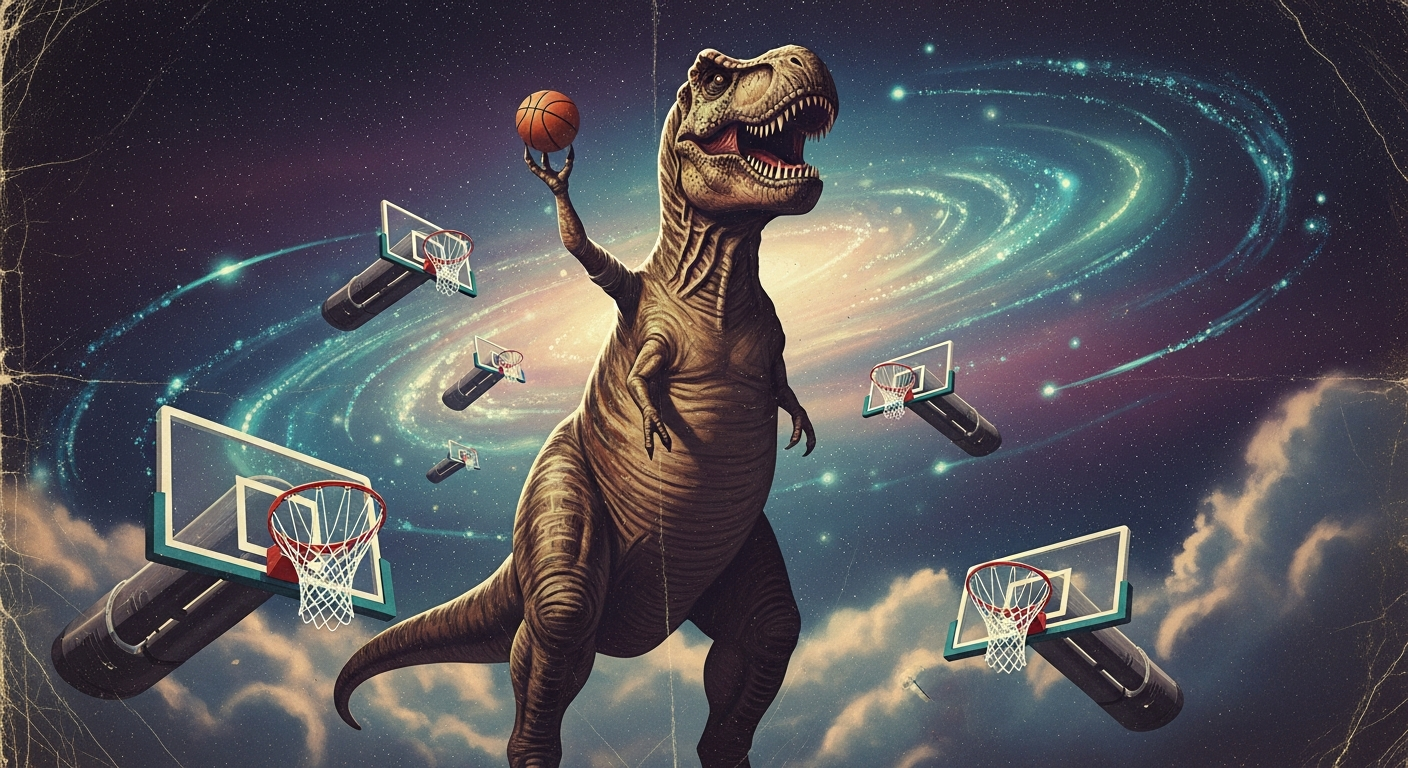
Could a T-Rex Play Basketball? The Secret Anatomy of Dinosaur Athletes

Could a T-Rex Play Basketball? The Secret Anatomy of Dinosaur Athletes Introduction: The Ultimate Prehistoric Matchup Imagine the stadium lights shining down on the hardwood court. The buzzer sounds, the crowd roars, and stepping up to the free-throw line is a seven-ton Tyrannosaurus rex. Could the most famous predator of the Cretaceous period actually play basketball? While it sounds like a scene from a funny cartoon, asking if a T-Rex could play sports is actually one of the best ways to explore dinosaur biomechanics—the science of how prehistoric bodies moved and worked. As a science writer, I am going to take you on a journey inside the secret anatomy of dinosaur athletes. By looking at their bones, muscles, and senses, we can figure out exactly how a T-Rex would perform on the basketball court. Spoiler alert: they might not make the best point guards, but the scientific reasons why are absolutely fascinating! The Detailed Science: Breaking Down T-Rex Anatomy The Tiny Arms: A Dribbling Disaster Let’s start with the most obvious problem: the famous tiny arms of the T-Rex. An adult T-Rex grew up to 40 feet (12 meters) long, but its arms were only about 3 feet (1 meter) long—roughly the same size as a human adult's arms! Because their arms could not even reach past their enormous jaws, dribbling a basketball would be completely impossible. However, scientifically speaking, these arms were not useless. Fossil records show thick muscle attachments on their arm bones, meaning they could curl hundreds of pounds. They were incredibly strong, but just not built for a crossover dribble. Powerful Legs: Could a Dinosaur Slam Dunk? If they can't shoot, could they jump and slam dunk? A T-Rex belongs to a group of dinosaurs called theropods, which walked on two legs. Their bodies were built like giant seesaws: a massive, heavy head in the front balanced by a long, thick, muscular tail in the back, all pivoting on two powerful hind legs. While these legs made them excellent walkers and runners, jumping was out of the question. An adult T-Rex weighed around 8 tons (about the same as a massive school bus). If an animal that heavy tried to jump, the sheer gravity and impact of landing would instantly shatter its leg bones! So, our dinosaur athlete is permanently grounded. There would be no slam dunks or jumping for rebounds. Eagle-Eyed Aim: The Power of Binocular Vision You might have heard the movie myth that a T-Rex can only see you if you stand perfectly still. Science tells a very different story! A T-Rex had eyes that faced forward, much like a human or an owl. This gave them incredible binocular vision, which allows for perfect depth perception. If a T-Rex could hold a basketball, its brain and eyes were perfectly evolved to calculate the exact distance to the hoop. They had some of the best eyesight in the history of the animal kingdom—perfect for tracking fast-moving prey, or perhaps a fast-moving basketball. Dinosaur Stamina: Breathing Like a Bird Basketball requires a lot of running back and forth, which means a player needs great lungs. Here, the T-Rex has a huge advantage. Dinosaurs are the ancestors of modern birds, and they shared a similar avian respiratory system. Instead of just breathing in and out like humans and other mammals do, a T-Rex had special "air sacs" hidden inside its skeleton. These sacs allowed fresh oxygen to flow through their lungs constantly, both when they breathed in and when they breathed out! This highly efficient system means our dinosaur athlete would have incredible stamina and would almost never get winded, even in the fourth quarter. Conclusion: The MVP of the Cretaceous Court So, could a T-Rex play basketball? The scientific evidence points to a resounding "no." Their incredibly heavy, school-bus-sized bodies made jumping dangerous, and their famous tiny arms meant they could never dribble, pass, or shoot the ball. They would be terrible on offense! However, by asking this fun question, we uncover the incredible truth about dinosaur anatomy. The T-Rex wasn't built for human sports; it was a perfectly engineered athlete for its own environment. With its powerful seesaw-like balance, unbreakable stamina powered by bird-like lungs, and razor-sharp binocular vision, the T-Rex was the undisputed MVP (Most Valuable Predator) of its time. They may be benchwarmers on a basketball court, but in the wild game of prehistoric survival, the T-Rex was definitely a champion. biological

Could a T-Rex Play Basketball? The Secret Anatomy of Dinosaur Athletes

Introduction: The Ultimate Prehistoric Matchup

Imagine the stadium lights shining down on the hardwood court. The buzzer sounds, the crowd roars, and stepping up to the free-throw line is a seven-ton Tyrannosaurus rex. Could the most famous predator of the Cretaceous period actually play basketball? While it sounds like a scene from a funny cartoon, asking if a T-Rex could play sports is actually one of the best ways to explore dinosaur biomechanics—the science of how prehistoric bodies moved and worked.

As a science writer, I am going to take you on a journey inside the secret anatomy of dinosaur athletes. By looking at their bones, muscles, and senses, we can figure out exactly how a T-Rex would perform on the basketball court. Spoiler alert: they might not make the best point guards, but the scientific reasons why are absolutely fascinating!

The Detailed Science: Breaking Down T-Rex Anatomy

The Tiny Arms: A Dribbling Disaster

Let’s start with the most obvious problem: the famous tiny arms of the T-Rex. An adult T-Rex grew up to 40 feet (12 meters) long, but its arms were only about 3 feet (1 meter) long—roughly the same size as a human adult’s arms! Because their arms could not even reach past their enormous jaws, dribbling a basketball would be completely impossible. However, scientifically speaking, these arms were not useless. Fossil records show thick muscle attachments on their arm bones, meaning they could curl hundreds of pounds. They were incredibly strong, but just not built for a crossover dribble.

Powerful Legs: Could a Dinosaur Slam Dunk?

If they can’t shoot, could they jump and slam dunk? A T-Rex belongs to a group of dinosaurs called theropods, which walked on two legs. Their bodies were built like giant seesaws: a massive, heavy head in the front balanced by a long, thick, muscular tail in the back, all pivoting on two powerful hind legs.

While these legs made them excellent walkers and runners, jumping was out of the question. An adult T-Rex weighed around 8 tons (about the same as a massive school bus). If an animal that heavy tried to jump, the sheer gravity and impact of landing would instantly shatter its leg bones! So, our dinosaur athlete is permanently grounded. There would be no slam dunks or jumping for rebounds.

Eagle-Eyed Aim: The Power of Binocular Vision

You might have heard the movie myth that a T-Rex can only see you if you stand perfectly still. Science tells a very different story! A T-Rex had eyes that faced forward, much like a human or an owl. This gave them incredible binocular vision, which allows for perfect depth perception. If a T-Rex could hold a basketball, its brain and eyes were perfectly evolved to calculate the exact distance to the hoop. They had some of the best eyesight in the history of the animal kingdom—perfect for tracking fast-moving prey, or perhaps a fast-moving basketball.

Dinosaur Stamina: Breathing Like a Bird

Basketball requires a lot of running back and forth, which means a player needs great lungs. Here, the T-Rex has a huge advantage. Dinosaurs are the ancestors of modern birds, and they shared a similar avian respiratory system. Instead of just breathing in and out like humans and other mammals do, a T-Rex had special “air sacs” hidden inside its skeleton. These sacs allowed fresh oxygen to flow through their lungs constantly, both when they breathed in and when they breathed out! This highly efficient system means our dinosaur athlete would have incredible stamina and would almost never get winded, even in the fourth quarter.

Conclusion: The MVP of the Cretaceous Court

So, could a T-Rex play basketball? The scientific evidence points to a resounding “no.” Their incredibly heavy, school-bus-sized bodies made jumping dangerous, and their famous tiny arms meant they could never dribble, pass, or shoot the ball. They would be terrible on offense!

However, by asking this fun question, we uncover the incredible truth about dinosaur anatomy. The T-Rex wasn’t built for human sports; it was a perfectly engineered athlete for its own environment. With its powerful seesaw-like balance, unbreakable stamina powered by bird-like lungs, and razor-sharp binocular vision, the T-Rex was the undisputed MVP (Most Valuable Predator) of its time. They may be benchwarmers on a basketball court, but in the wild game of prehistoric survival, the T-Rex was definitely a champion.


Reader Comments

  1. Harmony3205 より:
  2. Kristen4166 より:
タイトルとURLをコピーしました