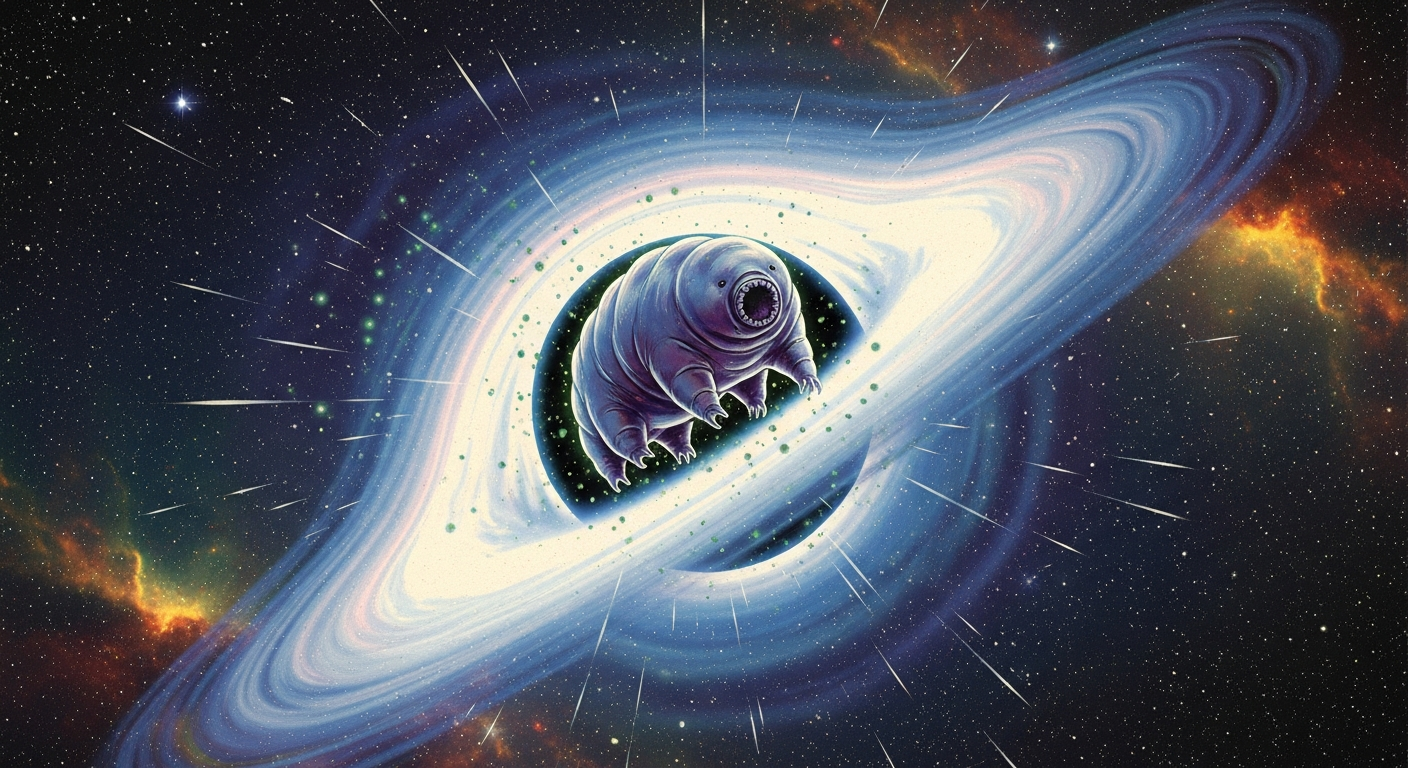
Could a Water Bear Survive Inside a Black Hole? The Ultimate Space Biology Mystery
Introduction: The Ultimate Cosmic Showdown
Welcome to the ultimate space biology mystery! Have you ever wondered what would happen if the toughest little creature on Earth picked a fight with the most dangerous, mysterious object in the entire universe? In the world of science, asking “what if?” is the best way to learn. Today, we are going to explore an epic imaginary battle: A Water Bear vs. A Black Hole.
On one side, we have the water bear, also known as a tardigrade. It is a microscopic animal famous for surviving almost anything, from extreme heat to the freezing vacuum of outer space. On the other side, we have a black hole, a cosmic beast with gravity so strong that not even light can escape its pull. Could Earth’s tiniest superhero survive a trip into the darkest place in space? Let us dive into the science to find out!
Detailed Scientific Explanation: The Water Bear vs. The Black Hole
Meet the Unbreakable Water Bear (Tardigrade)
Before we throw our tiny friend into a black hole, we need to know what makes it so special. A water bear is a microscopic animal with eight legs that looks like a squishy, clumsy bear. Even though they are tiny—usually less than a millimeter long—they have a superpower called cryptobiosis.
When the environment gets too harsh, the water bear curls up into a tiny, dried-out ball called a “tun.” In this state, it slows down its body’s engine (metabolism) to almost zero. Because of this superpower, scientists have found that water bears can survive being boiled, being frozen in ice, extreme radiation, and even the complete emptiness of outer space! But can this super-shield protect it from a black hole?
The Cosmic Vacuum Cleaner: What is a Black Hole?
Now, let’s talk about the black hole. Imagine a star that is many times bigger than our Sun running out of fuel and collapsing inward. All of its weight gets crushed into a tiny point. This creates a gravitational pull so powerful that it acts like a cosmic vacuum cleaner. Nothing, not even a ray of light, can travel fast enough to escape it.
A black hole has two main parts we need to worry about: the Event Horizon (the invisible “doorway” or point of no return) and the Singularity (the crushed center where gravity is infinite).
Crossing the Event Horizon: The Point of No Return
Imagine our water bear, floating in space in its indestructible “tun” state, drifting closer to the black hole. The first thing it meets is the Event Horizon. What happens here depends on the size of the black hole.
If it is a Supermassive Black Hole (the giant kind found at the center of galaxies), the water bear might actually float right through the Event Horizon without feeling a thing! To a water bear, crossing this line would just feel like floating in regular space. But make no mistake—once it crosses that invisible line, it is trapped forever. It can never go back home.
Spaghettification: The Noodle Effect
If our water bear falls into a smaller, normal-sized black hole (a Stellar Black Hole), things get very bad, very quickly. Because the black hole is smaller, the gravity changes incredibly fast the closer you get.
Imagine the water bear is falling feet first. The gravity pulling on its tiny, microscopic feet would be millions of times stronger than the gravity pulling on its head! This intense difference in gravity is called a tidal force. This force stretches the water bear out longer and longer, thinner and thinner, until it looks like a piece of spaghetti. Scientists actually call this Spaghettification! Even though the water bear’s cryptobiosis shield is amazing, it cannot stop gravity from pulling its tiny body—and even its DNA—apart like a rubber band snapping.
The Singularity: The Final Crush
Let’s pretend the water bear magically survived the Event Horizon and the stretching of Spaghettification. What happens at the very end of the journey? It reaches the Singularity.
At the center of the black hole, all matter is crushed into a space infinitely small. At this point, the rules of biology and chemistry completely break down. The water bear relies on its cells, proteins, and atoms holding together to survive. But the gravity at the Singularity is so unbelievably strong that it crushes atoms themselves. The water bear wouldn’t just die; it would stop being an animal at all, becoming just a tiny speck of crushed energy and mass added to the black hole.
Conclusion: Even Superheroes Have Limits
So, could a water bear survive inside a black hole? The answer to this ultimate space biology mystery is no.
While tardigrades are the undisputed champions of survival on Earth, perfectly adapted to wait out freezing ice ages, boiling hot springs, and even trips to the moon, a black hole is not an environment—it is the ultimate destroyer of matter. The immense gravity, the stretching forces of spaghettification, and the crushing power of the singularity would break apart the water bear on a level that no biological superpower could ever fix.
However, running this fun thought experiment teaches us something amazing. It shows us just how incredibly tough life on Earth can be, while also reminding us of the awesome, unstoppable power of the universe’s greatest mysteries. The water bear might not beat the black hole, but it will always be our favorite microscopic superhero!


Reader Comments