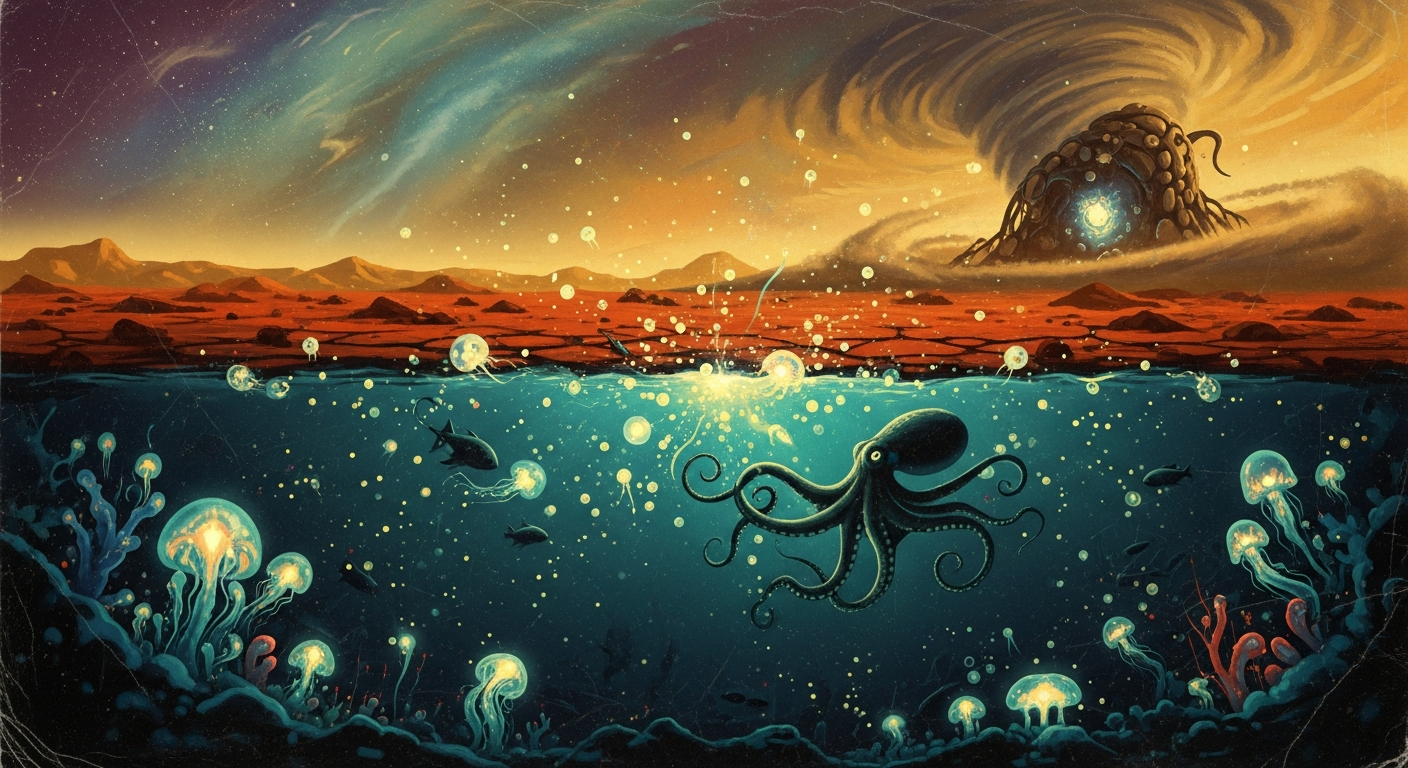
Could an Octopus Live on Mars? The Secret Link Between Deep-Sea Biology and Alien Worlds

Could an Octopus Live on Mars? The Secret Link Between Deep-Sea Biology and Alien Worlds Introduction: The Ultimate "Alien" Right Here on Earth Imagine a creature with three hearts, blue blood, a brain that wraps around its throat, and eight arms that can think for themselves. If you saw this monster in a sci-fi movie about alien worlds, you wouldn't be surprised. But this creature isn't from outer space—it's an octopus, and it lives right here in Earth's oceans! For decades, scientists have asked a fascinating question: Could an octopus live on Mars? While throwing a normal octopus onto the dusty red surface of Mars today wouldn't work out very well, the question hides a thrilling scientific truth. To understand how life might survive on other planets, astrobiologists (scientists who study alien life) are looking deep underwater. The freezing, pitch-black, and extreme world of deep-sea biology is actually our best map for finding life on alien worlds. The Detailed Science: How the Deep Sea Mimics Outer Space What Do Mars and the Bottom of the Ocean Have in Common? At first glance, Mars and Earth's deep ocean seem completely different. Mars is a dry, freezing desert, while the deep ocean is, well, wet! But to a tiny living cell, both environments share the same extreme challenges: they are freezing cold, they have very little oxygen, and they receive absolutely zero sunlight. For a long time, scientists thought all life needed the Sun to survive. Plants use sunlight to make food (photosynthesis), and animals eat the plants. But in the deep ocean, scientists discovered a "secret link"—a completely different way to live. No Sun? No Problem: The Magic of Hydrothermal Vents Deep at the bottom of the ocean, there are underwater volcanoes called hydrothermal vents. These vents shoot out boiling hot, toxic chemicals from inside the Earth. Instead of using sunlight, special bacteria eat these harsh chemicals to make energy. This process is called chemosynthesis. Why is this a big deal for space exploration? Because Mars, as well as ice moons like Jupiter's Europa and Saturn's Enceladus, might have similar chemical vents hidden under their icy or rocky surfaces! If deep-sea creatures can survive without the Sun by using chemicals on Earth, alien life could do the exact same thing on another planet. The Octopus Superpower: Blue Blood and Brainy Arms So, where does the octopus fit into this space mission? Octopuses are what we call extremophiles (lovers of extreme conditions). They have evolved incredible biological tools to survive in places that would instantly freeze or crush a human. Blue Blood (Hemocyanin): Human blood is red because it contains iron. Octopus blood is blue because it is based on copper, a protein called hemocyanin. In freezing cold temperatures with almost no oxygen—like the deep sea or a Martian underground lake—copper-based blood is much better at carrying oxygen to the body than iron-based blood. It's like built-in antifreeze! Alien Intelligence: Mars is a harsh, constantly changing environment. To survive, an alien would need to be very smart and adaptable. An octopus has a central brain, but each of its eight arms also contains mini-brains. If an arm gets cut off, it can still search for food on its own. This decentralized nervous system is exactly the kind of weird, flexible biology scientists expect to find in alien life forms. The Reality Check: Could an Earth Octopus Survive Mars Today? If we put an Earth octopus on the surface of Mars right now, it would not survive. Mars currently has almost no atmosphere, dangerous space radiation, and no liquid water on its surface. However, billions of years ago, Mars was covered in deep oceans, much like Earth. If life ever existed on Mars, it might have retreated deep underground into dark, salty, icy lakes to survive the radiation—an environment very similar to Earth's deep sea. So, while our friendly Earth octopus can't pack a bag and move to Mars tomorrow, an ancient Martian creature might have looked and functioned a lot like an octopus, using copper-based blood and chemical energy to survive the extreme cold. Conclusion: Looking Down to Look Up The secret link between deep-sea biology and alien worlds teaches us one very important lesson: life is incredibly stubborn. Whether it is hiding in the crushing darkness of the ocean floor or buried under the rusty dust of Mars, life finds a way to adapt to the most extreme conditions imaginable. While a literal octopus might never build a home on Mars, studying these brilliant, blue-blooded, eight-armed wonders helps scientists design better space missions. By exploring the deepest, darkest parts of our own world, we are training to recognize the weird and wonderful alien life that might be waiting for us out in the stars. Next time you look at an octopus, remember—you might just be looking at the closest thing to a real-life alien! biological

Could an Octopus Live on Mars? The Secret Link Between Deep-Sea Biology and Alien Worlds

Introduction: The Ultimate “Alien” Right Here on Earth

Imagine a creature with three hearts, blue blood, a brain that wraps around its throat, and eight arms that can think for themselves. If you saw this monster in a sci-fi movie about alien worlds, you wouldn’t be surprised. But this creature isn’t from outer space—it’s an octopus, and it lives right here in Earth’s oceans!

For decades, scientists have asked a fascinating question: Could an octopus live on Mars? While throwing a normal octopus onto the dusty red surface of Mars today wouldn’t work out very well, the question hides a thrilling scientific truth. To understand how life might survive on other planets, astrobiologists (scientists who study alien life) are looking deep underwater. The freezing, pitch-black, and extreme world of deep-sea biology is actually our best map for finding life on alien worlds.

The Detailed Science: How the Deep Sea Mimics Outer Space

What Do Mars and the Bottom of the Ocean Have in Common?

At first glance, Mars and Earth’s deep ocean seem completely different. Mars is a dry, freezing desert, while the deep ocean is, well, wet! But to a tiny living cell, both environments share the same extreme challenges: they are freezing cold, they have very little oxygen, and they receive absolutely zero sunlight.

For a long time, scientists thought all life needed the Sun to survive. Plants use sunlight to make food (photosynthesis), and animals eat the plants. But in the deep ocean, scientists discovered a “secret link”—a completely different way to live.

No Sun? No Problem: The Magic of Hydrothermal Vents

Deep at the bottom of the ocean, there are underwater volcanoes called hydrothermal vents. These vents shoot out boiling hot, toxic chemicals from inside the Earth. Instead of using sunlight, special bacteria eat these harsh chemicals to make energy. This process is called chemosynthesis.

Why is this a big deal for space exploration? Because Mars, as well as ice moons like Jupiter’s Europa and Saturn’s Enceladus, might have similar chemical vents hidden under their icy or rocky surfaces! If deep-sea creatures can survive without the Sun by using chemicals on Earth, alien life could do the exact same thing on another planet.

The Octopus Superpower: Blue Blood and Brainy Arms

So, where does the octopus fit into this space mission? Octopuses are what we call extremophiles (lovers of extreme conditions). They have evolved incredible biological tools to survive in places that would instantly freeze or crush a human.

  • Blue Blood (Hemocyanin): Human blood is red because it contains iron. Octopus blood is blue because it is based on copper, a protein called hemocyanin. In freezing cold temperatures with almost no oxygen—like the deep sea or a Martian underground lake—copper-based blood is much better at carrying oxygen to the body than iron-based blood. It’s like built-in antifreeze!
  • Alien Intelligence: Mars is a harsh, constantly changing environment. To survive, an alien would need to be very smart and adaptable. An octopus has a central brain, but each of its eight arms also contains mini-brains. If an arm gets cut off, it can still search for food on its own. This decentralized nervous system is exactly the kind of weird, flexible biology scientists expect to find in alien life forms.

The Reality Check: Could an Earth Octopus Survive Mars Today?

If we put an Earth octopus on the surface of Mars right now, it would not survive. Mars currently has almost no atmosphere, dangerous space radiation, and no liquid water on its surface. However, billions of years ago, Mars was covered in deep oceans, much like Earth.

If life ever existed on Mars, it might have retreated deep underground into dark, salty, icy lakes to survive the radiation—an environment very similar to Earth’s deep sea. So, while our friendly Earth octopus can’t pack a bag and move to Mars tomorrow, an ancient Martian creature might have looked and functioned a lot like an octopus, using copper-based blood and chemical energy to survive the extreme cold.

Conclusion: Looking Down to Look Up

The secret link between deep-sea biology and alien worlds teaches us one very important lesson: life is incredibly stubborn. Whether it is hiding in the crushing darkness of the ocean floor or buried under the rusty dust of Mars, life finds a way to adapt to the most extreme conditions imaginable.

While a literal octopus might never build a home on Mars, studying these brilliant, blue-blooded, eight-armed wonders helps scientists design better space missions. By exploring the deepest, darkest parts of our own world, we are training to recognize the weird and wonderful alien life that might be waiting for us out in the stars. Next time you look at an octopus, remember—you might just be looking at the closest thing to a real-life alien!


Reader Comments

Copied title and URL