How Do Spiders Build Webs in Zero Gravity? The Secret Physics of Astronaut Bugs

How Do Spiders Build Webs in Zero Gravity? The Secret Physics of Astronaut Bugs Introduction: Meet the "Arachnauts" Imagine trying to build a complicated house out of sticky string, all while floating inside a giant, invisible swimming pool where there is no "up" and no "down." That is exactly the challenge faced by some very special eight-legged astronauts! For decades, scientists have been sending spiders into space—dating all the way back to the Skylab missions in the 1970s and continuing on the International Space Station (ISS). These space-traveling spiders, affectionately called "arachnauts," weren't sent to space just for fun. Scientists wanted to answer a fascinating question about spiders in zero gravity: How do they know how to build their webs when there is no gravity to guide them? The answers discovered by researchers revealed a secret superpower hidden inside the tiny brains of these astronaut bugs. Let's dive into the amazing physics and biology of how spiders build webs in space! The Science of Space Webs: A Detailed Explanation The Earth Rule: Down is Where Gravity Pulls To understand what happens in space, we first have to look at how spiders behave on Earth. A team of scientists, including Dr. Samuel Zschokke from the University of Basel, studied a specific type of spider called the Golden silk orb-weaver (Trichonephila clavipes). On Earth, these spiders build webs that are asymmetrical. That is a big science word that just means "lopsided". Instead of the center of the web (the hub) being perfectly in the middle, it is built closer to the top edge. When the spider waits for a tasty bug to fly into the trap, it sits in the middle of the web facing downwards. Why? Because of gravity! If a fly gets caught in the bottom of the web, the spider can simply let go and quickly fall toward its dinner. Gravity acts like a compass, telling the spider exactly which way is up and which way is down. The Zero-Gravity Puzzle on the ISS In the microgravity of the International Space Station, things get weird. Microgravity means there is so little gravity that everything floats in a state of free-fall. Without gravity pulling on their bodies, how would the spiders know where to put the center of their web? And which way would they face while waiting for food? Scientists hypothesized that without gravity, the spiders would get confused. They guessed the spiders would build perfectly round, symmetrical webs and sit facing totally random directions. When the ISS spider experiments began, cameras took pictures of the spiders every five minutes. At first, the scientists were right! In the dark, the space spiders built perfectly circular webs and rested facing any random way. But then, the scientists noticed something completely unexpected. The Secret Back-Up System: Follow the Light! The habitats holding the spiders had special lamps attached to the top. When the lights were turned ON, the spiders suddenly changed their behavior. Instead of building round webs, they started building lopsided webs again—just like they do on Earth! They placed the center of the web near the lamps, and when they rested, they pointed their heads away from the light. The spiders were using the light to replace gravity! Because sunlight comes from the sky on Earth, the spider's brain has a secret "back-up system." When gravity disappears, their instincts tell them, "Okay, I can't feel gravity pulling me, so I will just assume the bright light is 'UP' and the dark area is 'DOWN.'" This blew the scientists' minds. Spiders have evolved on Earth for hundreds of millions of years. They have never naturally experienced zero gravity. Yet, built into their biology is a brilliant backup plan that allows them to use light as a substitute for gravity. Conclusion: The Brilliant Adaptability of Nature The mystery of how spiders build webs in space teaches us a powerful lesson about the resilience of nature. Even when taken out of their natural environment and launched in a rocket millions of miles away from everything they know, these tiny astronaut bugs found a way to adapt and survive. By studying how animals react to microgravity, scientists learn more about the deep connections between Earth's environment, biology, and physics. So, the next time you see a spider spinning a web in your garden, take a moment to appreciate it. You aren't just looking at a garden bug; you are looking at a brilliant engineer with built-in backup sensors, fully capable of mastering the strange and floaty world of outer space! biological

How Do Spiders Build Webs in Zero Gravity? The Secret Physics of Astronaut Bugs

Introduction: Meet the “Arachnauts”

Imagine trying to build a complicated house out of sticky string, all while floating inside a giant, invisible swimming pool where there is no “up” and no “down.” That is exactly the challenge faced by some very special eight-legged astronauts! For decades, scientists have been sending spiders into space—dating all the way back to the Skylab missions in the 1970s and continuing on the International Space Station (ISS).

These space-traveling spiders, affectionately called “arachnauts,” weren’t sent to space just for fun. Scientists wanted to answer a fascinating question about spiders in zero gravity: How do they know how to build their webs when there is no gravity to guide them? The answers discovered by researchers revealed a secret superpower hidden inside the tiny brains of these astronaut bugs. Let’s dive into the amazing physics and biology of how spiders build webs in space!

The Science of Space Webs: A Detailed Explanation

The Earth Rule: Down is Where Gravity Pulls

To understand what happens in space, we first have to look at how spiders behave on Earth. A team of scientists, including Dr. Samuel Zschokke from the University of Basel, studied a specific type of spider called the Golden silk orb-weaver (Trichonephila clavipes).

On Earth, these spiders build webs that are asymmetrical. That is a big science word that just means “lopsided”. Instead of the center of the web (the hub) being perfectly in the middle, it is built closer to the top edge. When the spider waits for a tasty bug to fly into the trap, it sits in the middle of the web facing downwards.

Why? Because of gravity! If a fly gets caught in the bottom of the web, the spider can simply let go and quickly fall toward its dinner. Gravity acts like a compass, telling the spider exactly which way is up and which way is down.

The Zero-Gravity Puzzle on the ISS

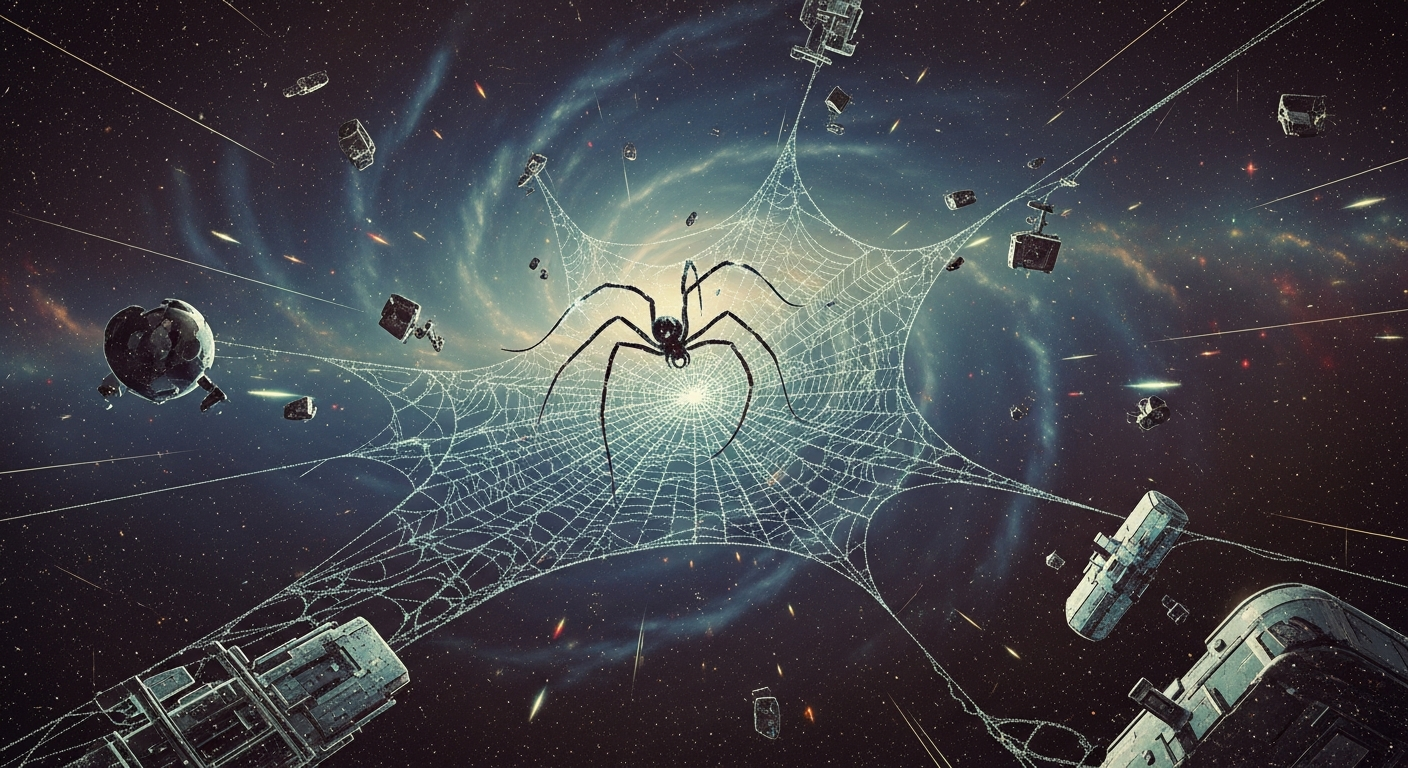
In the microgravity of the International Space Station, things get weird. Microgravity means there is so little gravity that everything floats in a state of free-fall. Without gravity pulling on their bodies, how would the spiders know where to put the center of their web? And which way would they face while waiting for food?

Scientists hypothesized that without gravity, the spiders would get confused. They guessed the spiders would build perfectly round, symmetrical webs and sit facing totally random directions. When the ISS spider experiments began, cameras took pictures of the spiders every five minutes. At first, the scientists were right! In the dark, the space spiders built perfectly circular webs and rested facing any random way. But then, the scientists noticed something completely unexpected.

The Secret Back-Up System: Follow the Light!

The habitats holding the spiders had special lamps attached to the top. When the lights were turned ON, the spiders suddenly changed their behavior. Instead of building round webs, they started building lopsided webs again—just like they do on Earth! They placed the center of the web near the lamps, and when they rested, they pointed their heads away from the light.

The spiders were using the light to replace gravity! Because sunlight comes from the sky on Earth, the spider’s brain has a secret “back-up system.” When gravity disappears, their instincts tell them, “Okay, I can’t feel gravity pulling me, so I will just assume the bright light is ‘UP’ and the dark area is ‘DOWN.'”

This blew the scientists’ minds. Spiders have evolved on Earth for hundreds of millions of years. They have never naturally experienced zero gravity. Yet, built into their biology is a brilliant backup plan that allows them to use light as a substitute for gravity.

Conclusion: The Brilliant Adaptability of Nature

The mystery of how spiders build webs in space teaches us a powerful lesson about the resilience of nature. Even when taken out of their natural environment and launched in a rocket millions of miles away from everything they know, these tiny astronaut bugs found a way to adapt and survive. By studying how animals react to microgravity, scientists learn more about the deep connections between Earth’s environment, biology, and physics.

So, the next time you see a spider spinning a web in your garden, take a moment to appreciate it. You aren’t just looking at a garden bug; you are looking at a brilliant engineer with built-in backup sensors, fully capable of mastering the strange and floaty world of outer space!


Reader Comments

Copied title and URL