How the Secrets of Spider Webs Could Help Us Clean Up Space Junk

How the Secrets of Spider Webs Could Help Us Clean Up Space Junk Introduction: The Hidden Mess Above Our Heads When you look up at the beautiful, twinkling night sky, it looks incredibly peaceful. But did you know that right above our atmosphere, there is a giant, high-speed traffic jam? This is called space junk or space debris. For decades, humans have been sending rockets and satellites into space. While these amazing machines give us internet, GPS, and weather forecasts, they eventually break down or crash into each other, leaving millions of pieces of trash floating in Earth's orbit. So, how do we clean up outer space? To solve this highly advanced, modern-day problem, scientists are looking for inspiration in one of nature's oldest and most clever architects: the spider. By studying the amazing secrets of spider webs, researchers are developing new space cleanup technologies that could help us sweep up space junk and make the cosmos safe again. The Science of Space Cleanup: Learning from Nature What Exactly is Space Junk and Why is it Dangerous? Imagine riding your bicycle on a road where millions of tiny rocks are flying around at a speed of 17,500 miles per hour (about 28,000 kilometers per hour). At that unbelievable speed, even a tiny fleck of paint or a stray metal screw can hit a spaceship with the explosive force of a bomb! This is the dangerous reality of space debris. Space junk includes dead satellites, empty rocket parts, and tiny fragments from space collisions. If we don't start cleaning up space junk soon, Earth's orbit could become too dangerous for astronauts or new satellites. This scary scientific scenario is known as the Kessler Syndrome, a situation where one crash causes a chain reaction of thousands of more crashes. The Superpowers of Spider Webs To catch a super-fast piece of space trash without breaking your catching tool into pieces, you need a material that is both incredibly strong and highly stretchy. This is exactly what a spider web is! Spiders spin silk that is truly a superhero material. Did you know that spider silk is proportionally stronger than steel and tougher than Kevlar (the material used to make bulletproof vests)? But its real scientific secret is its elasticity. When a fast-flying bug hits a spider web, the web doesn't snap. Instead, it stretches backward like a giant trampoline, absorbing all the flying energy (known as kinetic energy) of the bug, and safely bringing it to a gentle stop. Scientists call this perfect combination of strength and stretchiness "toughness," and it is the exact recipe needed for catching high-speed space junk. How Can a "Space Spider Web" Catch Debris? Scientists and space engineers are using a brilliant concept called biomimicry—which means studying and copying nature's best designs to solve human problems. They are designing special "hunter satellites" equipped with giant nets that act just like spider webs. Here is how the science of these robotic space webs works in action: Energy Absorption: Just as spider silk stretches to catch a heavy beetle, these space nets are woven from advanced, lightweight space-age materials. When they capture a tumbling, fast-moving satellite, the net stretches to absorb the massive shock without ripping apart. No-Tangle Geometric Design: A spider weaves its web in a very specific pattern so the crash force of a flying bug is spread out perfectly over the whole net. Engineers are mapping these natural web patterns using computers to weave space nets that won't tear or tangle upon impact in zero gravity. Electric "Stickiness": Some clever spiders use a tiny electrical charge in their webs to magically pull flying insects closer. Scientists are exploring how to use electrostatic forces in space nets. Because pieces of space junk often hold a slight electric charge from the sun's radiation, an electrified "sticky" net could physically attract small pieces of debris out of the dark, just like a magnet pulling in paper clips! Conclusion: A Cleaner Future in Orbit Cleaning up space junk is one of the biggest and most important challenges for the future of space exploration. If we want to travel to Mars, build space hotels, or just keep our mobile phones and internet running smoothly, we absolutely have to take out the space trash. It is truly amazing to think that the ultimate solution to keeping our ultra-modern satellites safe might come from a tiny, eight-legged bug spinning a web in your backyard. By combining advanced rocket engineering with the ancient secrets of spider webs, scientists are proving that nature is often the greatest inventor of all. Through biomimicry, we can weave a safer, cleaner, and brighter future—both here on Earth and high up among the stars. biological

How the Secrets of Spider Webs Could Help Us Clean Up Space Junk

Introduction: The Hidden Mess Above Our Heads

When you look up at the beautiful, twinkling night sky, it looks incredibly peaceful. But did you know that right above our atmosphere, there is a giant, high-speed traffic jam? This is called space junk or space debris. For decades, humans have been sending rockets and satellites into space. While these amazing machines give us internet, GPS, and weather forecasts, they eventually break down or crash into each other, leaving millions of pieces of trash floating in Earth’s orbit.

So, how do we clean up outer space? To solve this highly advanced, modern-day problem, scientists are looking for inspiration in one of nature’s oldest and most clever architects: the spider. By studying the amazing secrets of spider webs, researchers are developing new space cleanup technologies that could help us sweep up space junk and make the cosmos safe again.

The Science of Space Cleanup: Learning from Nature

What Exactly is Space Junk and Why is it Dangerous?

Imagine riding your bicycle on a road where millions of tiny rocks are flying around at a speed of 17,500 miles per hour (about 28,000 kilometers per hour). At that unbelievable speed, even a tiny fleck of paint or a stray metal screw can hit a spaceship with the explosive force of a bomb! This is the dangerous reality of space debris.

Space junk includes dead satellites, empty rocket parts, and tiny fragments from space collisions. If we don’t start cleaning up space junk soon, Earth’s orbit could become too dangerous for astronauts or new satellites. This scary scientific scenario is known as the Kessler Syndrome, a situation where one crash causes a chain reaction of thousands of more crashes.

The Superpowers of Spider Webs

To catch a super-fast piece of space trash without breaking your catching tool into pieces, you need a material that is both incredibly strong and highly stretchy. This is exactly what a spider web is! Spiders spin silk that is truly a superhero material.

Did you know that spider silk is proportionally stronger than steel and tougher than Kevlar (the material used to make bulletproof vests)? But its real scientific secret is its elasticity. When a fast-flying bug hits a spider web, the web doesn’t snap. Instead, it stretches backward like a giant trampoline, absorbing all the flying energy (known as kinetic energy) of the bug, and safely bringing it to a gentle stop. Scientists call this perfect combination of strength and stretchiness “toughness,” and it is the exact recipe needed for catching high-speed space junk.

How Can a “Space Spider Web” Catch Debris?

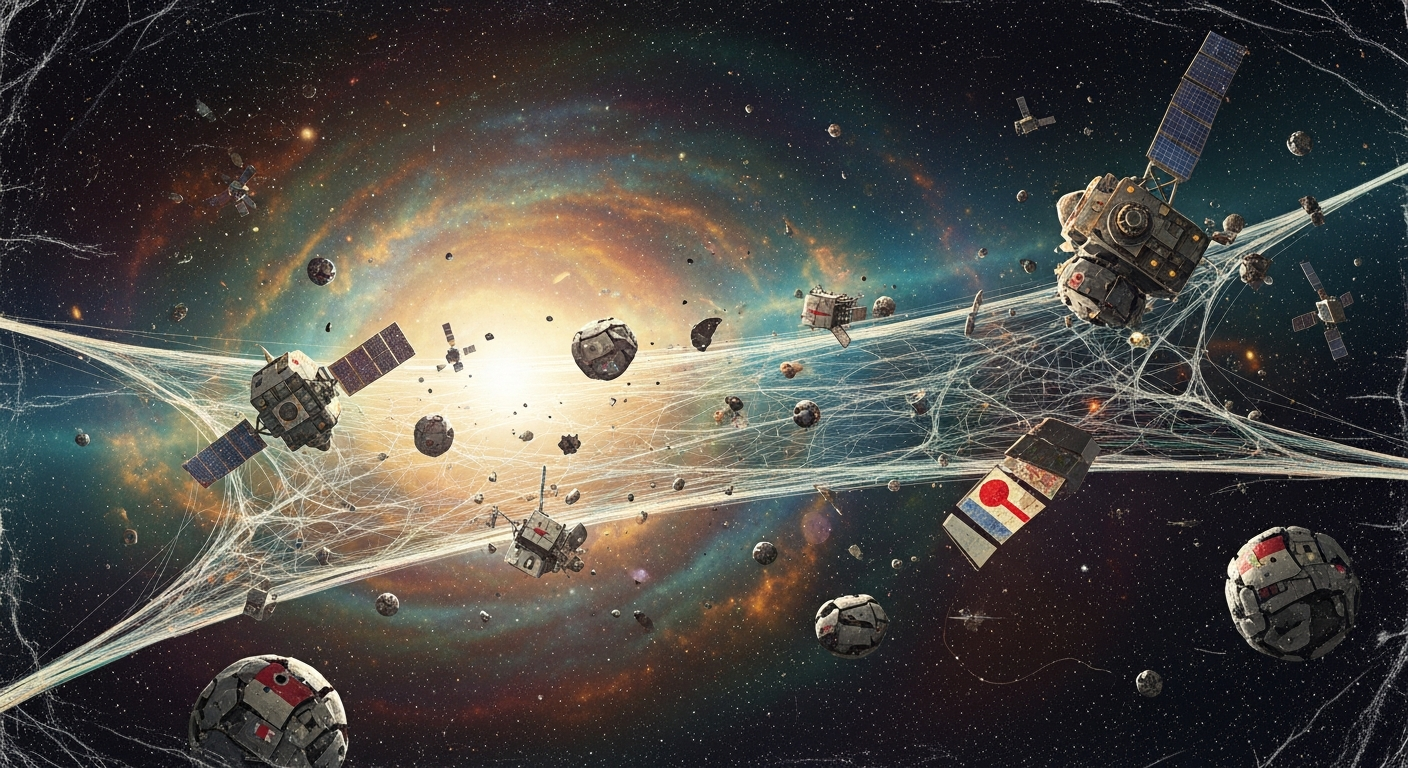
Scientists and space engineers are using a brilliant concept called biomimicry—which means studying and copying nature’s best designs to solve human problems. They are designing special “hunter satellites” equipped with giant nets that act just like spider webs.

Here is how the science of these robotic space webs works in action:

  • Energy Absorption: Just as spider silk stretches to catch a heavy beetle, these space nets are woven from advanced, lightweight space-age materials. When they capture a tumbling, fast-moving satellite, the net stretches to absorb the massive shock without ripping apart.
  • No-Tangle Geometric Design: A spider weaves its web in a very specific pattern so the crash force of a flying bug is spread out perfectly over the whole net. Engineers are mapping these natural web patterns using computers to weave space nets that won’t tear or tangle upon impact in zero gravity.
  • Electric “Stickiness”: Some clever spiders use a tiny electrical charge in their webs to magically pull flying insects closer. Scientists are exploring how to use electrostatic forces in space nets. Because pieces of space junk often hold a slight electric charge from the sun’s radiation, an electrified “sticky” net could physically attract small pieces of debris out of the dark, just like a magnet pulling in paper clips!

Conclusion: A Cleaner Future in Orbit

Cleaning up space junk is one of the biggest and most important challenges for the future of space exploration. If we want to travel to Mars, build space hotels, or just keep our mobile phones and internet running smoothly, we absolutely have to take out the space trash.

It is truly amazing to think that the ultimate solution to keeping our ultra-modern satellites safe might come from a tiny, eight-legged bug spinning a web in your backyard. By combining advanced rocket engineering with the ancient secrets of spider webs, scientists are proving that nature is often the greatest inventor of all. Through biomimicry, we can weave a safer, cleaner, and brighter future—both here on Earth and high up among the stars.


Reader Comments

Copied title and URL