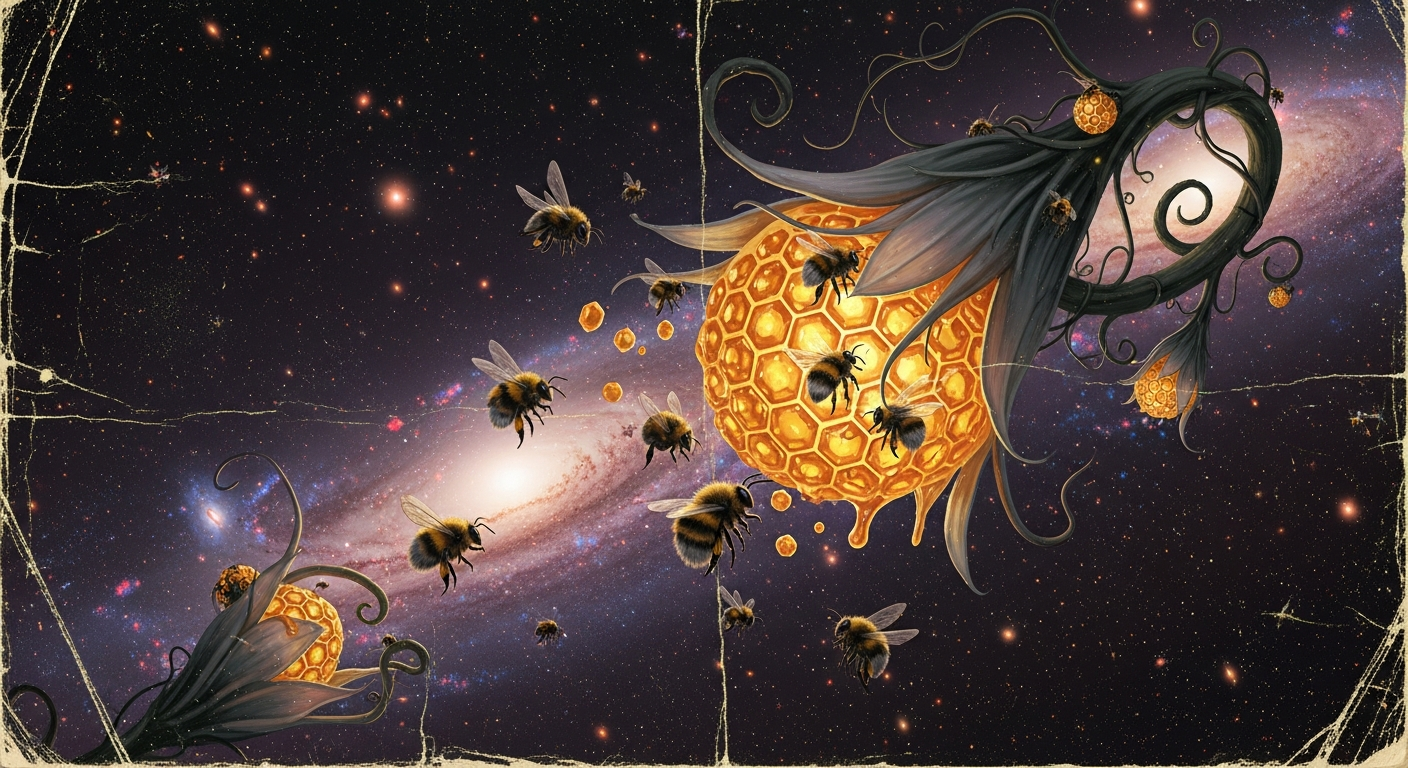
Can Bees Make Honey in Space? The Secret Biology of Zero Gravity

Can Bees Make Honey in Space? The Secret Biology of Zero Gravity Introduction: A Buzz in Outer Space When you think of astronauts, you probably imagine brave men and women in big white suits floating around a spaceship. But did you know that humans aren't the only ones who have traveled to outer space? Over the years, scientists have sent all kinds of animals into orbit to study zero gravity biology. One of the most fascinating questions space researchers ever asked was: Can bees make honey in space? Imagine trying to build a perfectly shaped LEGO castle while you and all your LEGO bricks are floating helplessly in mid-air. Sounds impossible, right? For a honey bee, building a honeycomb and making honey is their version of building a complicated castle. In this article, we are going to dive into the incredible science of how honey bees adapt to microgravity, how their tiny biological systems handle weightlessness, and whether we might one day enjoy fresh "space honey" on a mission to Mars! Detailed Scientific Explanation: The Biology of Zero-G Bees The 1984 NASA Space Bee Experiment To understand how insects act in space, we don't have to guess—we actually have the science to prove it! In 1984, NASA launched the Space Shuttle Challenger for a mission called STS-41C. On board was a special student-designed experiment called the "Space Station for Wood Carpenter Bees" (though they actually used honey bees). The crew took a special buzzing box containing around 3,300 worker bees and one queen bee into orbit. The main goal was to observe their animal behavior in a microgravity (zero gravity) environment. How Do You Fly When You Can't Fall? Down here on Earth, bees rely heavily on a biological superpower called geotaxis. This is a scientific word that means the ability to sense gravity. It tells insects which way is "up" and which way is "down." Bees use this built-in compass to fly straight, navigate back to their hive, and build their honeycombs perfectly straight up and down. When the bees first reached outer space, they were incredibly confused. Imagine waking up in a room where the ceiling, floor, and walls all felt exactly the same. At first, the bees tumbled and floated uncontrollably. But here is where the "secret biology" of bees kicks in: they are highly adaptable. Within just a few days, the bees stopped relying on gravity. Instead, they adapted by using light to figure out their direction. They learned to fly, hover, and glide in zero gravity by making tiny adjustments to their wings. Nature's biology is incredibly smart! Building the Perfect Floating Honeycomb The most amazing part of the NASA experiment was watching the bees build their honeycomb. On Earth, gravity gently pulls on the warm beeswax, helping the bees measure and shape those perfect little hexagons. Scientists originally thought that without gravity, the bees would build a messy, chaotic web of wax. They were wrong! After their initial space-sickness wore off, the worker bees grouped together and built a honeycomb that looked almost exactly like the ones they build on Earth. Because their bodies couldn't feel gravity, they used their own body sizes and the physical touch of the other bees around them as a measuring tool. Their biological teamwork was stronger than the lack of gravity! The Big Question: Did They Actually Make Honey? So, we know they can fly, and we know they can build a honeycomb in space. But can they actually make honey? The short scientific answer is: Yes, but they need a complete ecosystem. To make real honey, bees need to visit blooming flowers, drink a sweet liquid called nectar, bring it back to the hive, and fan it with their wings until it dries out and turns into thick, sticky honey. On the 1984 space shuttle, there were no blooming flowers, just a special sugar-water feeder. Because they didn't have flowers, they couldn't make brand-new natural honey from scratch. However, they did successfully drink the sugar water, process it in their bodies, and store it in their newly built floating honeycomb, just like they do with real honey! This proves that if we ever build a greenhouse spaceship full of blooming plants, the biology of the bee is ready to make real space honey. Conclusion: Nature's Super Astronauts The secret biology of zero gravity shows us that life on Earth is amazingly tough and adaptable. Even though they are tiny insects, honey bees proved that they can learn, survive, and work together, even when the very rules of gravity are completely turned upside down. They figured out how to fly, build complex structures, and store food in the great unknown of outer space. As space agencies look forward to the future—like building lunar bases on the Moon or sending human explorers to Mars—we will need to grow our own food in deep space. To grow fruits and vegetables, we will absolutely need insects to pollinate the plants. Knowing that bees can thrive and do their jobs in zero gravity brings us one giant leap closer to making long-term space exploration a reality. Who knows? The astronauts of the future might just start their day with a piece of space-baked toast, covered in fresh, zero-gravity honey! biological

Can Bees Make Honey in Space? The Secret Biology of Zero Gravity

Introduction: A Buzz in Outer Space

When you think of astronauts, you probably imagine brave men and women in big white suits floating around a spaceship. But did you know that humans aren’t the only ones who have traveled to outer space? Over the years, scientists have sent all kinds of animals into orbit to study zero gravity biology. One of the most fascinating questions space researchers ever asked was: Can bees make honey in space?

Imagine trying to build a perfectly shaped LEGO castle while you and all your LEGO bricks are floating helplessly in mid-air. Sounds impossible, right? For a honey bee, building a honeycomb and making honey is their version of building a complicated castle. In this article, we are going to dive into the incredible science of how honey bees adapt to microgravity, how their tiny biological systems handle weightlessness, and whether we might one day enjoy fresh “space honey” on a mission to Mars!

Detailed Scientific Explanation: The Biology of Zero-G Bees

The 1984 NASA Space Bee Experiment

To understand how insects act in space, we don’t have to guess—we actually have the science to prove it! In 1984, NASA launched the Space Shuttle Challenger for a mission called STS-41C. On board was a special student-designed experiment called the “Space Station for Wood Carpenter Bees” (though they actually used honey bees). The crew took a special buzzing box containing around 3,300 worker bees and one queen bee into orbit. The main goal was to observe their animal behavior in a microgravity (zero gravity) environment.

How Do You Fly When You Can’t Fall?

Down here on Earth, bees rely heavily on a biological superpower called geotaxis. This is a scientific word that means the ability to sense gravity. It tells insects which way is “up” and which way is “down.” Bees use this built-in compass to fly straight, navigate back to their hive, and build their honeycombs perfectly straight up and down.

When the bees first reached outer space, they were incredibly confused. Imagine waking up in a room where the ceiling, floor, and walls all felt exactly the same. At first, the bees tumbled and floated uncontrollably. But here is where the “secret biology” of bees kicks in: they are highly adaptable. Within just a few days, the bees stopped relying on gravity. Instead, they adapted by using light to figure out their direction. They learned to fly, hover, and glide in zero gravity by making tiny adjustments to their wings. Nature’s biology is incredibly smart!

Building the Perfect Floating Honeycomb

The most amazing part of the NASA experiment was watching the bees build their honeycomb. On Earth, gravity gently pulls on the warm beeswax, helping the bees measure and shape those perfect little hexagons. Scientists originally thought that without gravity, the bees would build a messy, chaotic web of wax.

They were wrong! After their initial space-sickness wore off, the worker bees grouped together and built a honeycomb that looked almost exactly like the ones they build on Earth. Because their bodies couldn’t feel gravity, they used their own body sizes and the physical touch of the other bees around them as a measuring tool. Their biological teamwork was stronger than the lack of gravity!

The Big Question: Did They Actually Make Honey?

So, we know they can fly, and we know they can build a honeycomb in space. But can they actually make honey? The short scientific answer is: Yes, but they need a complete ecosystem.

To make real honey, bees need to visit blooming flowers, drink a sweet liquid called nectar, bring it back to the hive, and fan it with their wings until it dries out and turns into thick, sticky honey. On the 1984 space shuttle, there were no blooming flowers, just a special sugar-water feeder. Because they didn’t have flowers, they couldn’t make brand-new natural honey from scratch. However, they did successfully drink the sugar water, process it in their bodies, and store it in their newly built floating honeycomb, just like they do with real honey! This proves that if we ever build a greenhouse spaceship full of blooming plants, the biology of the bee is ready to make real space honey.

Conclusion: Nature’s Super Astronauts

The secret biology of zero gravity shows us that life on Earth is amazingly tough and adaptable. Even though they are tiny insects, honey bees proved that they can learn, survive, and work together, even when the very rules of gravity are completely turned upside down. They figured out how to fly, build complex structures, and store food in the great unknown of outer space.

As space agencies look forward to the future—like building lunar bases on the Moon or sending human explorers to Mars—we will need to grow our own food in deep space. To grow fruits and vegetables, we will absolutely need insects to pollinate the plants. Knowing that bees can thrive and do their jobs in zero gravity brings us one giant leap closer to making long-term space exploration a reality. Who knows? The astronauts of the future might just start their day with a piece of space-baked toast, covered in fresh, zero-gravity honey!


Reader Comments

  1. Beryl2552 says:
  2. Brian4122 says:
Copied title and URL