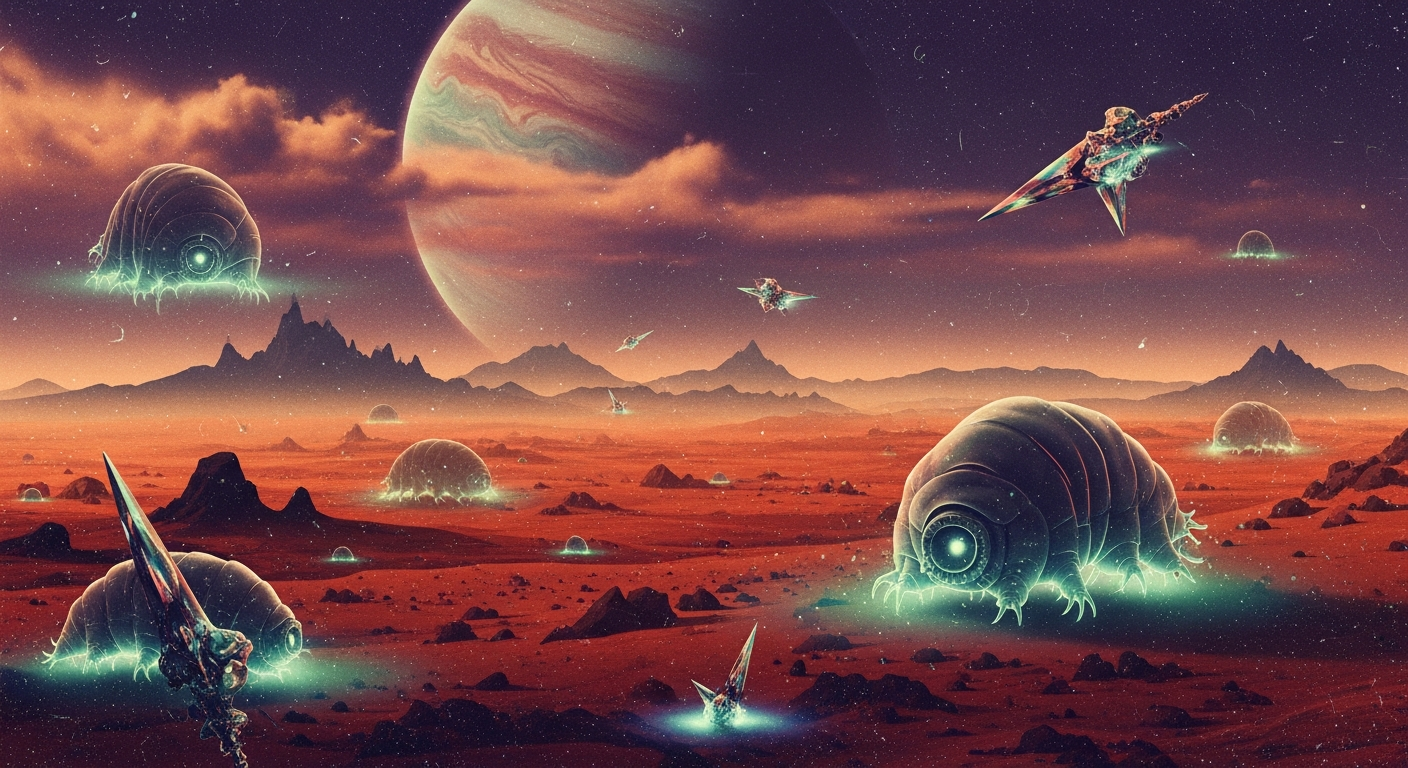
Could Water Bears Survive on Mars? The Ultimate Space Biology Mystery
Introduction: Meet the Toughest Tiny Astronauts
Have you ever wondered if life exists beyond Earth? When scientists look for extraterrestrial life, they often think about Mars. But what if the perfect Martian explorer is already living right here in your backyard? Enter the water bear, scientifically known as a tardigrade. These microscopic animals are famous in the world of space biology for their incredible ability to survive extreme conditions that would instantly kill humans. But the ultimate mystery remains: Could water bears survive on Mars? Let’s put on our space suits, shrink down to the size of a grain of sand, and dive into this fascinating scientific puzzle!
Detailed Scientific Explanation: Tardigrades vs. The Red Planet
What Exactly is a Water Bear?
Despite their cute name, water bears are not actual bears. They are microscopic, eight-legged animals that usually live in wet moss or water. If you look at them under a microscope, they look like pudgy little aliens with claws! But what makes them special is their ultimate superpower: a process called cryptobiosis.
When an environment gets too hot, too cold, or completely dries out, a water bear doesn’t die. Instead, it curls up into a tiny, dry ball called a “tun.” It hits the “pause button” on its own life! In this deep-sleep state, they do not need food, water, or even oxygen. They can stay like this for decades, waiting for a drop of water to wake them back up.
What is the Environment on Mars Like?
To understand if our little friends could survive on Mars, we need to know what they are up against. Mars is not exactly a vacation spot. Here is what the Red Planet is like:
- Freezing Cold: The average temperature on Mars is about -81 degrees Fahrenheit (-62 degrees Celsius).
- No Breathable Air: Mars has a very thin atmosphere made mostly of carbon dioxide. There is virtually no oxygen.
- Zero Liquid Water: Mars is completely bone-dry on the surface.
- Dangerous Radiation: Because Mars doesn’t have a thick magnetic shield like Earth, it is blasted with harmful ultraviolet (UV) radiation from the Sun.
The Big Question: Can Water Bears Survive on Mars?
So, could a water bear survive this harsh Martian world? The scientific answer is yes, but with a big catch!
If we dropped a sleeping water bear (in its “tun” state) onto the surface of Mars, the extreme cold and lack of oxygen would not bother it at all. Tardigrades have already proven they can survive the freezing vacuum of outer space in experiments aboard the International Space Station! They can also handle incredible amounts of radiation. Because of this, scientists believe a water bear could easily survive on Mars for a long time.
Surviving vs. Thriving
Here is where we have to think like real space biologists. There is a huge difference between surviving and thriving (living a normal, happy life). Because Mars has no liquid water on its surface, the water bear would never be able to wake up from its deep sleep. It couldn’t uncurl, eat, walk around, or have babies. It would stay frozen in time like a tiny statue. So, while Mars wouldn’t immediately kill a sleeping water bear, it wouldn’t let it live a normal life, either.
Conclusion: What This Means for Space Biology
The mystery of whether water bears could survive on Mars teaches us a lot about the universe. It shows us that life is incredibly tough and can endure the harshest places in the solar system. While a water bear might only be able to sleep on the dusty surface of Mars today, learning about their amazing “pause button” helps scientists figure out how to protect human astronauts in the future.
Who knows? Maybe one day, deep underground on Mars where ice might melt into water, we will find an environment where tiny, tough creatures just like water bears are waking up and exploring. Until then, the tardigrade remains Earth’s ultimate microscopic astronaut, proving that you don’t have to be big to be the strongest creature in the galaxy!


Reader Comments