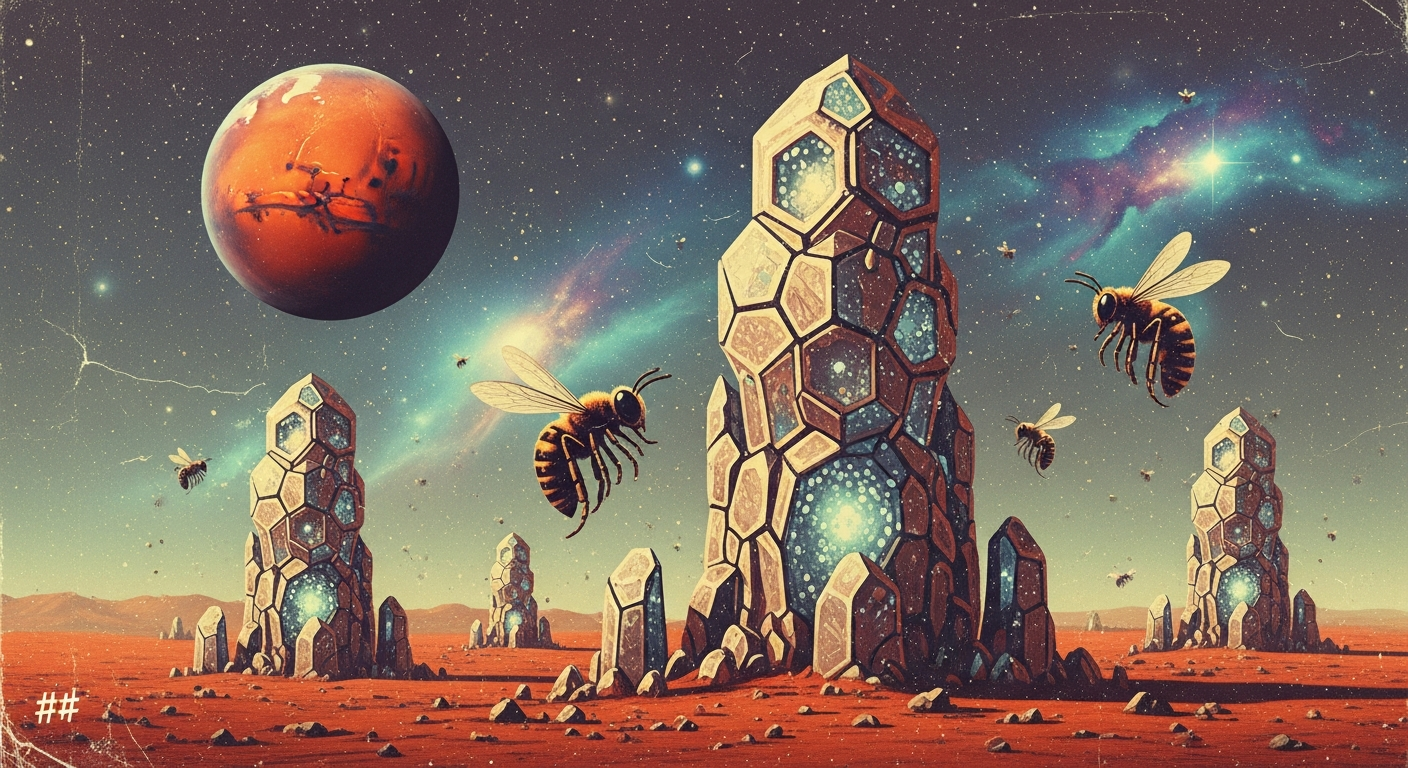
Could Bees Build Honeycombs on Mars? The Secret Biology of Space Insects

Could Bees Build Honeycombs on Mars? The Secret Biology of Space Insects The Buzz About Space: Can Bees Live on Mars? Imagine an astronaut sitting down for breakfast on the dusty red surface of Mars, spreading sweet, fresh honey on their toast. It sounds like a scene from a science fiction movie, doesn't it? But as space agencies around the world prepare to send humans to the Red Planet, scientists are asking a very serious question: Could bees build honeycombs on Mars? When we think of space exploration, we usually picture giant rockets, high-tech rovers, and brave astronauts. However, the unsung heroes of our future space colonies might just be tiny bugs! Welcome to the fascinating world of space biology. By studying the secret lives of space insects, scientists are trying to figure out if our buzzing friends can help us grow food, pollinate plants, and survive on a planet millions of miles away from Earth. The Secret Biology of Space Insects Gravity and the Famous "Waggle Dance" On Earth, bees are master communicators. When a scout bee finds a patch of delicious flowers, it returns to the hive and performs a special move called the "waggle dance." This dance acts like a tiny biological GPS, telling the other bees exactly where to go. But there is a catch: bees use Earth's gravity to figure out which way is "up" during their dance. Mars is much smaller than Earth, which means it has less gravity—only about 38% of the gravity we feel here. Scientists wonder: will this low-gravity environment confuse the bees? If they cannot feel the strong pull of Earth, their dance might become a little wobbly. However, insects are incredibly adaptable. In past experiments aboard the Space Shuttle, bees eventually learned to fly and navigate even in zero gravity. With a little practice, Martian bees might just invent a brand new space dance! Building the Perfect Honeycomb on Mars Bees are nature's greatest architects. They build their honeycombs using perfect six-sided shapes called hexagons. This shape allows them to store the most amount of honey using the least amount of beeswax. But building these delicate structures requires an understanding of direction and weight. Without Earth's normal gravity, how would bees know which way to hang their honeycombs? In a microgravity environment, insects sometimes build messy, unpredictable webs or nests. But because Mars still has some gravity, scientists believe bees would adapt over time. The honeycombs on Mars might look slightly thicker or have a different curve to handle the lower gravity, but the bees' biological instinct to build strong, efficient hexagons would likely survive the journey. Surviving the Harsh Martian Climate Could a bee fly through the Martian sky? Sadly, no. The atmosphere on Mars is incredibly thin—about 100 times thinner than Earth's—and is made mostly of poisonous carbon dioxide. It is also freezing cold, and the planet is blasted by harmful space radiation. To survive, our space bees would need to live inside heavily protected, pressurized space greenhouses alongside humans. Inside these domes, scientists would recreate a perfect Earth-like environment with warm temperatures, breathable air, and artificial sunlight. The bees would never know they were on another planet! They would spend their days safely buzzing among rows of space-grown tomatoes, strawberries, and apple trees. Why Do We Need Space Bees? You might be wondering, "Why go through all this trouble to send bugs to space?" The answer is pollination. If astronauts want to live on Mars for a long time, they cannot bring all their food in packages. They need to grow fresh crops. On Earth, bees pollinate about one-third of the food we eat. When a bee lands on a flower, it transfers pollen, allowing the plant to grow fruits and vegetables. Without bees, growing food on Mars would be incredibly difficult. Astronauts would have to pollinate every single flower by hand using tiny paintbrushes—a job that would take hours every day! By bringing space insects along, humans can create a self-sustaining ecosystem, just like Mother Nature does on Earth. A Sweet Future for Space Exploration Sending bees to Mars is not just a fun idea; it is a vital step in making human life possible on other planets. While the lower gravity and harsh environment present big challenges, the incredible adaptability of insects gives scientists hope. With the help of high-tech space greenhouses, our buzzing friends could thrive millions of miles from home. As we look up at the stars, it is amazing to think that our biggest leaps in space exploration might rely on the tiny wings of space bees. So, the next time you see a bee buzzing around a flower, give it a little nod of respect. You might just be looking at the ancestors of the very first Martian farmers! biological

Could Bees Build Honeycombs on Mars? The Secret Biology of Space Insects

The Buzz About Space: Can Bees Live on Mars?

Imagine an astronaut sitting down for breakfast on the dusty red surface of Mars, spreading sweet, fresh honey on their toast. It sounds like a scene from a science fiction movie, doesn’t it? But as space agencies around the world prepare to send humans to the Red Planet, scientists are asking a very serious question: Could bees build honeycombs on Mars?

When we think of space exploration, we usually picture giant rockets, high-tech rovers, and brave astronauts. However, the unsung heroes of our future space colonies might just be tiny bugs! Welcome to the fascinating world of space biology. By studying the secret lives of space insects, scientists are trying to figure out if our buzzing friends can help us grow food, pollinate plants, and survive on a planet millions of miles away from Earth.

The Secret Biology of Space Insects

Gravity and the Famous “Waggle Dance”

On Earth, bees are master communicators. When a scout bee finds a patch of delicious flowers, it returns to the hive and performs a special move called the “waggle dance.” This dance acts like a tiny biological GPS, telling the other bees exactly where to go. But there is a catch: bees use Earth’s gravity to figure out which way is “up” during their dance.

Mars is much smaller than Earth, which means it has less gravity—only about 38% of the gravity we feel here. Scientists wonder: will this low-gravity environment confuse the bees? If they cannot feel the strong pull of Earth, their dance might become a little wobbly. However, insects are incredibly adaptable. In past experiments aboard the Space Shuttle, bees eventually learned to fly and navigate even in zero gravity. With a little practice, Martian bees might just invent a brand new space dance!

Building the Perfect Honeycomb on Mars

Bees are nature’s greatest architects. They build their honeycombs using perfect six-sided shapes called hexagons. This shape allows them to store the most amount of honey using the least amount of beeswax. But building these delicate structures requires an understanding of direction and weight.

Without Earth’s normal gravity, how would bees know which way to hang their honeycombs? In a microgravity environment, insects sometimes build messy, unpredictable webs or nests. But because Mars still has some gravity, scientists believe bees would adapt over time. The honeycombs on Mars might look slightly thicker or have a different curve to handle the lower gravity, but the bees’ biological instinct to build strong, efficient hexagons would likely survive the journey.

Surviving the Harsh Martian Climate

Could a bee fly through the Martian sky? Sadly, no. The atmosphere on Mars is incredibly thin—about 100 times thinner than Earth’s—and is made mostly of poisonous carbon dioxide. It is also freezing cold, and the planet is blasted by harmful space radiation.

To survive, our space bees would need to live inside heavily protected, pressurized space greenhouses alongside humans. Inside these domes, scientists would recreate a perfect Earth-like environment with warm temperatures, breathable air, and artificial sunlight. The bees would never know they were on another planet! They would spend their days safely buzzing among rows of space-grown tomatoes, strawberries, and apple trees.

Why Do We Need Space Bees?

You might be wondering, “Why go through all this trouble to send bugs to space?” The answer is pollination. If astronauts want to live on Mars for a long time, they cannot bring all their food in packages. They need to grow fresh crops.

On Earth, bees pollinate about one-third of the food we eat. When a bee lands on a flower, it transfers pollen, allowing the plant to grow fruits and vegetables. Without bees, growing food on Mars would be incredibly difficult. Astronauts would have to pollinate every single flower by hand using tiny paintbrushes—a job that would take hours every day! By bringing space insects along, humans can create a self-sustaining ecosystem, just like Mother Nature does on Earth.

A Sweet Future for Space Exploration

Sending bees to Mars is not just a fun idea; it is a vital step in making human life possible on other planets. While the lower gravity and harsh environment present big challenges, the incredible adaptability of insects gives scientists hope. With the help of high-tech space greenhouses, our buzzing friends could thrive millions of miles from home.

As we look up at the stars, it is amazing to think that our biggest leaps in space exploration might rely on the tiny wings of space bees. So, the next time you see a bee buzzing around a flower, give it a little nod of respect. You might just be looking at the ancestors of the very first Martian farmers!


Reader Comments

Copied title and URL