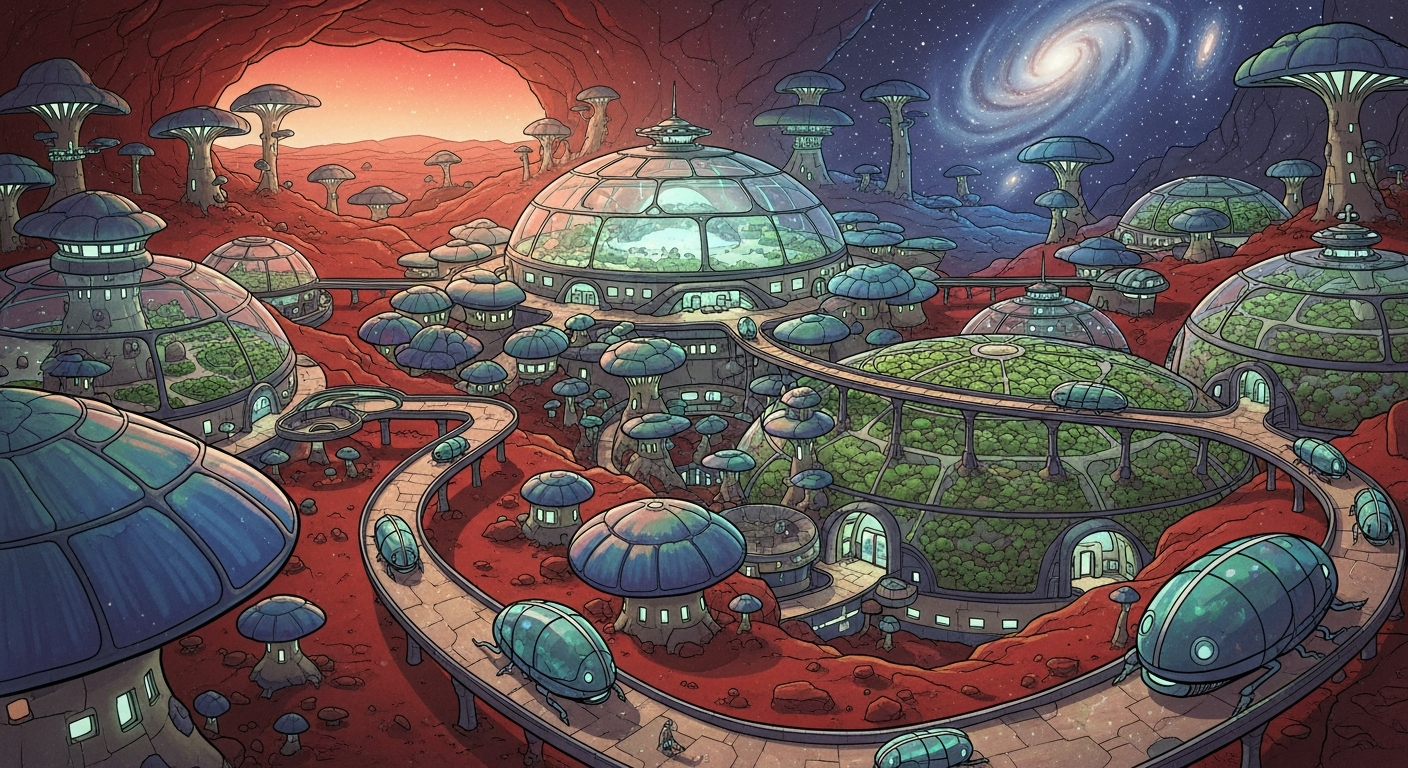
Galactic Gardens: How Earth’s Mushrooms Could Build Homes for Astronauts on Mars

Galactic Gardens: How Earth's Mushrooms Could Build Homes for Astronauts on Mars Introduction: A Fungal Frontier Imagine you are an astronaut who has just landed on Mars. The sky is a dusty red, the air is too thin to breathe, and the temperature is freezing cold. You need a safe, warm house to survive. But how do you build an astronaut home on Mars? You cannot load heavy bricks, steel, or concrete onto a rocket—it would be too heavy and cost billions of dollars! What if, instead of building a house, you could grow one using a simple Earth mushroom? Welcome to the amazing world of mycotecture (building with fungi). Scientists at NASA are currently researching how the humble mushrooms we see in our forests could become the ultimate building material for space exploration. This incredible idea solves one of the biggest challenges of moving to another planet: how to travel light but build strong. By taking tiny, lightweight mushroom spores to the Red Planet, astronauts could grow safe, radiation-proof habitats. Let us dive into the fascinating science behind these galactic gardens! Detailed Scientific Explanation: The Science of Space Shrooms What is Mycelium? Nature's 3D Printer When you think of a mushroom, you probably picture the little umbrella-shaped cap popping out of the dirt. But that is just the "fruit" of the organism. The real magic happens underground. Beneath the soil, fungi have a massive network of tiny, white, thread-like roots called mycelium. Mycelium is like nature's living glue. It grows incredibly fast, stretching out to find food. As it grows, it binds tightly to whatever it touches—whether that is wood, soil, or rocks. Scientists have discovered that if you put mycelium into a mold, it will grow into that exact shape, creating a solid block that is stronger than concrete, lighter than wood, and completely fire-resistant! The Rocket Packing Problem: Why Grow Instead of Build? In rocket science, there is a strict rule: every gram counts. Launching heavy building materials into space takes an enormous amount of rocket fuel. This is called the "payload mass problem." Here is where mushrooms save the day. Instead of packing thousands of heavy bricks, astronauts only need to carry a small, lightweight packet of fungal spores (mushroom seeds). When they arrive on Mars, they can use local resources to feed these spores and grow giant Martian habitats. It is a brilliant way to trick the weight limits of space travel! Step-by-Step: How to Grow a House on Mars So, how exactly do we turn a tiny spore into a giant space cabin? NASA researchers have designed an ingenious, multi-layered system that works like a living recipe: Step 1: The Bubble Frame. First, astronauts will inflate a large plastic dome. This acts as the skeleton of the house. Step 2: The Algae Layer. Inside the outer layer of the dome, astronauts will add water and tiny green organisms called cyanobacteria (algae). Using energy from the distant Sun, these tiny helpers will produce oxygen and sugar. Step 3: Feeding the Fungi. The sugar produced by the algae is fed to the mycelium. The fungal network begins to eat, growing rapidly and thickly around the frame of the house. Step 4: Baking the Bricks. Once the house is fully grown and thick enough, it is time to stop the growth. Astronauts will heat the walls to "bake" the mushrooms. This kills the fungi so they do not grow out of control, leaving behind a super-strong, solid shell. Built-in Super Shields: Fighting Space Radiation One of the biggest dangers on Mars is invisible: cosmic radiation. Earth has a thick atmosphere and a magnetic field that protects us from the Sun's harmful rays, but Mars does not. If astronauts live on Mars, they need a super shield. Amazingly, mushrooms are perfect for this! Fungi contain a huge amount of water, which is one of the best natural barriers against radiation. Furthermore, scientists are looking at special types of fungi that contain melanin—the same pigment that gives human skin its color. On Earth, melanin-rich fungi have been found growing inside the damaged Chernobyl nuclear reactor, actually "eating" the radiation! A house made of melanin-rich mycelium would absorb dangerous cosmic rays, keeping the astronauts safe inside. Conclusion: The Future is Fungi Space exploration is not just about building shiny metal rockets or high-tech computers; sometimes, the most advanced technology is found right under our feet in the forest dirt. By combining biology and engineering, scientists are proving that nature has already solved some of our hardest problems. Using Earth's mushrooms to build homes for astronauts on Mars is a perfect example of thinking outside the box. Mycotecture offers a lightweight, super-strong, and radiation-blocking solution that could finally make human life on the Red Planet a reality. The next time you see a mushroom growing in the woods, take a closer look. You might just be looking at the future of space travel, helping humanity plant its roots among the stars! biological

Galactic Gardens: How Earth’s Mushrooms Could Build Homes for Astronauts on Mars

Introduction: A Fungal Frontier

Imagine you are an astronaut who has just landed on Mars. The sky is a dusty red, the air is too thin to breathe, and the temperature is freezing cold. You need a safe, warm house to survive. But how do you build an astronaut home on Mars? You cannot load heavy bricks, steel, or concrete onto a rocket—it would be too heavy and cost billions of dollars! What if, instead of building a house, you could grow one using a simple Earth mushroom?

Welcome to the amazing world of mycotecture (building with fungi). Scientists at NASA are currently researching how the humble mushrooms we see in our forests could become the ultimate building material for space exploration. This incredible idea solves one of the biggest challenges of moving to another planet: how to travel light but build strong. By taking tiny, lightweight mushroom spores to the Red Planet, astronauts could grow safe, radiation-proof habitats. Let us dive into the fascinating science behind these galactic gardens!

Detailed Scientific Explanation: The Science of Space Shrooms

What is Mycelium? Nature’s 3D Printer

When you think of a mushroom, you probably picture the little umbrella-shaped cap popping out of the dirt. But that is just the “fruit” of the organism. The real magic happens underground. Beneath the soil, fungi have a massive network of tiny, white, thread-like roots called mycelium.

Mycelium is like nature’s living glue. It grows incredibly fast, stretching out to find food. As it grows, it binds tightly to whatever it touches—whether that is wood, soil, or rocks. Scientists have discovered that if you put mycelium into a mold, it will grow into that exact shape, creating a solid block that is stronger than concrete, lighter than wood, and completely fire-resistant!

The Rocket Packing Problem: Why Grow Instead of Build?

In rocket science, there is a strict rule: every gram counts. Launching heavy building materials into space takes an enormous amount of rocket fuel. This is called the “payload mass problem.”

Here is where mushrooms save the day. Instead of packing thousands of heavy bricks, astronauts only need to carry a small, lightweight packet of fungal spores (mushroom seeds). When they arrive on Mars, they can use local resources to feed these spores and grow giant Martian habitats. It is a brilliant way to trick the weight limits of space travel!

Step-by-Step: How to Grow a House on Mars

So, how exactly do we turn a tiny spore into a giant space cabin? NASA researchers have designed an ingenious, multi-layered system that works like a living recipe:

  • Step 1: The Bubble Frame. First, astronauts will inflate a large plastic dome. This acts as the skeleton of the house.
  • Step 2: The Algae Layer. Inside the outer layer of the dome, astronauts will add water and tiny green organisms called cyanobacteria (algae). Using energy from the distant Sun, these tiny helpers will produce oxygen and sugar.
  • Step 3: Feeding the Fungi. The sugar produced by the algae is fed to the mycelium. The fungal network begins to eat, growing rapidly and thickly around the frame of the house.
  • Step 4: Baking the Bricks. Once the house is fully grown and thick enough, it is time to stop the growth. Astronauts will heat the walls to “bake” the mushrooms. This kills the fungi so they do not grow out of control, leaving behind a super-strong, solid shell.

Built-in Super Shields: Fighting Space Radiation

One of the biggest dangers on Mars is invisible: cosmic radiation. Earth has a thick atmosphere and a magnetic field that protects us from the Sun’s harmful rays, but Mars does not. If astronauts live on Mars, they need a super shield.

Amazingly, mushrooms are perfect for this! Fungi contain a huge amount of water, which is one of the best natural barriers against radiation. Furthermore, scientists are looking at special types of fungi that contain melanin—the same pigment that gives human skin its color. On Earth, melanin-rich fungi have been found growing inside the damaged Chernobyl nuclear reactor, actually “eating” the radiation! A house made of melanin-rich mycelium would absorb dangerous cosmic rays, keeping the astronauts safe inside.

Conclusion: The Future is Fungi

Space exploration is not just about building shiny metal rockets or high-tech computers; sometimes, the most advanced technology is found right under our feet in the forest dirt. By combining biology and engineering, scientists are proving that nature has already solved some of our hardest problems.

Using Earth’s mushrooms to build homes for astronauts on Mars is a perfect example of thinking outside the box. Mycotecture offers a lightweight, super-strong, and radiation-blocking solution that could finally make human life on the Red Planet a reality. The next time you see a mushroom growing in the woods, take a closer look. You might just be looking at the future of space travel, helping humanity plant its roots among the stars!


Reader Comments

Copied title and URL