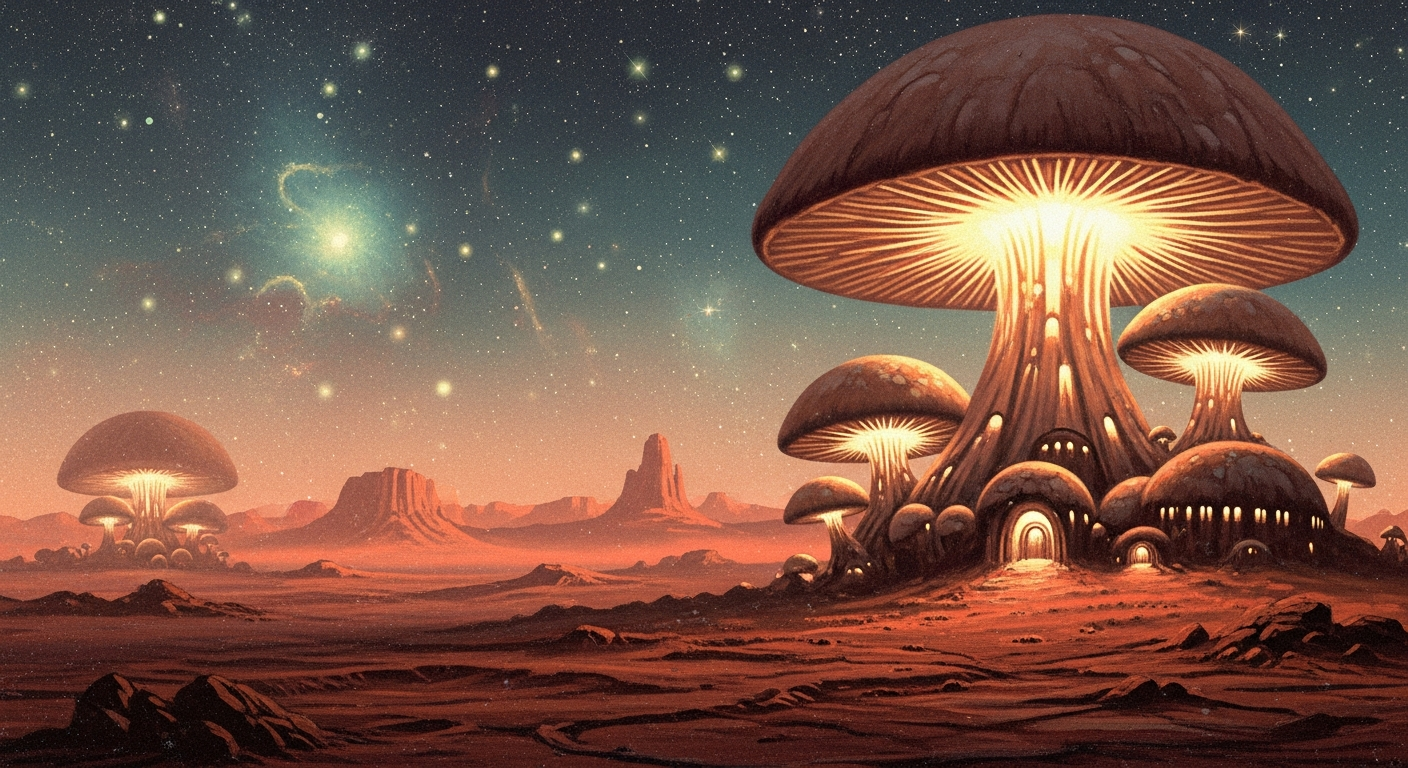
Space Mushrooms: Could We Grow Real-Life Minecraft Houses on Mars?

Space Mushrooms: Could We Grow Real-Life Minecraft Houses on Mars? Introduction: From Video Games to the Red Planet If you have ever played Minecraft, you probably know how fun it is to explore the Mushroom Fields biome and build a giant, bouncy mushroom house. It sounds like pure video game magic, right? Well, what if I told you that real-life rocket scientists at NASA are working on a way to do the exact same thing... on Mars? As humans prepare to travel deeper into space, we face a massive problem: how do we build homes on another planet? We cannot exactly load up a spaceship with heavy bricks, steel, and concrete. It would cost billions of dollars and require too much rocket fuel. Instead of taking our houses with us, scientists have come up with a brilliant, mind-blowing idea: what if we grow our houses in space? Welcome to the weird, wonderful world of myco-architecture—the science of building structures out of fungi! Detailed Scientific Explanation: The Magic of Space Fungi The Heavy Problem with Space Travel To understand why we need mushroom houses, we first need to understand gravity. Earth’s gravity pulls everything down. To blast a rocket into space, it needs to be as light as possible. Every single pound of cargo costs about $10,000 to launch into orbit! If we want to build a base on the Moon or Mars, carrying traditional building materials is simply impossible. We need a material that is incredibly light to carry but becomes super strong when it is time to build. Meet Mycelium: Nature's Ultimate Building Block When you think of a mushroom, you probably picture the little umbrella-shaped cap popping out of the dirt. But that is just the "fruit" of the fungus. Underneath the ground lies the real superstar: a massive, invisible network of tiny, white, web-like threads called mycelium. Mycelium acts like the roots of the mushroom. In nature, it spreads through the soil, breaking down dead plants and absorbing nutrients. But in a science lab, mycelium is a superhero material. When scientists feed it the right food, mycelium can grow into incredibly thick, strong blocks. In fact, dried mycelium can be stronger than concrete, tougher than wood, and much lighter than both! How Do We Grow a House on Mars? NASA scientists are working on a special plan to grow real-life Minecraft houses on Mars. Here is the step-by-step scientific recipe: Step 1: The Space Bag. Astronauts will travel to Mars carrying large, folded-up bags made of flexible plastic. Inside these bags are dormant (sleeping) mushroom spores and a special type of algae called cyanobacteria. Step 2: Add Water and Sun. Once on Mars, astronauts will unfold the bags and add water. The cyanobacteria will use energy from the sun (a process called photosynthesis) to grow and produce sugary food. Step 3: The Feeding Frenzy. The mushroom spores wake up! They eat the sugary food made by the algae and quickly start spreading their web-like mycelium all around the inside of the bag. Step 4: Bake to Perfection. After a few weeks, the mycelium will have grown so much that it fills the entire bag, creating a sturdy, thick shell. To stop the mushroom from growing any further, the astronauts will heat it up (or use Mars' natural radiation). This bakes the mycelium into a hard, strong, and safe house! Super Shields: Defending Against Space Dangers Living on Mars is not just about having a roof over your head; it is about surviving a very dangerous environment. Mars does not have a thick atmosphere or a magnetic field like Earth, which means it gets blasted by harmful space radiation and freezing temperatures. This is where our mushroom houses shine! Mycelium is naturally rich in melanin—the same pigment that gives human skin its color and protects us from sunburn. In space fungi, melanin acts like a super shield, absorbing dangerous cosmic radiation and keeping the astronauts inside safe. On top of that, millions of tiny air pockets trapped inside the dried mycelium make it an excellent insulator, keeping the freezing Martian cold out and the cozy, warm air in. Conclusion: The Future is Fungi Who knew that the secret to surviving on the Red Planet was hiding in the dirt right beneath our feet? By looking closely at nature, scientists have figured out how to solve one of the biggest challenges of space exploration. The idea of myco-architecture is still being tested in laboratories today, but it proves that the best scientific solutions often require a little bit of imagination. The next time you are building a mushroom base in Minecraft, just remember: you are not just playing a game. You are practicing exactly what real astronauts might do on Mars in the near future. The future of space travel is not just made of steel and rocket fuel—it is alive, it is growing, and it is fungi! biological

Space Mushrooms: Could We Grow Real-Life Minecraft Houses on Mars?

Introduction: From Video Games to the Red Planet

If you have ever played Minecraft, you probably know how fun it is to explore the Mushroom Fields biome and build a giant, bouncy mushroom house. It sounds like pure video game magic, right? Well, what if I told you that real-life rocket scientists at NASA are working on a way to do the exact same thing… on Mars?

As humans prepare to travel deeper into space, we face a massive problem: how do we build homes on another planet? We cannot exactly load up a spaceship with heavy bricks, steel, and concrete. It would cost billions of dollars and require too much rocket fuel. Instead of taking our houses with us, scientists have come up with a brilliant, mind-blowing idea: what if we grow our houses in space?

Welcome to the weird, wonderful world of myco-architecture—the science of building structures out of fungi!

Detailed Scientific Explanation: The Magic of Space Fungi

The Heavy Problem with Space Travel

To understand why we need mushroom houses, we first need to understand gravity. Earth’s gravity pulls everything down. To blast a rocket into space, it needs to be as light as possible. Every single pound of cargo costs about $10,000 to launch into orbit! If we want to build a base on the Moon or Mars, carrying traditional building materials is simply impossible. We need a material that is incredibly light to carry but becomes super strong when it is time to build.

Meet Mycelium: Nature’s Ultimate Building Block

When you think of a mushroom, you probably picture the little umbrella-shaped cap popping out of the dirt. But that is just the “fruit” of the fungus. Underneath the ground lies the real superstar: a massive, invisible network of tiny, white, web-like threads called mycelium.

Mycelium acts like the roots of the mushroom. In nature, it spreads through the soil, breaking down dead plants and absorbing nutrients. But in a science lab, mycelium is a superhero material. When scientists feed it the right food, mycelium can grow into incredibly thick, strong blocks. In fact, dried mycelium can be stronger than concrete, tougher than wood, and much lighter than both!

How Do We Grow a House on Mars?

NASA scientists are working on a special plan to grow real-life Minecraft houses on Mars. Here is the step-by-step scientific recipe:

  • Step 1: The Space Bag. Astronauts will travel to Mars carrying large, folded-up bags made of flexible plastic. Inside these bags are dormant (sleeping) mushroom spores and a special type of algae called cyanobacteria.
  • Step 2: Add Water and Sun. Once on Mars, astronauts will unfold the bags and add water. The cyanobacteria will use energy from the sun (a process called photosynthesis) to grow and produce sugary food.
  • Step 3: The Feeding Frenzy. The mushroom spores wake up! They eat the sugary food made by the algae and quickly start spreading their web-like mycelium all around the inside of the bag.
  • Step 4: Bake to Perfection. After a few weeks, the mycelium will have grown so much that it fills the entire bag, creating a sturdy, thick shell. To stop the mushroom from growing any further, the astronauts will heat it up (or use Mars’ natural radiation). This bakes the mycelium into a hard, strong, and safe house!

Super Shields: Defending Against Space Dangers

Living on Mars is not just about having a roof over your head; it is about surviving a very dangerous environment. Mars does not have a thick atmosphere or a magnetic field like Earth, which means it gets blasted by harmful space radiation and freezing temperatures.

This is where our mushroom houses shine! Mycelium is naturally rich in melanin—the same pigment that gives human skin its color and protects us from sunburn. In space fungi, melanin acts like a super shield, absorbing dangerous cosmic radiation and keeping the astronauts inside safe. On top of that, millions of tiny air pockets trapped inside the dried mycelium make it an excellent insulator, keeping the freezing Martian cold out and the cozy, warm air in.

Conclusion: The Future is Fungi

Who knew that the secret to surviving on the Red Planet was hiding in the dirt right beneath our feet? By looking closely at nature, scientists have figured out how to solve one of the biggest challenges of space exploration.

The idea of myco-architecture is still being tested in laboratories today, but it proves that the best scientific solutions often require a little bit of imagination. The next time you are building a mushroom base in Minecraft, just remember: you are not just playing a game. You are practicing exactly what real astronauts might do on Mars in the near future. The future of space travel is not just made of steel and rocket fuel—it is alive, it is growing, and it is fungi!


Reader Comments

Copied title and URL