Can Glowing Deep-Sea Jellyfish Help Us Light Up Cities on Mars? The Surprising Science of Bio-Engineering
Introduction: From the Deepest Oceans to the Red Planet
Imagine plunging deep into the Earth’s oceans, far beyond the reach of sunlight. In this pitch-black world, you suddenly see a magical sight: tiny, glowing green and blue lights floating in the water. These lights belong to deep-sea jellyfish, which use their natural glow to survive in the dark. Now, imagine taking that exact same deep-sea magic and using it to light up human cities millions of miles away on the dusty, red surface of Mars. Sounds like a sci-fi movie, right?
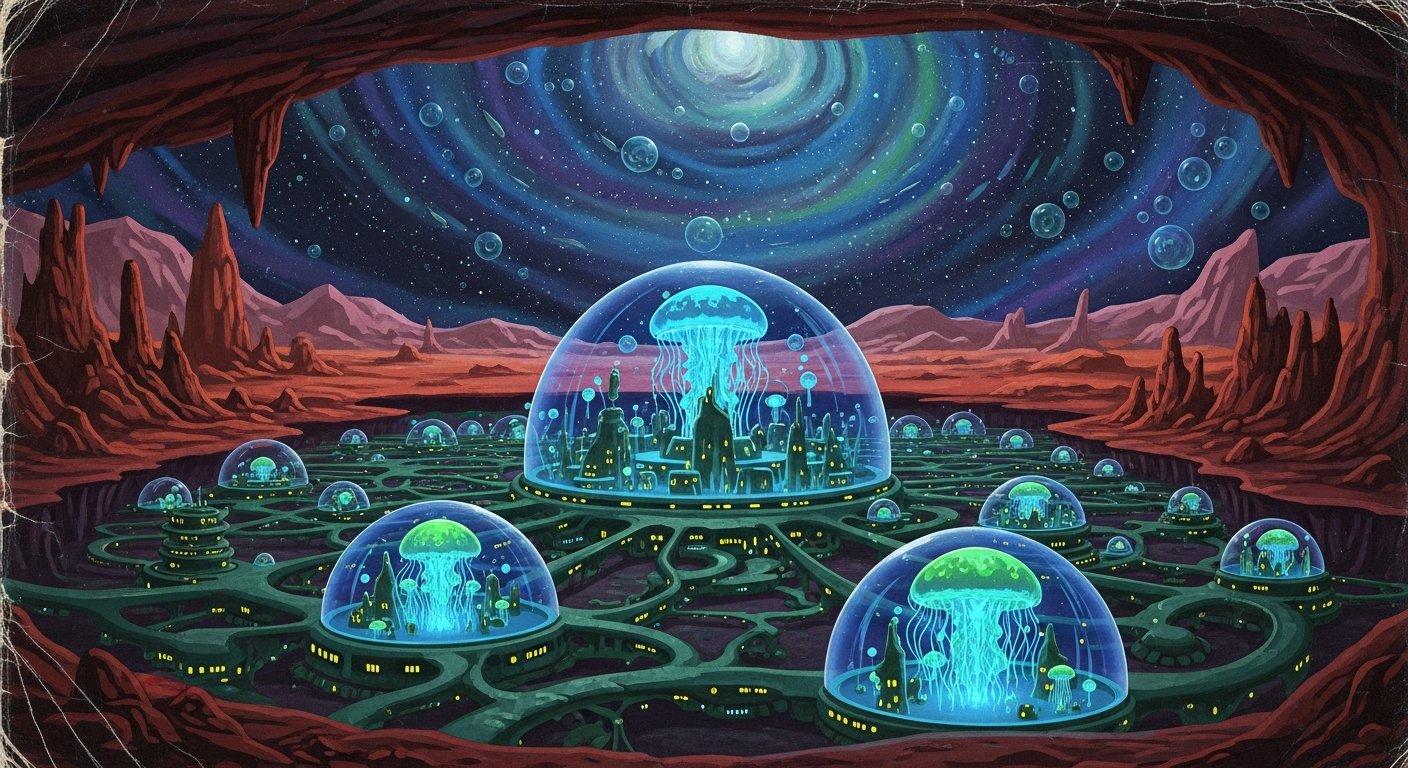
Actually, it is a very real, cutting-edge idea! Scientists are currently exploring how the natural glow of deep-sea jellyfish can help us create sustainable, living streetlights for future space colonies. By combining the mysteries of the ocean with the wonders of space travel, researchers are using a fascinating tool called bio-engineering. Let’s dive into how this incredible science works, and how nature’s built-in lightbulbs might one day help us conquer the stars.
Detailed Scientific Explanation: The Magic of Bioluminescence and Bio-Engineering
What is Bioluminescence? (Nature’s Glow-in-the-Dark Trick)
To understand how we can light up Mars, we first need to understand how jellyfish glow. This superpower is called bioluminescence (pronounced bio-loo-mi-nes-cents). In simple terms, “bio” means living, and “luminescence” means light. It is living light!
Inside the jellyfish, a cool chemical dance is happening. They have a special molecule called luciferin and a helper enzyme called luciferase. When these two mix together with a little bit of oxygen, they create a chemical reaction that releases energy in the form of cold, bright light. Unlike the lightbulbs in your house, which get very hot, a jellyfish’s light is totally cold, meaning no energy is wasted as heat.
One of the most famous glowing tools found in jellyfish is called Green Fluorescent Protein (GFP). GFP is like a tiny, natural flashlight hidden inside their cells.
How Bio-Engineering Works: Copying Nature’s Recipe
So, how do we get the glow out of the jellyfish and onto Mars? We use bio-engineering! You can think of every living thing’s DNA as a giant recipe book. This book holds all the instructions for making you, a tree, or a jellyfish.
Bio-engineers are basically science chefs. They can find the specific “recipe” (the gene) in the jellyfish’s DNA that says, “Make Green Fluorescent Protein and glow!” Using special microscopic tools, scientists can carefully copy this glowing recipe and paste it into the recipe book of a completely different living thing—like a houseplant, a tree, or even tiny algae.
When the plant grows, it reads its new DNA recipe book and thinks, “Oh, I’m supposed to glow in the dark!” Suddenly, we have a plant that naturally produces its own light, without ever needing a battery or a plug.
Why Mars Needs “Living Lights”
You might be wondering: “Why don’t we just use regular solar panels and LED lights on Mars?” That is a great question!
Mars is a very difficult planet to live on. It is incredibly far away from Earth, which means we cannot easily ship batteries, wires, or replacement lightbulbs. Mars is also famous for its massive, planet-wide dust storms. These dust storms can block the sun for weeks, covering solar panels in red dirt and cutting off electricity. If our cities on Mars rely only on solar power, they could go completely dark.
This is where glowing bio-engineered plants and algae come to the rescue. Living lights offer incredible benefits for space explorers:
- Self-Growing and Self-Repairing: Unlike a glass lightbulb that shatters and becomes useless, a glowing plant can grow new glowing leaves. If an algae lamp gets damaged, the algae can simply multiply and heal itself.
- Zero Electricity Needed: Bio-luminescent plants only need water, carbon dioxide, and some nutrients to glow. They don’t need a power grid.
- Double Duty (Light and Air!): Plants and algae naturally “breathe” in carbon dioxide and “breathe” out oxygen. On a planet like Mars where there is no breathable air, glowing algae could light up our living spaces and produce fresh oxygen for astronauts to breathe at the exact same time!
Conclusion: Bringing Deep-Sea Magic to the Stars
The journey from the deepest, darkest trenches of Earth’s oceans to the furthest reaches of outer space shows us just how connected our universe really is. By studying something as simple as a glowing deep-sea jellyfish, scientists have unlocked the secrets of bioluminescence and bio-engineering.
While we might still be a few years away from planting glowing trees on the Red Planet, scientists are already testing these bio-engineered glowing plants right here on Earth to create eco-friendly streetlights that don’t need electricity. The very same technology that could one day light up the streets of a Martian city might soon be glowing in your own backyard.
By learning from nature’s brilliant designs, we are realizing that the greatest solutions to the future of space exploration might just be swimming right below our feet. The next time you look up at the stars, remember the glowing jellyfish—nature’s tiny, living lightbulbs leading the way into the future!


Reader Comments