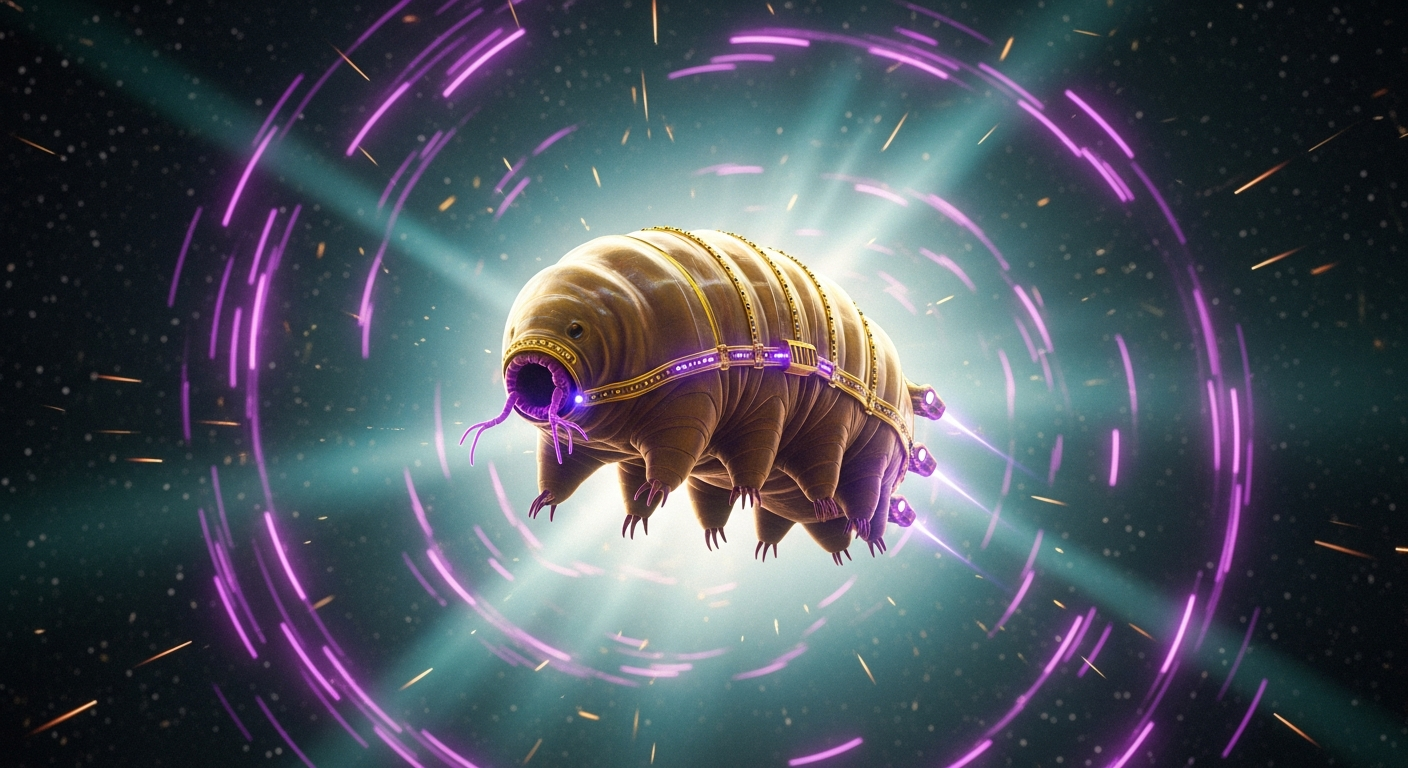
The Immortal Tardigrade: How Earth’s Toughest Animal Survives the Vacuum of Space

The Immortal Tardigrade: How Earth's Toughest Animal Survives the Vacuum of Space Introduction: Meet the Water Bear, Earth's Most Resilient Extremophile When we think of biological resilience, we often imagine armored insects or deep-sea predators. Yet, the title of Earth's toughest animal belongs to a microscopic, eight-legged invertebrate no larger than a grain of sand: the tardigrade. Colloquially known as "water bears" or "moss piglets," tardigrades have captured the imagination of the scientific community and the public alike due to their seemingly supernatural ability to withstand environments that would be instantly lethal to any other known form of life. Found everywhere from the damp moss of your backyard to the crushing depths of the Marianas Trench, tardigrades are the ultimate extremophiles. However, their most astonishing feat is their proven ability to survive the ultimate hostile environment: the vacuum of space. By understanding the profound biological mechanisms that allow tardigrades to cheat death, scientists are unlocking secrets that could revolutionize medicine, agriculture, and the future of human spaceflight. In this article, we delve deep into the anatomy and cellular biology of the immortal tardigrade to explain exactly how it survives the cosmos. The Science of Survival: Decoding the Tardigrade's Superpowers To understand how a tardigrade survives the freezing, irradiated, and airless void of space, we must look at the microscopic adaptations built into its genetic code. The tardigrade does not fight extreme conditions; rather, it yields to them through highly specialized metabolic processes. Cryptobiosis: The Art of Suspended Animation The cornerstone of tardigrade immortality is a biological process called cryptobiosis. When faced with environmental stress—such as freezing temperatures or a complete lack of water—tardigrades enter a state of suspended animation. The most common form of this is anhydrobiosis (life without water). As their environment dries out, tardigrades curl up into a dehydrated ball known as a "tun." During this transition, their metabolism drops to less than 0.01% of normal levels, and their water content decreases to just 1%. But how do their cells not collapse? The secret lies in unique proteins known as Tardigrade-specific Intrinsically Disordered Proteins (TDPs). Unlike normal proteins that have a rigid 3D structure, TDPs are floppy and flexible. As water leaves the cell, these proteins form a glass-like matrix (vitrification) that envelops and preserves moisture-sensitive molecules, preventing cellular structures from shattering. Once rehydrated, the glass melts away, and the tardigrade simply walks away as if nothing happened. Surviving the Space Vacuum: The 2007 TARDIS Experiment The true test of tardigrade resilience occurred in 2007 during the European Space Agency's Foton-M3 mission. In an experiment aptly named TARDIS (Tardigrades in Space), scientists exposed living tardigrades directly to the freezing, airless vacuum of low Earth orbit for 10 days. In the vacuum of space, the lack of pressure causes the water inside biological cells to boil and vaporize instantly, tearing standard organisms apart. Because the tardigrades were already in their desiccated "tun" state, the vacuum had no effect on their cellular integrity. Upon returning to Earth and being rehydrated, an astonishing percentage of the tardigrades revived, and many even went on to reproduce, producing perfectly healthy offspring. Shielding Against Cosmic Radiation: The Magic of the Dsup Protein Surviving a vacuum is one thing, but space is also flooded with deadly levels of ionizing cosmic radiation and unfiltered ultraviolet (UV) rays from the sun. Radiation destroys life by shattering DNA, leading to catastrophic mutations and cellular death. Yet, tardigrades possess a highly unique biological shield. Scientists discovered a specific protein in tardigrades called Dsup (Damage Suppressor). The Dsup protein physically binds to the nucleosomes (the structures that pack and protect DNA) like a protective blanket. This molecular shield prevents the hydroxyl radicals produced by X-rays and cosmic rays from breaking the DNA strands. Even when their DNA does sustain minor damage, tardigrades possess a hyper-active DNA repair mechanism that stitches their genome back together within days of rehydration. This extraordinary adaptation makes tardigrades up to 1,000 times more resistant to radiation than humans. Conclusion: What Tardigrades Teach Us About Astrobiology and the Future The immortal tardigrade is much more than a biological curiosity; it is a living blueprint for extreme survival. The fact that a terrestrial animal possesses the exact biological toolkit necessary to survive the vacuum of space has profound implications for astrobiology and the theory of panspermia—the idea that life could potentially travel between planets on meteorites. Furthermore, the detailed scientific study of tardigrades is already driving human innovation. Researchers are currently exploring how to replicate the stabilizing effects of TDPs to preserve human blood, vaccines, and sensitive medications at room temperature, eliminating the need for complex refrigeration supply chains. Additionally, understanding the DNA-shielding properties of the Dsup protein could lead to revolutionary treatments for radiation sickness, or even protective therapies for astronauts embarking on long-duration missions to Mars. Earth's toughest animal proves that life is incredibly resilient. By decoding the molecular secrets of how the tardigrade survives the vacuum of space, we are not just learning about a microscopic water bear—we are unlocking the biological technology necessary to secure the future of life itself in the hostile frontiers of the universe. General

The Immortal Tardigrade: How Earth’s Toughest Animal Survives the Vacuum of Space

Introduction: Meet the Water Bear, Earth’s Most Resilient Extremophile

When we think of biological resilience, we often imagine armored insects or deep-sea predators. Yet, the title of Earth’s toughest animal belongs to a microscopic, eight-legged invertebrate no larger than a grain of sand: the tardigrade. Colloquially known as “water bears” or “moss piglets,” tardigrades have captured the imagination of the scientific community and the public alike due to their seemingly supernatural ability to withstand environments that would be instantly lethal to any other known form of life.

Found everywhere from the damp moss of your backyard to the crushing depths of the Marianas Trench, tardigrades are the ultimate extremophiles. However, their most astonishing feat is their proven ability to survive the ultimate hostile environment: the vacuum of space. By understanding the profound biological mechanisms that allow tardigrades to cheat death, scientists are unlocking secrets that could revolutionize medicine, agriculture, and the future of human spaceflight. In this article, we delve deep into the anatomy and cellular biology of the immortal tardigrade to explain exactly how it survives the cosmos.

The Science of Survival: Decoding the Tardigrade’s Superpowers

To understand how a tardigrade survives the freezing, irradiated, and airless void of space, we must look at the microscopic adaptations built into its genetic code. The tardigrade does not fight extreme conditions; rather, it yields to them through highly specialized metabolic processes.

Cryptobiosis: The Art of Suspended Animation

The cornerstone of tardigrade immortality is a biological process called cryptobiosis. When faced with environmental stress—such as freezing temperatures or a complete lack of water—tardigrades enter a state of suspended animation. The most common form of this is anhydrobiosis (life without water).

As their environment dries out, tardigrades curl up into a dehydrated ball known as a “tun.” During this transition, their metabolism drops to less than 0.01% of normal levels, and their water content decreases to just 1%. But how do their cells not collapse? The secret lies in unique proteins known as Tardigrade-specific Intrinsically Disordered Proteins (TDPs). Unlike normal proteins that have a rigid 3D structure, TDPs are floppy and flexible. As water leaves the cell, these proteins form a glass-like matrix (vitrification) that envelops and preserves moisture-sensitive molecules, preventing cellular structures from shattering. Once rehydrated, the glass melts away, and the tardigrade simply walks away as if nothing happened.

Surviving the Space Vacuum: The 2007 TARDIS Experiment

The true test of tardigrade resilience occurred in 2007 during the European Space Agency’s Foton-M3 mission. In an experiment aptly named TARDIS (Tardigrades in Space), scientists exposed living tardigrades directly to the freezing, airless vacuum of low Earth orbit for 10 days.

In the vacuum of space, the lack of pressure causes the water inside biological cells to boil and vaporize instantly, tearing standard organisms apart. Because the tardigrades were already in their desiccated “tun” state, the vacuum had no effect on their cellular integrity. Upon returning to Earth and being rehydrated, an astonishing percentage of the tardigrades revived, and many even went on to reproduce, producing perfectly healthy offspring.

Shielding Against Cosmic Radiation: The Magic of the Dsup Protein

Surviving a vacuum is one thing, but space is also flooded with deadly levels of ionizing cosmic radiation and unfiltered ultraviolet (UV) rays from the sun. Radiation destroys life by shattering DNA, leading to catastrophic mutations and cellular death. Yet, tardigrades possess a highly unique biological shield.

Scientists discovered a specific protein in tardigrades called Dsup (Damage Suppressor). The Dsup protein physically binds to the nucleosomes (the structures that pack and protect DNA) like a protective blanket. This molecular shield prevents the hydroxyl radicals produced by X-rays and cosmic rays from breaking the DNA strands. Even when their DNA does sustain minor damage, tardigrades possess a hyper-active DNA repair mechanism that stitches their genome back together within days of rehydration. This extraordinary adaptation makes tardigrades up to 1,000 times more resistant to radiation than humans.

Conclusion: What Tardigrades Teach Us About Astrobiology and the Future

The immortal tardigrade is much more than a biological curiosity; it is a living blueprint for extreme survival. The fact that a terrestrial animal possesses the exact biological toolkit necessary to survive the vacuum of space has profound implications for astrobiology and the theory of panspermia—the idea that life could potentially travel between planets on meteorites.

Furthermore, the detailed scientific study of tardigrades is already driving human innovation. Researchers are currently exploring how to replicate the stabilizing effects of TDPs to preserve human blood, vaccines, and sensitive medications at room temperature, eliminating the need for complex refrigeration supply chains. Additionally, understanding the DNA-shielding properties of the Dsup protein could lead to revolutionary treatments for radiation sickness, or even protective therapies for astronauts embarking on long-duration missions to Mars.

Earth’s toughest animal proves that life is incredibly resilient. By decoding the molecular secrets of how the tardigrade survives the vacuum of space, we are not just learning about a microscopic water bear—we are unlocking the biological technology necessary to secure the future of life itself in the hostile frontiers of the universe.


Reader Comments

Copied title and URL