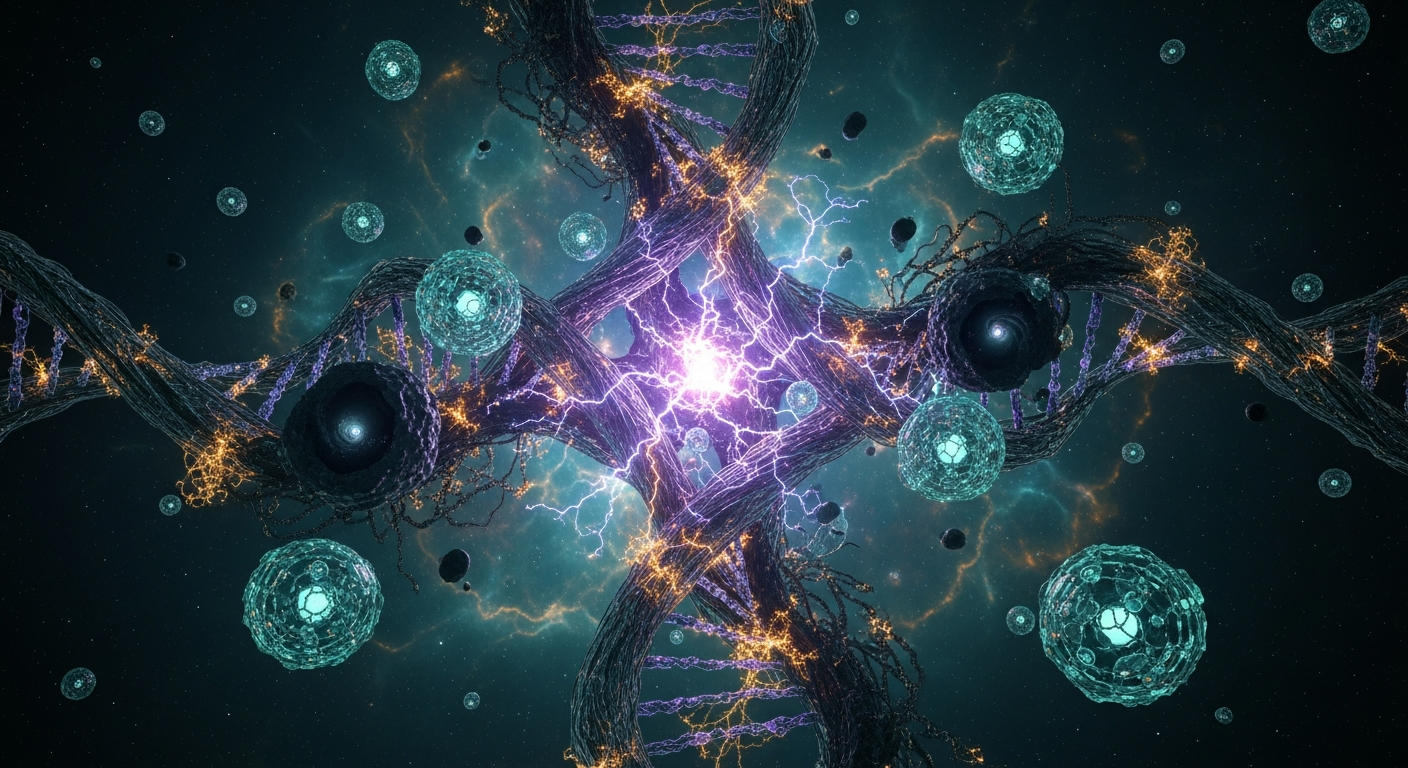
The Dark Matter of DNA: Unlocking the Hidden 98% of the Human Genome

The Dark Matter of DNA: Unlocking the Hidden 98% of the Human Genome Introduction: Exploring the Unseen Blueprint of Life When the Human Genome Project was completed in 2003, it delivered a biological revelation that stunned the scientific community. Researchers discovered that out of the roughly 3 billion base pairs that make up human DNA, only a meager 2% contain the instructions for building proteins. The remaining 98% of the human genome did not code for any proteins at all. For years, this vast, uncharted genetic territory was dismissively labeled as "junk DNA"—believed to be nothing more than the evolutionary leftovers of millions of years of genetic mutation. Today, this outdated paradigm has been entirely dismantled. Scientists now refer to this non-coding region as the "Dark Matter of DNA." Much like the dark matter in astrophysics that invisibly shapes the universe, genomic dark matter invisibly shapes human biology. It holds the key to understanding gene regulation, cellular differentiation, and the underlying mechanisms of complex human diseases. Unlocking this hidden 98% is currently one of the most exciting and rapidly advancing frontiers in modern genetics. The Scientific Reality of Genomic Dark Matter The Fall of "Junk DNA" and the Rise of ENCODE The turning point in our understanding of non-coding DNA came with the launch of the Encyclopedia of DNA Elements (ENCODE) project. Tasked with identifying all functional elements within the human genome, the ENCODE consortium revealed that at least 80% of our genome is biochemically active. Instead of being an inert graveyard of genetic fossils, the dark matter of DNA is teeming with activity, serving as a highly complex operating system that dictates when, where, and how the 2% of protein-coding genes are expressed. The Orchestrators: Promoters, Enhancers, and Silencers The dark matter of DNA is heavily populated by regulatory elements. These are specific sequences of non-coding DNA that act as genetic switches and dials: Promoters: Located just upstream of a gene, promoters are the starting lines where the machinery for transcribing DNA into RNA binds. Enhancers: These sequences can be located far away from the gene they regulate—sometimes hundreds of thousands of base pairs distant. Through the physical looping of the 3D DNA molecule, enhancers come into contact with promoters to dramatically ramp up gene expression. Silencers: The molecular brakes of the genome. When specific proteins bind to silencer regions, they suppress the expression of a gene, preventing proteins from being manufactured at the wrong time or in the wrong cell type. Non-Coding RNAs: The Unseen Messengers One of the most profound discoveries within the dark matter of DNA is that while it does not code for proteins, much of it is transcribed into non-coding RNAs (ncRNAs). These molecules are critical architects of cellular function: microRNAs (miRNAs): Short RNA molecules that bind to messenger RNA (mRNA) to prevent them from being translated into proteins. They act as fine-tuners of gene expression and are heavily implicated in cancer biology. Long non-coding RNAs (lncRNAs): These larger molecules act as scaffolds, guides, and decoys. They are deeply involved in epigenetics, helping to recruit chromatin-remodeling complexes that physically alter how tightly DNA is wound, thereby turning entire genetic neighborhoods on or off. Transposons: Jumping Genes and Evolutionary Engines Nearly half of the human genome consists of transposable elements, or "jumping genes." Originally discovered by geneticist Barbara McClintock, these sequences have the unique ability to copy and paste themselves throughout the genome. While active transposition can cause harmful mutations, over evolutionary time, these elements have been co-opted by the human body to drive genetic diversity and create new regulatory networks. Transposons are a testament to the dynamic, ever-changing nature of our genomic dark matter. Genomic Dark Matter and Human Disease The medical implications of decoding non-coding DNA are staggering. Genome-Wide Association Studies (GWAS) have shown that over 90% of genetic variants associated with complex human diseases—such as Alzheimer's disease, type 2 diabetes, autoimmune disorders, and various cancers—lie entirely within the dark matter of DNA. A mutation in an enhancer region, for example, might not alter the structure of a protein, but it can cause that protein to be produced in massive, unchecked quantities, leading to tumor growth. By shifting the focus from the 2% of coding genes to the 98% of regulatory dark matter, researchers are identifying novel biomarkers for early disease detection and uncovering completely new targets for precision therapies. Conclusion: Lighting Up the Genomic Dark Universe The journey from the dismissive concept of "junk DNA" to the intricate reality of genomic dark matter represents a monumental paradigm shift in biological science. We now understand that the blueprint of human life is not merely a list of protein ingredients, but a remarkably sophisticated, interconnected web of regulatory networks hidden within the 98% of our non-coding DNA. As sequencing technologies become more advanced and artificial intelligence models are deployed to map complex 3D genomic structures, the dark matter of DNA is slowly stepping into the light. Unlocking these secrets promises to revolutionize our understanding of human evolution, developmental biology, and molecular medicine. The blueprint of life has always been in our hands, but we are finally learning how to read the most important instructions hidden between the lines. General

The Dark Matter of DNA: Unlocking the Hidden 98% of the Human Genome

Introduction: Exploring the Unseen Blueprint of Life

When the Human Genome Project was completed in 2003, it delivered a biological revelation that stunned the scientific community. Researchers discovered that out of the roughly 3 billion base pairs that make up human DNA, only a meager 2% contain the instructions for building proteins. The remaining 98% of the human genome did not code for any proteins at all. For years, this vast, uncharted genetic territory was dismissively labeled as “junk DNA”—believed to be nothing more than the evolutionary leftovers of millions of years of genetic mutation.

Today, this outdated paradigm has been entirely dismantled. Scientists now refer to this non-coding region as the “Dark Matter of DNA.” Much like the dark matter in astrophysics that invisibly shapes the universe, genomic dark matter invisibly shapes human biology. It holds the key to understanding gene regulation, cellular differentiation, and the underlying mechanisms of complex human diseases. Unlocking this hidden 98% is currently one of the most exciting and rapidly advancing frontiers in modern genetics.

The Scientific Reality of Genomic Dark Matter

The Fall of “Junk DNA” and the Rise of ENCODE

The turning point in our understanding of non-coding DNA came with the launch of the Encyclopedia of DNA Elements (ENCODE) project. Tasked with identifying all functional elements within the human genome, the ENCODE consortium revealed that at least 80% of our genome is biochemically active. Instead of being an inert graveyard of genetic fossils, the dark matter of DNA is teeming with activity, serving as a highly complex operating system that dictates when, where, and how the 2% of protein-coding genes are expressed.

The Orchestrators: Promoters, Enhancers, and Silencers

The dark matter of DNA is heavily populated by regulatory elements. These are specific sequences of non-coding DNA that act as genetic switches and dials:

  • Promoters: Located just upstream of a gene, promoters are the starting lines where the machinery for transcribing DNA into RNA binds.
  • Enhancers: These sequences can be located far away from the gene they regulate—sometimes hundreds of thousands of base pairs distant. Through the physical looping of the 3D DNA molecule, enhancers come into contact with promoters to dramatically ramp up gene expression.
  • Silencers: The molecular brakes of the genome. When specific proteins bind to silencer regions, they suppress the expression of a gene, preventing proteins from being manufactured at the wrong time or in the wrong cell type.

Non-Coding RNAs: The Unseen Messengers

One of the most profound discoveries within the dark matter of DNA is that while it does not code for proteins, much of it is transcribed into non-coding RNAs (ncRNAs). These molecules are critical architects of cellular function:

  • microRNAs (miRNAs): Short RNA molecules that bind to messenger RNA (mRNA) to prevent them from being translated into proteins. They act as fine-tuners of gene expression and are heavily implicated in cancer biology.
  • Long non-coding RNAs (lncRNAs): These larger molecules act as scaffolds, guides, and decoys. They are deeply involved in epigenetics, helping to recruit chromatin-remodeling complexes that physically alter how tightly DNA is wound, thereby turning entire genetic neighborhoods on or off.

Transposons: Jumping Genes and Evolutionary Engines

Nearly half of the human genome consists of transposable elements, or “jumping genes.” Originally discovered by geneticist Barbara McClintock, these sequences have the unique ability to copy and paste themselves throughout the genome. While active transposition can cause harmful mutations, over evolutionary time, these elements have been co-opted by the human body to drive genetic diversity and create new regulatory networks. Transposons are a testament to the dynamic, ever-changing nature of our genomic dark matter.

Genomic Dark Matter and Human Disease

The medical implications of decoding non-coding DNA are staggering. Genome-Wide Association Studies (GWAS) have shown that over 90% of genetic variants associated with complex human diseases—such as Alzheimer’s disease, type 2 diabetes, autoimmune disorders, and various cancers—lie entirely within the dark matter of DNA.

A mutation in an enhancer region, for example, might not alter the structure of a protein, but it can cause that protein to be produced in massive, unchecked quantities, leading to tumor growth. By shifting the focus from the 2% of coding genes to the 98% of regulatory dark matter, researchers are identifying novel biomarkers for early disease detection and uncovering completely new targets for precision therapies.

Conclusion: Lighting Up the Genomic Dark Universe

The journey from the dismissive concept of “junk DNA” to the intricate reality of genomic dark matter represents a monumental paradigm shift in biological science. We now understand that the blueprint of human life is not merely a list of protein ingredients, but a remarkably sophisticated, interconnected web of regulatory networks hidden within the 98% of our non-coding DNA.

As sequencing technologies become more advanced and artificial intelligence models are deployed to map complex 3D genomic structures, the dark matter of DNA is slowly stepping into the light. Unlocking these secrets promises to revolutionize our understanding of human evolution, developmental biology, and molecular medicine. The blueprint of life has always been in our hands, but we are finally learning how to read the most important instructions hidden between the lines.

Reader Comments

Copied title and URL