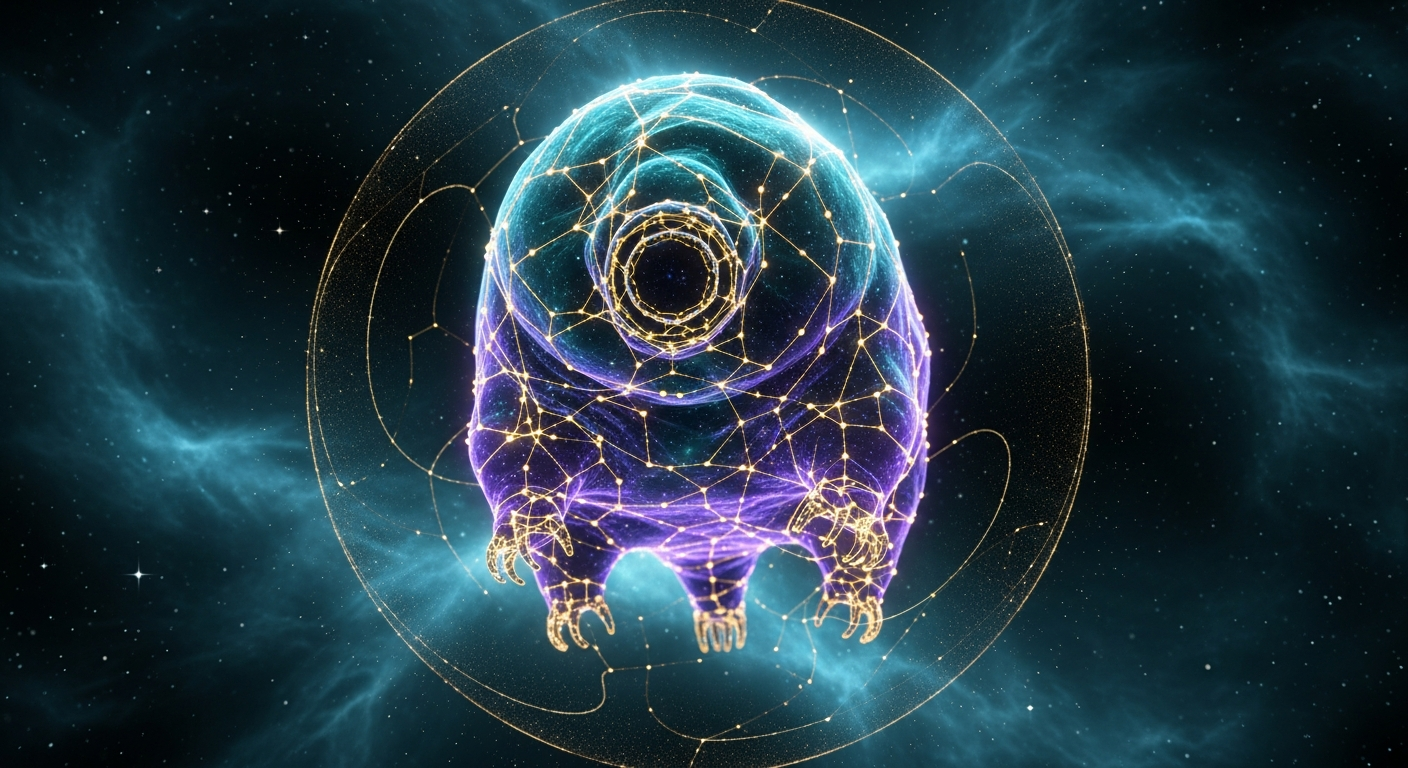
The Tardigrade Enigma: How Earth’s Toughest Microbe Survives the Vacuum of Space
Introduction: Meet the Cosmic “Water Bear”
When we imagine the harsh, unforgiving environment of outer space, we assume it to be completely hostile to biology. The freezing temperatures, the absolute lack of oxygen, and the deadly barrage of cosmic radiation form a lethal combination for almost all known life forms. Yet, there is a microscopic titan that defies the laws of biological fragility: the tardigrade.
Often affectionately referred to as “water bears” or “moss piglets,” tardigrades are microscopic, eight-legged animals (typically measuring just 0.5 millimeters in length) that can be found in almost every ecosystem on Earth, from deep-sea trenches to Himalayan peaks. However, their true claim to fame is their unprecedented resilience. Despite being colloquially labeled as Earth’s toughest microbe, they are actually complex micro-animals capable of surviving conditions that would instantly annihilate human beings. The greatest testament to their resilience is their ability to survive the ultimate extreme environment: the vacuum of space. But how exactly does this tiny organism achieve such biological wizardry?
The Science of Survival: Decoding the Tardigrade Enigma
The secret to the tardigrade’s cosmic survival does not lie in an impenetrable physical shell, but rather in a masterful display of extreme biochemical adaptation. Scientists have identified several mind-bending physiological mechanisms that allow tardigrades to cheat death.
1. Cryptobiosis: Entering the “Tun” State
The primary mechanism allowing tardigrades to survive the vacuum of space is a state of suspended animation known as cryptobiosis, specifically anhydrobiosis (life without water). When exposed to extreme desiccation or the absolute zero-like conditions of space, the tardigrade curls up into a dehydrated, seed-like ball called a tun.
During this transformation, the tardigrade reduces its metabolism to less than 0.01% of its normal rate and expels up to 95% of the water from its body. In most organisms, severe cellular dehydration causes cell membranes to rupture and proteins to unfold, leading to immediate death. However, tardigrades produce unique molecules, including specific sugars like trehalose and a unique set of Tardigrade-Specific Intrinsically Disordered Proteins (TDPs). These molecules act like biological glass (a process called vitrification), encasing and protecting vital cellular structures from collapsing and preventing the formation of lethal ice crystals in freezing temperatures.
2. The Shield of Dsup: DNA Protection Against Cosmic Radiation
Surviving the lack of oxygen and pressure is only half the battle; outer space is flooded with lethal ultraviolet (UV) and ionizing cosmic radiation that tears DNA apart. In 2016, researchers sequencing the genome of the extremely resilient tardigrade species Ramazzottius varieornatus made a groundbreaking discovery: a unique protein they named Dsup (Damage Suppressor).
Dsup is a specialized protein that binds to the tardigrade’s DNA, acting like a microscopic molecular shield. It physically wraps around the genetic material, neutralizing damaging free radicals generated by ionizing radiation and preventing X-rays and cosmic rays from snapping the fragile DNA strands. Remarkably, Dsup protects the DNA without interfering with normal cellular functions. When scientists introduced the Dsup protein into human cells in a laboratory setting, those engineered cells exhibited a roughly 40% higher tolerance to X-ray radiation, opening revolutionary pathways for human medicine and space exploration.
3. Tardigrades in Space: Real-World Cosmic Voyagers
The tardigrade’s space-faring capabilities are not just theoretical; they have been rigorously tested in the actual vacuum of space. In 2007, the European Space Agency (ESA) launched the TARDIS (Tardigrades in Space) experiment aboard the FOTON-M3 spacecraft. Living tardigrades were exposed directly to the vacuum of space and deadly solar radiation for 10 days.
Upon returning to Earth and being rehydrated, a significant portion of the tardigrades “woke up,” resumed their normal biological functions, and even successfully reproduced. More recently, in 2019, an Israeli lunar lander named Beresheet crashed on the Moon while carrying thousands of dehydrated tardigrades, leading scientists to speculate that dormant “tuns” may currently be resting intact on the lunar surface.
Conclusion: What Tardigrades Teach Us About Life in the Universe
The tardigrade enigma forces us to expand our understanding of the limits of biology. These microscopic survivors prove that life is incredibly resilient, possessing biochemical mechanisms capable of adapting to conditions that do not even naturally exist on Earth.
The implications of tardigrade research extend far beyond mere scientific curiosity. By unlocking the secrets of the tun state and the Dsup protein, researchers are exploring breakthroughs in medicine, such as creating shelf-stable blood products and vaccines that do not require continuous refrigeration. Furthermore, in the realm of astrobiology, the water bear gives credibility to the theory of panspermia—the idea that life could hitch a ride on meteorites and survive the perilous journey between planets.
Ultimately, as humanity looks toward the stars and prepares for deep-space exploration, Earth’s toughest microbe serves as both an inspiration and a biological blueprint. The tardigrade reminds us that while space is a vast, deadly vacuum, life—with enough time and evolutionary ingenuity—always finds a way.


Reader Comments