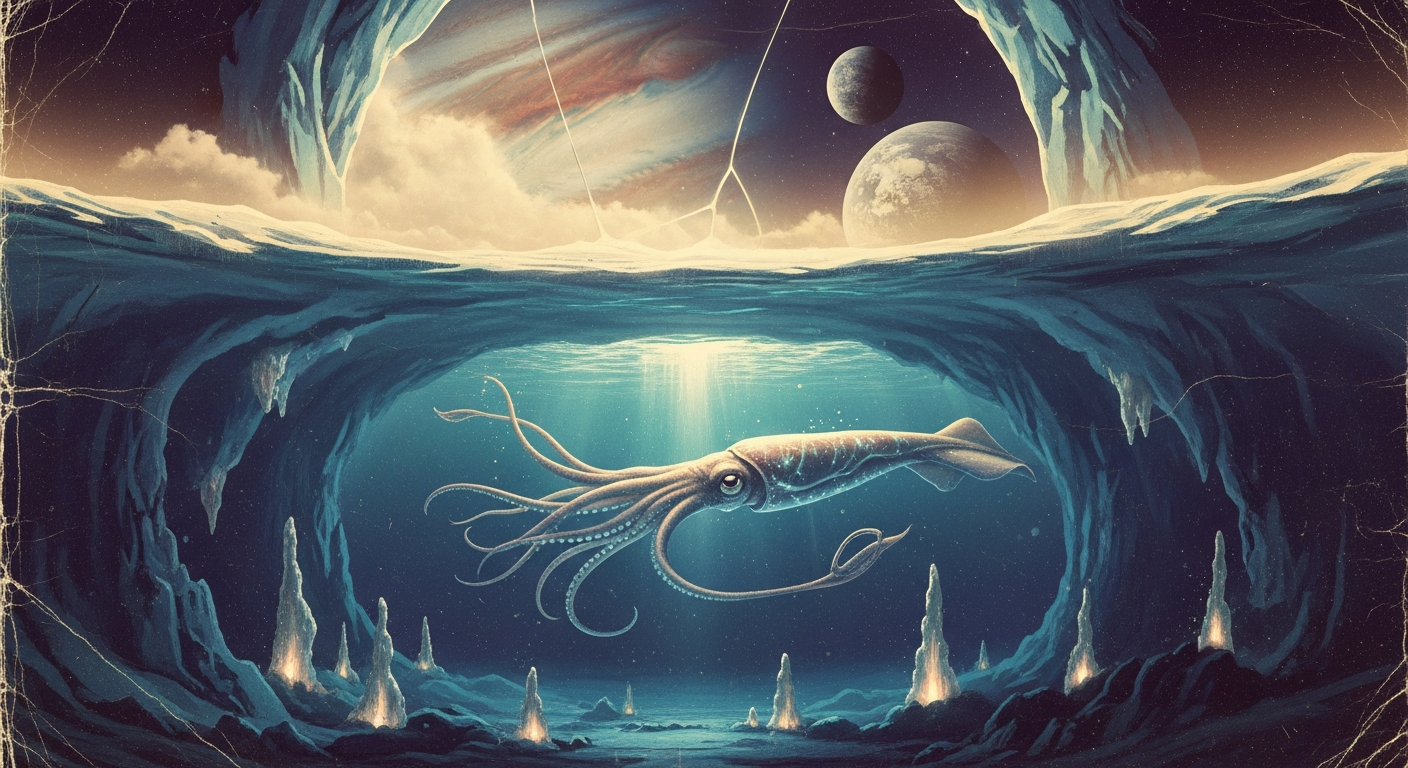
Space Oceans: Could Earth’s Giant Squids Survive on Jupiter’s Icy Moons?
When you look up at the night sky, you might imagine space as a dry, dusty, and empty place. But what if I told you that our solar system is actually hiding giant, swirling oceans? It is true! Millions of miles away from Earth, Jupiter’s icy moons are keeping a massive secret. Underneath their thick, frozen shells, moons like Europa and Ganymede hold more liquid water than all the oceans on Earth combined!
This amazing discovery has astrobiologists—scientists who study life in space—asking a very exciting question: If these moons have oceans, could deep-sea creatures from Earth live there? To find out, let us take one of the most mysterious monsters of our own planet, the Giant Squid, and send it on an imaginary journey to the space oceans of Jupiter!
The Hidden Space Oceans of Jupiter
Europa: An Ocean World
To understand if our giant squid could survive, we first need to know what a space ocean looks like. Let us look at Jupiter’s moon, Europa. From the outside, Europa looks like a giant, scratched-up snowball. Its surface is covered in a layer of solid ice that is miles thick.
But deep down below that ice, there is a giant ocean of salty, liquid water. Because it is so far from the Sun, you might wonder why the water does not freeze completely. The secret is something called tidal heating. Jupiter is a massive planet with incredibly strong gravity. As Europa circles Jupiter, this gravity pulls and stretches the moon, like bending a paperclip back and forth. This stretching creates friction and heat deep inside the moon, keeping the underground ocean warm and liquid!
Meet the Challenger: Earth’s Giant Squid
Now, let us introduce our space explorer: the Giant Squid (scientific name: Architeuthis dux). This magnificent creature can grow to be as long as a school bus, with massive eyes the size of dinner plates and long, powerful tentacles.
On Earth, the giant squid is a champion of the deep sea. It lives thousands of feet underwater where the ocean is pitch-black, freezing cold, and the weight of the water creates a crushing pressure that would instantly squash a human submarine. Since the squid already loves the dark, freezing, and high-pressure deep sea of Earth, it seems like the perfect candidate to survive in Europa’s dark space oceans. But would it actually survive? Let us put it to the test!
The Space Survival Test: Could a Squid Survive?
Test 1: Darkness, Cold, and Pressure
Europa’s ocean is completely dark because sunlight cannot pass through miles of thick surface ice. It is also very cold, and because the ocean is incredibly deep (maybe 60 miles or 100 kilometers deep!), the water pressure is intense.
The Verdict: PASS! The giant squid is already a master of the dark and the cold. Its giant eyes are designed to see glowing lights in the pitch-black ocean, and its squishy body has no air pockets, meaning the crushing water pressure of Europa would not bother it at all.
Test 2: Breathing Without Air
Just like you and me, giant squids need oxygen to live. On Earth, oxygen from the air mixes into the ocean waves, and special ocean currents carry that oxygen all the way down to the deep sea for the squid to breathe through its gills. However, Europa’s ocean is trapped under a thick roof of solid ice. There is no air above the water, and no waves to mix oxygen into the sea.
Scientists think there might be a tiny bit of oxygen on Europa, created when space radiation hits the ice, but it is probably not enough. A creature as huge and active as a giant squid needs a lot of oxygen to power its giant muscles and tentacles.
The Verdict: FAIL. Without enough oxygen, our giant squid would quickly run out of breath in the space ocean.
Test 3: The Cosmic Food Chain
Even if our giant squid brought a scuba tank to breathe, it would still need to eat! Giant squids are fierce predators; they eat large deep-sea fish and other squids. On Earth, the food chain starts with the Sun. Sunlight feeds plants, small fish eat the plants, and big fish eat the small fish. On Europa, there is no sunlight to start this food chain.
Scientists believe that if there is food on Europa, it comes from underwater volcanoes called hydrothermal vents. Special tiny bacteria can eat the chemicals from these volcanoes to survive (a process called chemosynthesis). While this is a cool way to make food, it is a very slow and small food chain. It might support tiny alien bugs or worms, but it would not provide nearly enough food to feed a giant, hungry squid!
The Verdict: FAIL. There are simply no giant space-fish for our squid to hunt and eat.
Conclusion: The Search for Alien “Squids”
So, could Earth’s giant squid survive on Jupiter’s icy moons? The scientific answer is no. While it could handle the cold and the dark, an Earth squid would eventually run out of oxygen and starve in the hidden oceans of Europa.
But do not let that make you sad! This thought experiment teaches us something incredibly important about alien life. Even though an Earth creature could not survive there as it is, it is very possible that alien creatures have evolved and adapted to live perfectly in Europa’s ocean. Instead of giant squids, there could be smaller, slower, alien squid-like creatures that do not need much oxygen and feed on the chemicals from underwater space volcanoes!
By studying how extreme creatures live in the deep, dark oceans of Earth, scientists are learning exactly where to look for life in outer space. The next time you look at the stars, remember: the universe is not just filled with rocks and gas. It is filled with vast, hidden oceans, just waiting to be explored.
The content is truly fascinating. Even if life cannot survive on Earth, organisms might be living on another, new planet. The possibility is not zero; after all, extraterrestrial life must exist somewhere in this universe.


Reader Comments