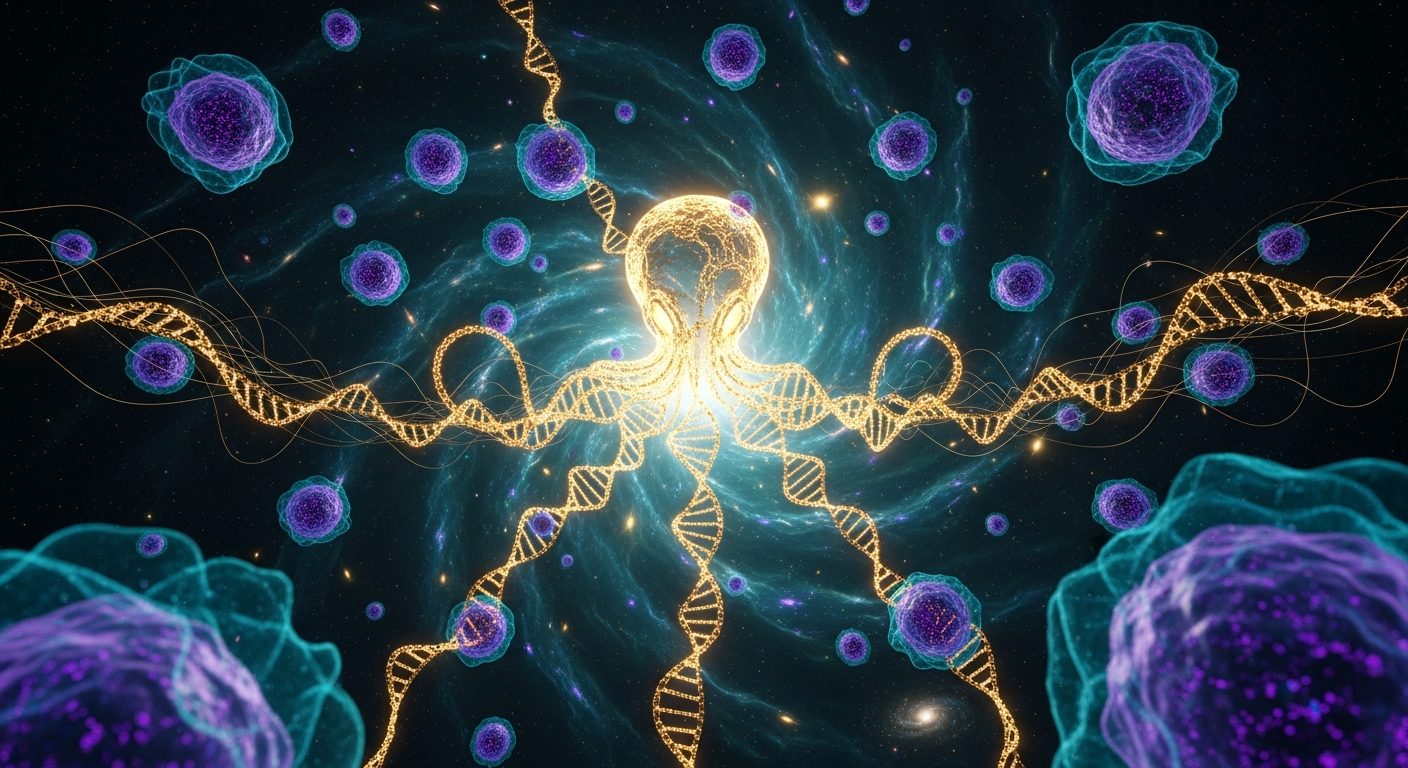
The Octopus Genome: Unraveling the Biological Mysteries of Earth’s Alien Intelligence

The Octopus Genome: Unraveling the Biological Mysteries of Earth's Alien Intelligence Introduction: Earth's Resident Aliens If we are searching for alien intelligence, we need not look to the stars; we need only peer into the depths of our own oceans. The octopus, a soft-bodied invertebrate, exhibits cognitive abilities that rival those of intelligent vertebrates. They navigate complex mazes, solve puzzles, use tools, and display sophisticated observational learning. Yet, from an evolutionary standpoint, human and octopus lineages diverged over 500 million years ago, our last common ancestor being a primitive, blind flatworm. This means that the high-level intelligence observed in cephalopods evolved entirely independently from our own, offering a fascinating parallel experiment in the evolution of mind. For decades, the biological machinery driving this unique intelligence remained largely a mystery. However, the sequencing of the first octopus genome—specifically the California two-spot octopus (Octopus bimaculoides)—ushered in a new era of cephalopod genomics. By unzipping the DNA of these enigmatic creatures, geneticists and evolutionary biologists have uncovered a molecular blueprint that defies conventional rules of neurobiology and genetics. The octopus genome is not merely a genetic code; it is a masterclass in biological plasticity, environmental adaptation, and evolutionary innovation. Decoding the Blueprint: Inside the Octopus Genome A Genome of Surprising Size and Architectural Chaos One of the most striking initial discoveries about the octopus genome is its sheer size and complexity. The genome contains approximately 2.7 billion base pairs, making it nearly as large as the human genome. Even more astounding is its gene count: the octopus boasts around 33,000 protein-coding genes, significantly outnumbering the 20,000 to 25,000 found in humans. This massive gene expansion challenges the outdated notion that invertebrate genomes are inherently simpler than those of vertebrates. Furthermore, the architecture of the octopus genome is dramatically "scrambled." In most animal genomes, specific groups of genes related to development—such as the Hox genes, which dictate the body plan—are clustered tightly together. In the octopus, these clusters have been shattered and redistributed across the genome. This extensive genomic rearrangement suggests a highly dynamic evolutionary history, unconstrained by the typical structural rules that govern other animal lineages. Protocadherins and the Decentralized Brain The octopus nervous system is famously decentralized. Of its roughly 500 million neurons, more than half are distributed across its eight arms, allowing each appendage to taste, touch, and even make decisions independently of the central brain. How does an invertebrate construct such a massively complex and distributed neural network? The answer lies in a massive expansion of a gene family known as protocadherins. In vertebrates, protocadherins regulate the development of neurons and the formation of synapses, acting as the intricate "wiring instructions" for the brain. Before the sequencing of the octopus genome, it was believed that large expansions of protocadherin genes were a uniquely vertebrate trait. Astoundingly, the octopus genome contains 168 protocadherin genes—more than twice the amount found in mammals. This convergent evolution demonstrates that a vast array of protocadherins is essential for constructing a highly complex, intelligent nervous system, regardless of the evolutionary lineage. The Power of RNA Editing: Rewriting the Code on the Fly Perhaps the most jaw-dropping revelation from cephalopod genetics is their unprecedented use of RNA editing. In most organisms, including humans, the genetic dogma is straightforward: DNA makes RNA, and RNA makes proteins. If a species needs a new protein variant to adapt to an environment, it typically waits for a beneficial genetic mutation to occur in its DNA over thousands of years. Octopuses (along with squid and cuttlefish) have hacked this system. They utilize enzymes called ADARs (Adenosine Deaminases Acting on RNA) to intercept the RNA transcript before it reaches the cellular protein factories, converting the nucleotide adenosine (A) into inosine (I). This "A-to-I recoding" alters the final protein structure without changing the underlying DNA sequence. While humans utilize RNA editing in merely a fraction of a percent of our genes, coleoid cephalopods recode over 60% of the RNA transcripts in their nervous system. This allows the octopus to instantly customize its neurological proteins in response to environmental changes, such as shifting water temperatures, providing unparalleled physiological adaptability. However, this biological superpower comes at a cost: to preserve the delicate sequences required for RNA editing, the underlying DNA must remain highly conserved. Thus, octopuses have effectively traded rapid DNA evolution for localized RNA plasticity, a uniquely successful evolutionary strategy unseen in any other animal taxa. Transposons: The Engine of Genomic Plasticity Further driving the biological quirks of the octopus is the massive presence of transposons, commonly known as "jumping genes." These mobile genetic elements can copy and paste themselves into different locations within the genome. In the octopus, transposons make up nearly half of the entire genetic code. While often dismissed as "junk DNA," transposons in the octopus genome appear to be highly active, particularly in neural tissues. By inserting themselves into new locations, these elements can alter gene expression, create novel regulatory networks, and drive the expansion of gene families like the aforementioned protocadherins. The frenetic activity of transposons is heavily responsible for the "scrambled" nature of the octopus genome, acting as the evolutionary engine that drove the development of their alien intelligence. Conclusion: Redefining the Limits of Evolution The sequencing of the octopus genome has profoundly reshaped our understanding of evolutionary biology. It proves that there is more than one way to build a complex, intelligent organism. By relying on massively expanded gene families, a heavily restructured genetic architecture, and an unparalleled mastery of RNA recoding, the octopus has forged an entirely unique path to high-level cognition. As marine biology and neurogenetics continue to converge, the biological mysteries of Earth's resident aliens offer immense scientific value. From inspiring novel artificial intelligence architectures modeled after decentralized nervous systems to yielding breakthroughs in genetic engineering and human medicine via RNA editing therapies, the study of the octopus genome is just beginning. The octopus stands as a mesmerizing reminder of nature's boundless creativity, proving that intelligence is not an exclusive property of the vertebrate lineage, but a remarkable, malleable force of evolution. 一般

The Octopus Genome: Unraveling the Biological Mysteries of Earth’s Alien Intelligence

Introduction: Earth’s Resident Aliens

If we are searching for alien intelligence, we need not look to the stars; we need only peer into the depths of our own oceans. The octopus, a soft-bodied invertebrate, exhibits cognitive abilities that rival those of intelligent vertebrates. They navigate complex mazes, solve puzzles, use tools, and display sophisticated observational learning. Yet, from an evolutionary standpoint, human and octopus lineages diverged over 500 million years ago, our last common ancestor being a primitive, blind flatworm. This means that the high-level intelligence observed in cephalopods evolved entirely independently from our own, offering a fascinating parallel experiment in the evolution of mind.

For decades, the biological machinery driving this unique intelligence remained largely a mystery. However, the sequencing of the first octopus genome—specifically the California two-spot octopus (Octopus bimaculoides)—ushered in a new era of cephalopod genomics. By unzipping the DNA of these enigmatic creatures, geneticists and evolutionary biologists have uncovered a molecular blueprint that defies conventional rules of neurobiology and genetics. The octopus genome is not merely a genetic code; it is a masterclass in biological plasticity, environmental adaptation, and evolutionary innovation.

Decoding the Blueprint: Inside the Octopus Genome

A Genome of Surprising Size and Architectural Chaos

One of the most striking initial discoveries about the octopus genome is its sheer size and complexity. The genome contains approximately 2.7 billion base pairs, making it nearly as large as the human genome. Even more astounding is its gene count: the octopus boasts around 33,000 protein-coding genes, significantly outnumbering the 20,000 to 25,000 found in humans. This massive gene expansion challenges the outdated notion that invertebrate genomes are inherently simpler than those of vertebrates.

Furthermore, the architecture of the octopus genome is dramatically “scrambled.” In most animal genomes, specific groups of genes related to development—such as the Hox genes, which dictate the body plan—are clustered tightly together. In the octopus, these clusters have been shattered and redistributed across the genome. This extensive genomic rearrangement suggests a highly dynamic evolutionary history, unconstrained by the typical structural rules that govern other animal lineages.

Protocadherins and the Decentralized Brain

The octopus nervous system is famously decentralized. Of its roughly 500 million neurons, more than half are distributed across its eight arms, allowing each appendage to taste, touch, and even make decisions independently of the central brain. How does an invertebrate construct such a massively complex and distributed neural network?

The answer lies in a massive expansion of a gene family known as protocadherins. In vertebrates, protocadherins regulate the development of neurons and the formation of synapses, acting as the intricate “wiring instructions” for the brain. Before the sequencing of the octopus genome, it was believed that large expansions of protocadherin genes were a uniquely vertebrate trait. Astoundingly, the octopus genome contains 168 protocadherin genes—more than twice the amount found in mammals. This convergent evolution demonstrates that a vast array of protocadherins is essential for constructing a highly complex, intelligent nervous system, regardless of the evolutionary lineage.

The Power of RNA Editing: Rewriting the Code on the Fly

Perhaps the most jaw-dropping revelation from cephalopod genetics is their unprecedented use of RNA editing. In most organisms, including humans, the genetic dogma is straightforward: DNA makes RNA, and RNA makes proteins. If a species needs a new protein variant to adapt to an environment, it typically waits for a beneficial genetic mutation to occur in its DNA over thousands of years.

Octopuses (along with squid and cuttlefish) have hacked this system. They utilize enzymes called ADARs (Adenosine Deaminases Acting on RNA) to intercept the RNA transcript before it reaches the cellular protein factories, converting the nucleotide adenosine (A) into inosine (I). This “A-to-I recoding” alters the final protein structure without changing the underlying DNA sequence. While humans utilize RNA editing in merely a fraction of a percent of our genes, coleoid cephalopods recode over 60% of the RNA transcripts in their nervous system.

This allows the octopus to instantly customize its neurological proteins in response to environmental changes, such as shifting water temperatures, providing unparalleled physiological adaptability. However, this biological superpower comes at a cost: to preserve the delicate sequences required for RNA editing, the underlying DNA must remain highly conserved. Thus, octopuses have effectively traded rapid DNA evolution for localized RNA plasticity, a uniquely successful evolutionary strategy unseen in any other animal taxa.

Transposons: The Engine of Genomic Plasticity

Further driving the biological quirks of the octopus is the massive presence of transposons, commonly known as “jumping genes.” These mobile genetic elements can copy and paste themselves into different locations within the genome. In the octopus, transposons make up nearly half of the entire genetic code.

While often dismissed as “junk DNA,” transposons in the octopus genome appear to be highly active, particularly in neural tissues. By inserting themselves into new locations, these elements can alter gene expression, create novel regulatory networks, and drive the expansion of gene families like the aforementioned protocadherins. The frenetic activity of transposons is heavily responsible for the “scrambled” nature of the octopus genome, acting as the evolutionary engine that drove the development of their alien intelligence.

Conclusion: Redefining the Limits of Evolution

The sequencing of the octopus genome has profoundly reshaped our understanding of evolutionary biology. It proves that there is more than one way to build a complex, intelligent organism. By relying on massively expanded gene families, a heavily restructured genetic architecture, and an unparalleled mastery of RNA recoding, the octopus has forged an entirely unique path to high-level cognition.

As marine biology and neurogenetics continue to converge, the biological mysteries of Earth’s resident aliens offer immense scientific value. From inspiring novel artificial intelligence architectures modeled after decentralized nervous systems to yielding breakthroughs in genetic engineering and human medicine via RNA editing therapies, the study of the octopus genome is just beginning. The octopus stands as a mesmerizing reminder of nature’s boundless creativity, proving that intelligence is not an exclusive property of the vertebrate lineage, but a remarkable, malleable force of evolution.


Reader Comments

タイトルとURLをコピーしました