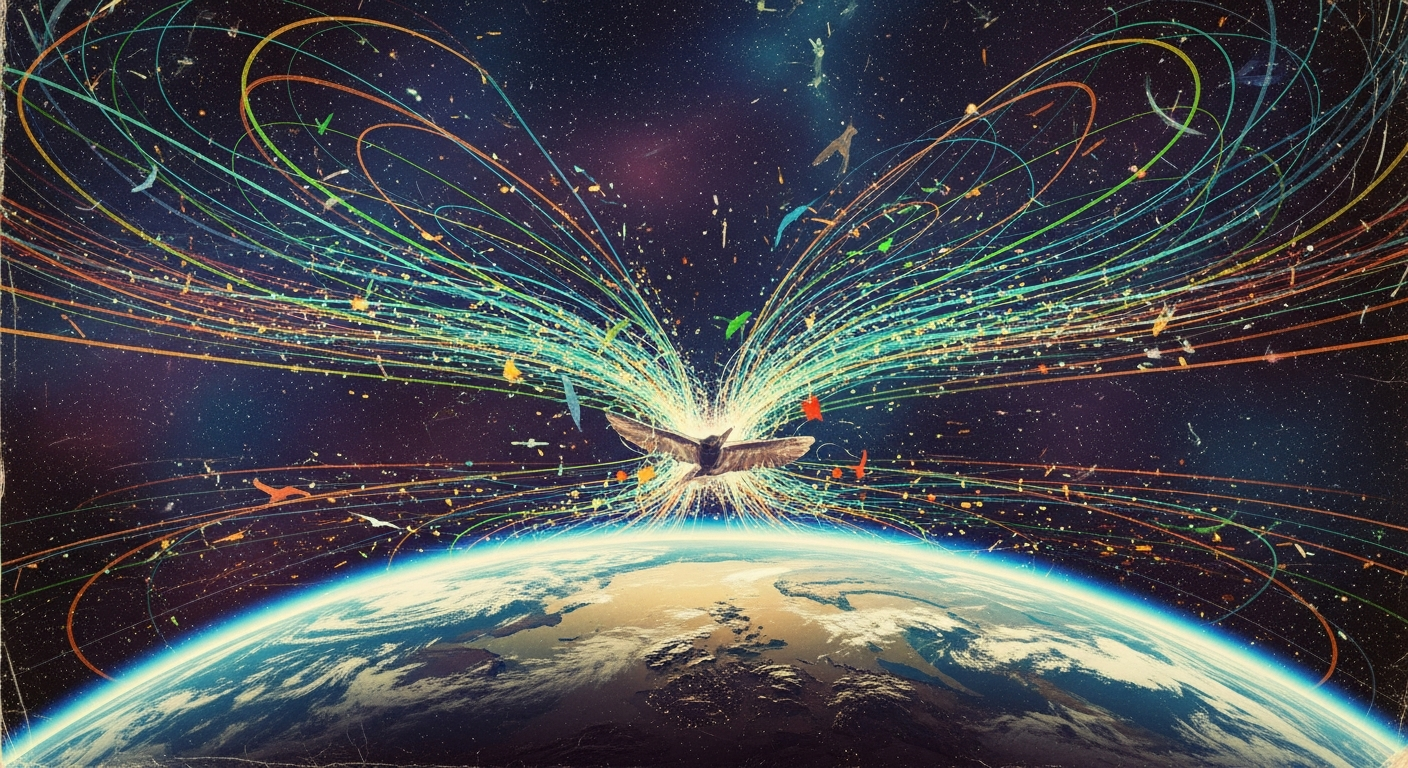
How Birds See Earth’s Magnetic Field: The Bizarre Mystery of Quantum Biology
Introduction: The Greatest Magic Trick in Nature
Imagine if you could look up at the sky and see a glowing, invisible map guiding you exactly where you need to go. You wouldn’t need a smartphone, a GPS, or even a paper map. For humans, this sounds like a superpower from a comic book. But for millions of birds around the world, this is just an ordinary Tuesday.
Every year, birds like the tiny European Robin and the Arctic Tern travel thousands of miles across oceans and continents. They fly through storms, darkness, and unknown territories, yet they always arrive exactly at their destination. How do they do it? For decades, scientists knew that birds were somehow navigating using Earth’s magnetic field. But the exact way they did this remained a giant, head-scratching puzzle.
Now, scientists have discovered the answer, and it is stranger than science fiction. It turns out that birds are not just feeling the magnetic field—they are actually seeing it. And to do this, they are using one of the most mysterious forces in the universe: Quantum Physics. Welcome to the bizarre and wonderful world of quantum biology!
The Detailed Science: Unlocking the Quantum Compass
To understand how a bird sees something invisible, we have to shrink down. We need to go smaller than a feather, smaller than an eye, all the way down to the tiny building blocks of the universe.
The Secret Inside the Eye: Meet “Cryptochrome”
Our journey starts inside the bird’s eye. Inside the retina (the back part of the eye that catches light), birds have a special, microscopic protein called cryptochrome. Think of cryptochrome as a tiny, highly sensitive light-catcher.
When a bird flies during the day, blue light from the sun enters its eye and hits this cryptochrome protein. But this is where the normal biology ends and the bizarre quantum magic begins. That single drop of blue light acts like a tiny spark, giving the protein a jolt of energy.
The Quantum Realm: The “Spooky” Dance of Electrons
When the blue light hits the cryptochrome, it knocks a tiny, super-small particle called an electron out of its normal spot. This creates something scientists call a “radical pair.”
You can think of a radical pair as twins holding hands. When the light hits them, they are pulled apart, but they remain perfectly connected by an invisible thread. In quantum physics, this magical connection is called quantum entanglement. Albert Einstein once called this “spooky action at a distance” because it seems impossible! Even though the two tiny electrons are separated, whatever happens to one instantly affects the other, like two dancers doing the exact same moves on different sides of a stage.
Here is the amazing part: as these two tiny electron twins “dance,” they act like incredibly tiny compass needles. They become super sensitive to the Earth’s magnetic field. Depending on which way the bird is looking (North, South, East, or West), the Earth’s magnetism changes the way the twin electrons spin. This spin tells the bird’s brain exactly which direction it is facing!
What Does the Bird Actually “See”?
So, we know the quantum physics happens inside the eye, but what does the bird actually see? Does a giant “N” for North pop up in the sky?
Scientists believe that birds see the magnetic field as a sort of Augmented Reality (AR) or a Heads-Up Display, much like a video game. Because the cryptochrome is mixed in with the normal cells the bird uses to see, the magnetic field probably looks like a faint shadow, a dark patch, or glowing lines of light superimposed over the normal world.
If the bird turns its head to the North, the shadow might sit perfectly in the center of its vision. If it turns East, the shadow might shift to the side. By keeping that glowing shadow exactly where it needs to be, the bird can fly in a perfect straight line for thousands of miles, safely guided by the quantum world.
Conclusion: A Whole New Frontier of Life
The discovery of magnetoreception (the ability to sense magnetic fields) through quantum physics changes everything we thought we knew about nature. For a long time, scientists believed that the strange, fragile rules of quantum mechanics could only happen inside freezing, heavily controlled laboratories. Nobody believed that quantum entanglement could happen inside the warm, messy, living eye of a tiny bird flapping its wings in the wind.
The incredible mystery of quantum biology shows us that nature is far smarter, more creative, and more magical than we ever imagined. The next time you see a little robin hopping around in your backyard or a flock of geese flying in a “V” shape across the sky, take a moment to look at them with wonder. You aren’t just looking at a bird. You are looking at a living, breathing, flying quantum supercomputer, guided by the invisible forces of the Earth.


Reader Comments