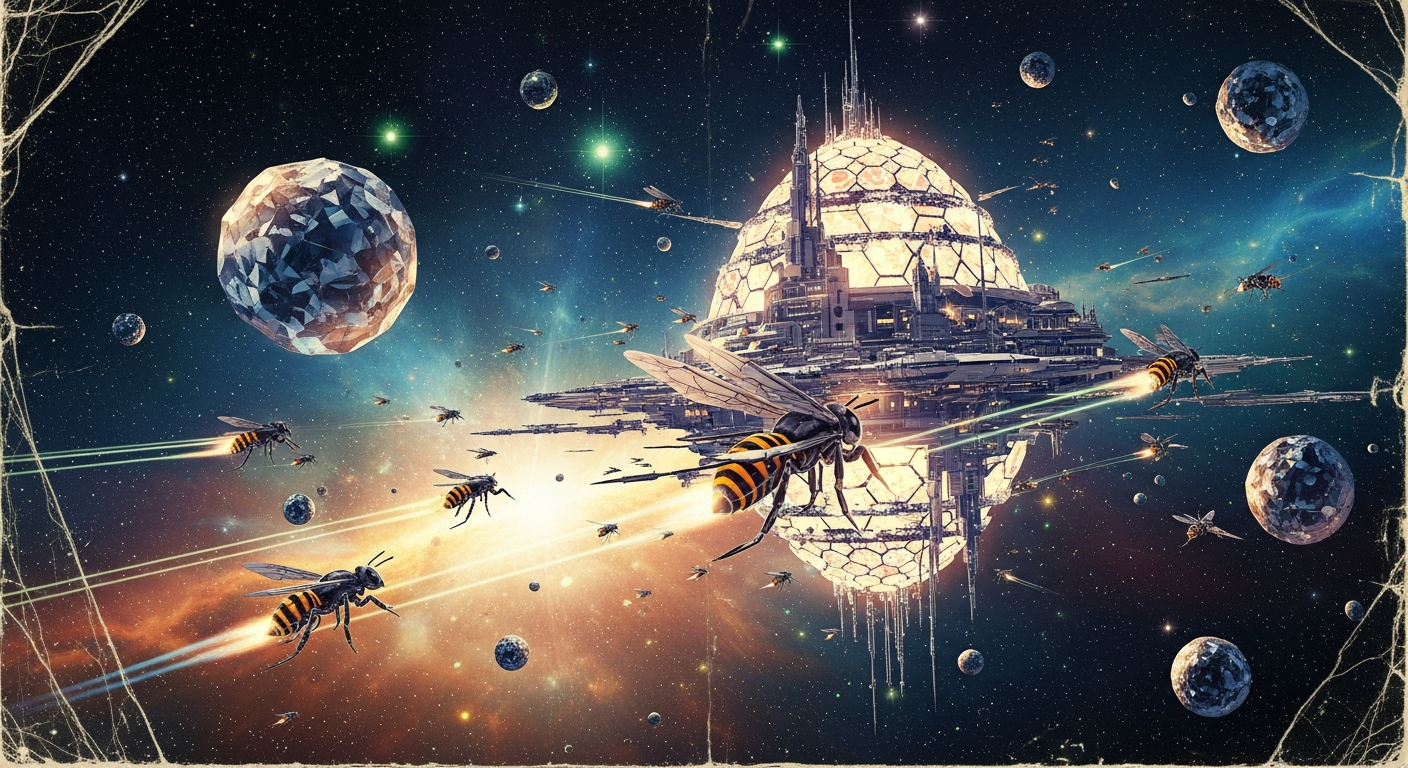
Introduction: The Tiny Astronauts in Your Backyard
Imagine you are an astronaut packing for a historic trip to Mars. You have to pack everything you will need for years in deep space: food, water, rocket fuel, and building materials. Because rockets can only carry so much weight, every single ounce matters. What if I told you that one of the greatest secrets to solving this space-travel puzzle comes from a tiny bug in your garden? Welcome to the fascinating world of Space Bees!
While bees are famous for making sweet honey, they are also nature’s master mathematicians and master engineers. Scientists and space agencies like NASA are looking at “honeybee math” to figure out how to build better spaceships, plot perfect flight paths, and eventually grow food on the Red Planet. Let’s dive into how these buzzing geniuses could help human astronauts travel millions of miles to Mars, explaining the deep science in a way that is easy for anyone to understand.
The Detailed Science: Unlocking Honeybee Math
The Magic of the Hexagon: Saving Space and Weight
Have you ever looked closely at a beehive’s honeycomb? It is made entirely of perfect six-sided shapes called hexagons. But why did bees choose hexagons instead of circles, squares, or triangles? This is where brilliant bee math comes in!
Making beeswax takes a massive amount of physical energy. A bee has to eat about eight ounces of honey just to produce a single ounce of wax! Because wax is so “expensive” for them to make, bees had to find a geometric shape that uses the least amount of wax to hold the most amount of honey. Mathematicians call this famous puzzle the Honeycomb Conjecture. Hexagons fit together flawlessly with absolutely no wasted space, providing huge storage capacity and incredible structural strength.
How does this help astronauts? Aerospace engineers use this exact same biomimicry (copying nature) to build spaceships! By designing the metal walls of rockets with a hidden honeycomb pattern inside, they make the spacecraft incredibly strong but very lightweight. Less weight means the rocket needs less fuel to blast off toward Mars, saving millions of dollars and making the dangerous journey much safer.
The Traveling Salesman: Plotting the Course to Mars
Getting to Mars isn’t just about pointing a rocket in the sky and flying in a straight line. Planets are constantly moving in their orbits! To get there safely, rocket scientists have to calculate the shortest and most fuel-efficient path through the solar system. In mathematics, finding the shortest possible route between multiple points is a highly complex puzzle called the “Traveling Salesman Problem.”
Believe it or not, bees solve this intense math problem every single day. When a bee leaves the hive to gather nectar, it might visit hundreds of flowers. Instead of flying around randomly and wasting energy, a bee’s tiny brain instantly calculates the absolute shortest route to visit the best flowers and get back home. By studying how bees process these complex navigation algorithms so quickly with brains the size of a sesame seed, computer scientists are developing smarter Artificial Intelligence (AI). These bee-inspired computer models are helping astronauts and computers calculate the safest and most efficient flight trajectories to Mars.
Zero Gravity and Martian Farms: Can Bees Survive in Space?
Honeybee math doesn’t just help us build rockets; the bees themselves might actually come with us on the spaceship! NASA has already sent bees into space to test their abilities. Back in 1984, over 3,400 bees flew on the Space Shuttle Challenger. Scientists wanted to know if bees could still use their geometric math skills without Earth’s gravity. Amazingly, the bees adapted to zero-gravity and successfully built perfectly shaped hexagonal honeycombs, just like they do on Earth!
When astronauts finally arrive on Mars, they will need to grow their own food inside special high-tech space greenhouses. One out of every three bites of food we eat requires a pollinator. By bringing space bees along, we can use their natural farming skills to pollinate Martian crops. This crucial idea of creating self-sustaining resources on another planet is known as In-Situ Resource Utilization (ISRU), and bees are the ultimate experts at making it work.
Conclusion: Reaching the Stars with Nature’s Help
As humanity prepares for the incredible journey to colonize Mars, it is amazing to think that our future relies on a creature that has been around for millions of years. Honeybee math has taught us how to build stronger, lighter spaceships and how to navigate the incredibly complicated map of the solar system.
Furthermore, the resilience of bees in space and their essential role in pollinating crops will be the key to growing food and surviving on a harsh, alien world. The next time you see a honeybee buzzing from flower to flower in your backyard, don’t just see a bug. See a tiny, brilliant astronaut and a master mathematician who holds the golden blueprint for humanity’s future among the stars!


Reader Comments