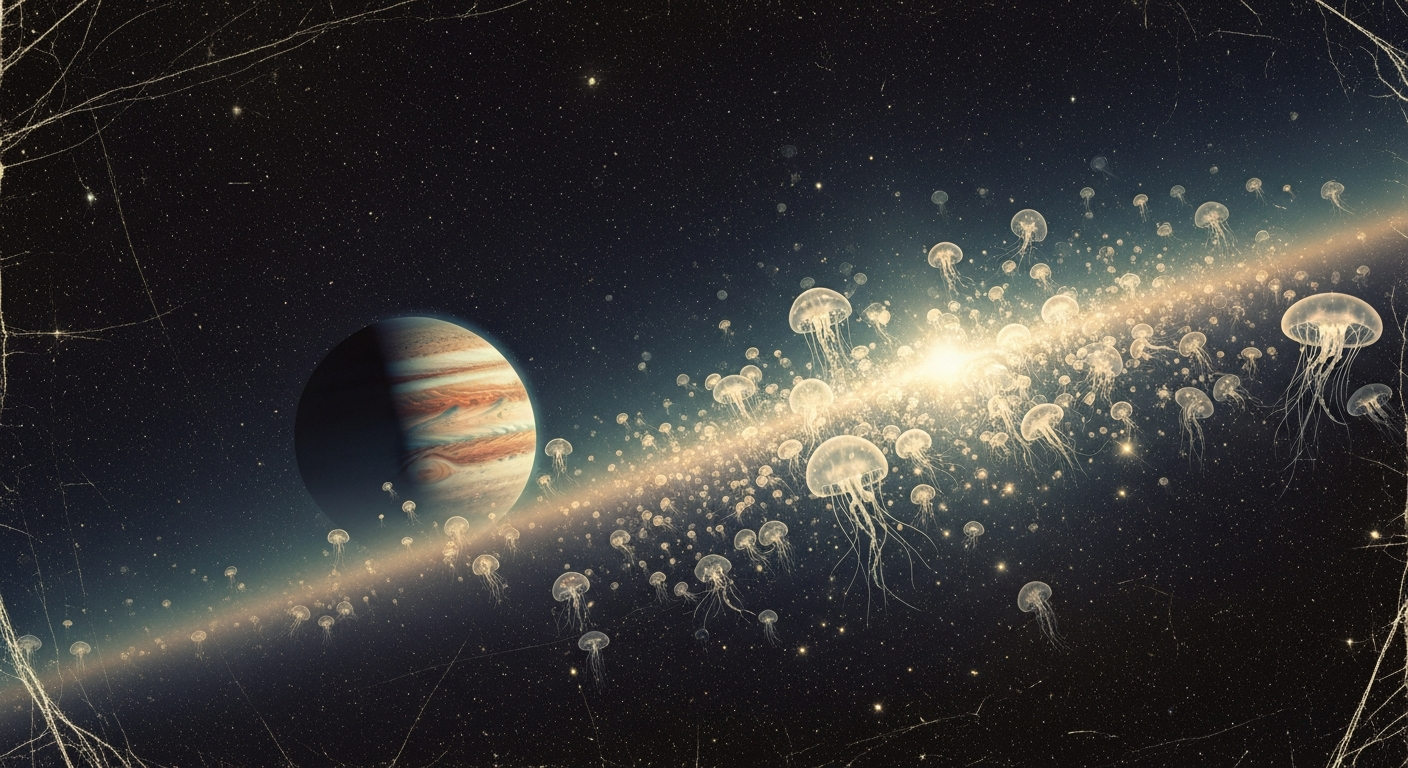
Could Glowing Ocean Jellyfish Help Us Find Alien Life on Jupiter? The Secret Biology of Space Oceans

Could Glowing Ocean Jellyfish Help Us Find Alien Life on Jupiter? The Secret Biology of Space Oceans Introduction: A Light in the Dark Imagine diving deep into Earth's oceans, far below where the sunlight can reach. It is pitch black, cold, and spooky. Suddenly, you see a flash of neon blue! It is a glowing ocean jellyfish, drifting gracefully through the dark water like a living lantern. This incredible trick of nature doesn't just look beautiful; it might actually be the key to one of the biggest mysteries in the universe: finding alien life on Jupiter. When scientists look for extraterrestrial life, they do not just stare at the stars. They look deep into our own oceans! The bizarre and amazing creatures living in Earth's deep sea teach us what life might look like in space oceans—massive bodies of water hidden on distant planets and moons. So, pack your space-suit and your submarine, because we are going on a journey to discover how glowing jellyfish might help us find alien life millions of miles away! The Secret Biology of Space Oceans: A Detailed Scientific Explanation What is Bioluminescence? Nature's Built-In Flashlight To understand space aliens, we first have to understand our glowing Earth friends. The science behind a glowing ocean jellyfish is called bioluminescence (bio-loo-mi-ness-ense). It is a big word, but it just means "living light." Animals create this light by mixing special chemicals inside their bodies. Think of it like snapping a glow stick! When the chemicals mix, they produce a bright, cold light. In the darkest parts of the ocean, animals use bioluminescence for three main reasons: To say hello: Finding friends or family in the dark. To hunt: Luring yummy prey toward their mouths, like a glowing fishing lure. To hide: Startling predators with a bright flash of light so the jellyfish can swim away safely. Europa: Jupiter's Secret Ocean Moon Now, let us zoom out into space, past Mars, all the way to the giant gas planet Jupiter. Jupiter is much too stormy and toxic for life, but it has a very special moon named Europa. From the outside, Europa looks like a giant, scratched-up ball of ice. But scientists have discovered a wonderful secret: underneath that thick ice shell is a gigantic, deep ocean of liquid water! In fact, Europa’s hidden space ocean holds more water than all the oceans on Earth combined. Because the water is trapped under miles of ice, it is completely dark—just like the very bottom of Earth's ocean. It is also kept warm by the gravity of Jupiter squeezing and pulling the moon, creating heat at the bottom of the sea. Water plus heat means life could exist there! Why Alien Life Might Glow If there is life swimming around in Europa's dark space ocean, how would they survive? They would face the exact same problem as our deep-sea jellyfish: it is completely dark! Without sunlight, aliens would not have eyes like ours, and they would not be able to see colors. Scientists believe that if alien fish or extraterrestrial jellyfish live inside Europa, they might have evolved bioluminescence to survive. Just like on Earth, glowing would be the perfect way for alien life to communicate, hunt, and defend themselves in the pitch-black waters of a space ocean. Nature loves a good idea, and glowing in the dark is one of the best survival tricks in the universe! How Scientists Plan to Search for Glowing Aliens How do we look for glowing space jellyfish on a moon that is 400 million miles away? Space agencies like NASA are already on the case! NASA's Europa Clipper mission is heading to Jupiter to map the moon and scan its icy shell. In the future, scientists hope to send a robot called a "cryobot." This nuclear-powered robot would melt a hole straight through Europa's ice and release a robotic submarine into the dark space ocean. Equipped with special cameras and sensors, this submarine would turn off its own lights and float quietly, searching for the faint, tell-tale flashes of alien bioluminescence in the dark. Conclusion: Looking to Earth to Understand the Stars The universe is filled with incredible secrets, but sometimes the best way to understand outer space is to look at our own planet. The glowing ocean jellyfish of Earth's deep sea are more than just beautiful animals; they are a biological map that shows scientists what to look for when searching for alien life on Jupiter. While we haven't found extraterrestrial life just yet, the idea that the dark space oceans of Europa might be filled with glowing, swimming creatures is one of the most exciting possibilities in science. So, the next time you see a picture or video of a glowing jellyfish, take a moment to look up at the night sky. Somewhere out there, hidden beneath miles of ice, a glowing space alien might be swimming through the dark, waiting to be discovered! biological

Could Glowing Ocean Jellyfish Help Us Find Alien Life on Jupiter? The Secret Biology of Space Oceans

Introduction: A Light in the Dark

Imagine diving deep into Earth’s oceans, far below where the sunlight can reach. It is pitch black, cold, and spooky. Suddenly, you see a flash of neon blue! It is a glowing ocean jellyfish, drifting gracefully through the dark water like a living lantern. This incredible trick of nature doesn’t just look beautiful; it might actually be the key to one of the biggest mysteries in the universe: finding alien life on Jupiter.

When scientists look for extraterrestrial life, they do not just stare at the stars. They look deep into our own oceans! The bizarre and amazing creatures living in Earth’s deep sea teach us what life might look like in space oceans—massive bodies of water hidden on distant planets and moons. So, pack your space-suit and your submarine, because we are going on a journey to discover how glowing jellyfish might help us find alien life millions of miles away!

The Secret Biology of Space Oceans: A Detailed Scientific Explanation

What is Bioluminescence? Nature’s Built-In Flashlight

To understand space aliens, we first have to understand our glowing Earth friends. The science behind a glowing ocean jellyfish is called bioluminescence (bio-loo-mi-ness-ense). It is a big word, but it just means “living light.”

Animals create this light by mixing special chemicals inside their bodies. Think of it like snapping a glow stick! When the chemicals mix, they produce a bright, cold light. In the darkest parts of the ocean, animals use bioluminescence for three main reasons:

  • To say hello: Finding friends or family in the dark.
  • To hunt: Luring yummy prey toward their mouths, like a glowing fishing lure.
  • To hide: Startling predators with a bright flash of light so the jellyfish can swim away safely.

Europa: Jupiter’s Secret Ocean Moon

Now, let us zoom out into space, past Mars, all the way to the giant gas planet Jupiter. Jupiter is much too stormy and toxic for life, but it has a very special moon named Europa. From the outside, Europa looks like a giant, scratched-up ball of ice. But scientists have discovered a wonderful secret: underneath that thick ice shell is a gigantic, deep ocean of liquid water!

In fact, Europa’s hidden space ocean holds more water than all the oceans on Earth combined. Because the water is trapped under miles of ice, it is completely dark—just like the very bottom of Earth’s ocean. It is also kept warm by the gravity of Jupiter squeezing and pulling the moon, creating heat at the bottom of the sea. Water plus heat means life could exist there!

Why Alien Life Might Glow

If there is life swimming around in Europa’s dark space ocean, how would they survive? They would face the exact same problem as our deep-sea jellyfish: it is completely dark! Without sunlight, aliens would not have eyes like ours, and they would not be able to see colors.

Scientists believe that if alien fish or extraterrestrial jellyfish live inside Europa, they might have evolved bioluminescence to survive. Just like on Earth, glowing would be the perfect way for alien life to communicate, hunt, and defend themselves in the pitch-black waters of a space ocean. Nature loves a good idea, and glowing in the dark is one of the best survival tricks in the universe!

How Scientists Plan to Search for Glowing Aliens

How do we look for glowing space jellyfish on a moon that is 400 million miles away? Space agencies like NASA are already on the case! NASA’s Europa Clipper mission is heading to Jupiter to map the moon and scan its icy shell.

In the future, scientists hope to send a robot called a “cryobot.” This nuclear-powered robot would melt a hole straight through Europa’s ice and release a robotic submarine into the dark space ocean. Equipped with special cameras and sensors, this submarine would turn off its own lights and float quietly, searching for the faint, tell-tale flashes of alien bioluminescence in the dark.

Conclusion: Looking to Earth to Understand the Stars

The universe is filled with incredible secrets, but sometimes the best way to understand outer space is to look at our own planet. The glowing ocean jellyfish of Earth’s deep sea are more than just beautiful animals; they are a biological map that shows scientists what to look for when searching for alien life on Jupiter.

While we haven’t found extraterrestrial life just yet, the idea that the dark space oceans of Europa might be filled with glowing, swimming creatures is one of the most exciting possibilities in science. So, the next time you see a picture or video of a glowing jellyfish, take a moment to look up at the night sky. Somewhere out there, hidden beneath miles of ice, a glowing space alien might be swimming through the dark, waiting to be discovered!


Reader Comments

Copied title and URL