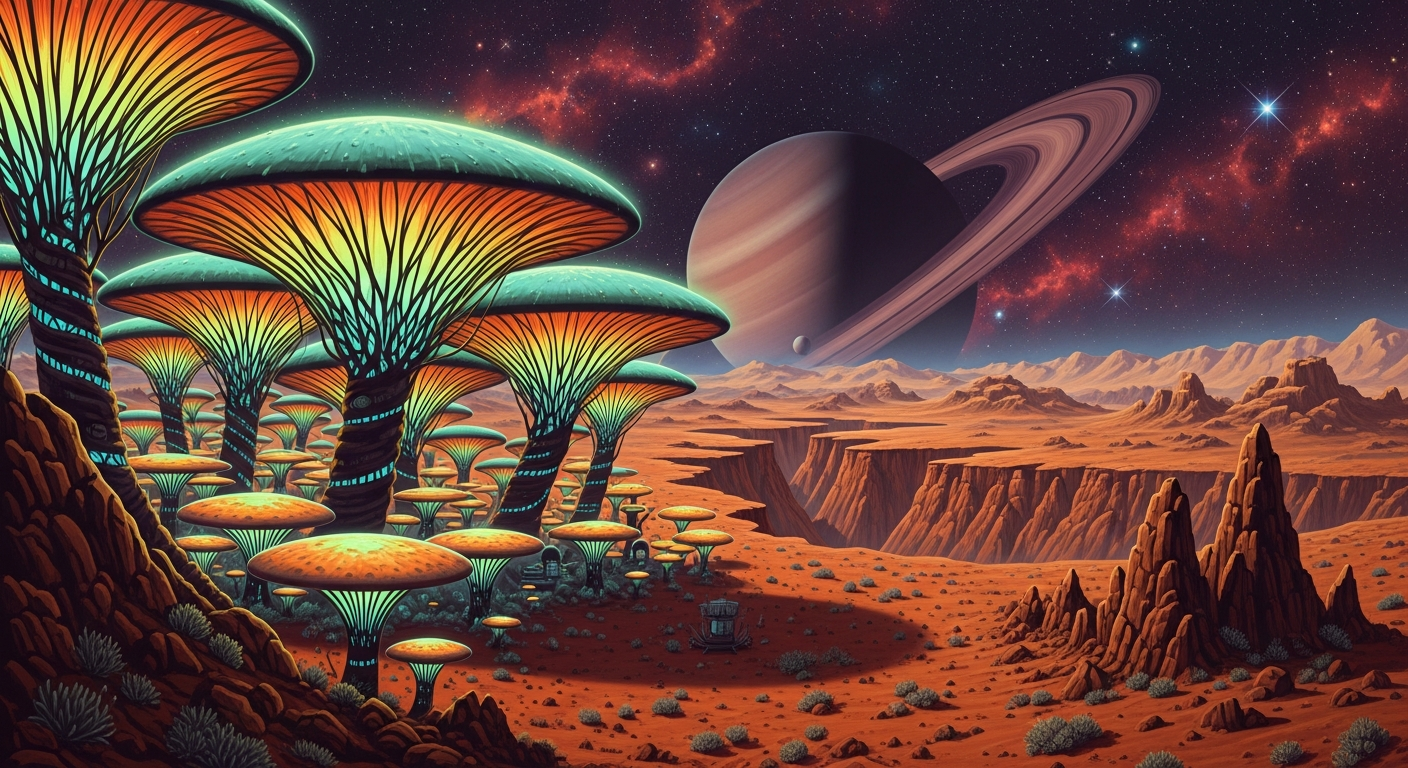
The Mushroom Astronauts: How Space Fungi Could Help Us Build Cities on Mars

The Mushroom Astronauts: How Space Fungi Could Help Us Build Cities on Mars Introduction: The Greatest Challenge of Mars Exploration Imagine you are an astronaut packing your bags for a trip to Mars. What do you need to bring? Food, water, and oxygen are obvious. But what about a house? On Earth, we build houses using heavy materials like bricks, concrete, and steel. However, in space exploration, weight is everything. Rockets cannot carry heavy metal and stone all the way to another planet. It is simply too expensive and takes too much fuel. So, how will we build safe, warm cities on the Red Planet? Scientists at NASA have come up with a surprising, brilliant, and completely natural solution: Space Fungi. Instead of carrying our homes to Mars, what if we could pack tiny seeds and just grow our houses when we get there? Welcome to the incredible world of the mushroom astronauts, where fungi might be the key to human life in space. Detailed Science: How Fungi Become Martian Homes What is Mycelium? Nature's Super-Glue When you think of a mushroom, you probably picture the cute, umbrella-like plant popping out of the ground. But that is only a tiny part of the fungus! Hidden underground is the real hero: the mycelium (pronounced my-SEE-lee-um). Think of mycelium as the root system of a mushroom. It looks like a microscopic, fuzzy, white spider web. On Earth, these tiny threads reach through the soil, breaking down dead plants and absorbing food. But for scientists and architects, mycelium is like a natural super-glue. If you let it grow inside a mold—like a Lego brick shape—it will tightly bind together whatever it touches. Once it is fully grown, you can bake it to stop the growth, leaving you with a brick that is lightweight, surprisingly strong, and totally eco-friendly. Myco-Architecture: Growing Bricks in Space Building things out of mushrooms is a totally new science called myco-architecture. Here is how it would work on Mars, explained in simple steps: Step 1: Pack Light. Astronauts bring tiny, lightweight bags of mushroom spores (which are like microscopic seeds) and some algae (tiny water plants). Step 2: Just Add Water. Once on Mars, astronauts unfold a large, inflatable tent shaped like a house. Step 3: Feed the Fungi. The algae use sunlight and the Martian atmosphere to grow, creating food for the fungi. The mycelium starts to eat, spread, and grow inside the walls of the tent. Step 4: Bake and Move In! After a few weeks, the fuzzy white web fills the walls completely. The astronauts then apply heat to stop the growth. The result is a solid, tough house that grew itself! The Magic Shield: Fungi That Eat Radiation Building a strong house is only half the battle. Space is full of dangerous invisible rays called radiation. On Earth, our planet's magnetic field acts like a giant umbrella, protecting us from this invisible sunburn. Mars does not have this umbrella, meaning radiation could make astronauts very sick. Amazingly, fungi can protect us from this, too! Scientists have discovered special types of fungi living in extremely radioactive places on Earth (like the broken Chernobyl nuclear plant). These incredible mushrooms have a dark pigment called melanin—the exact same stuff that makes human skin tan in the sun. Instead of being hurt by radiation, these dark fungi actually eat the invisible rays and turn them into energy, just like plants eat sunlight! By mixing these melanin-rich fungi into our Martian mushroom bricks, the walls of our houses could absorb dangerous space radiation, creating a perfect magic shield to keep astronauts safe and healthy inside. Conclusion: Fungi, The Future of Space and Earth The idea of "mushroom astronauts" shows us just how creative science can be. By teaming up with nature, we can solve the hardest problems in space exploration. Fungi give us a way to build strong, lightweight homes that grow themselves and protect humans from dangerous space radiation. But the best part of this space research is how it helps us right here at home. If we can learn to grow mushroom houses on Mars, we can use that same mycelium technology to grow clean, green, pollution-free buildings on Earth. So, the next time you see a mushroom in the forest, give it a little nod of respect. You might be looking at the greatest builder of the future, ready to help humanity reach the stars! biological

The Mushroom Astronauts: How Space Fungi Could Help Us Build Cities on Mars

Introduction: The Greatest Challenge of Mars Exploration

Imagine you are an astronaut packing your bags for a trip to Mars. What do you need to bring? Food, water, and oxygen are obvious. But what about a house? On Earth, we build houses using heavy materials like bricks, concrete, and steel. However, in space exploration, weight is everything. Rockets cannot carry heavy metal and stone all the way to another planet. It is simply too expensive and takes too much fuel.

So, how will we build safe, warm cities on the Red Planet? Scientists at NASA have come up with a surprising, brilliant, and completely natural solution: Space Fungi. Instead of carrying our homes to Mars, what if we could pack tiny seeds and just grow our houses when we get there? Welcome to the incredible world of the mushroom astronauts, where fungi might be the key to human life in space.

Detailed Science: How Fungi Become Martian Homes

What is Mycelium? Nature’s Super-Glue

When you think of a mushroom, you probably picture the cute, umbrella-like plant popping out of the ground. But that is only a tiny part of the fungus! Hidden underground is the real hero: the mycelium (pronounced my-SEE-lee-um).

Think of mycelium as the root system of a mushroom. It looks like a microscopic, fuzzy, white spider web. On Earth, these tiny threads reach through the soil, breaking down dead plants and absorbing food. But for scientists and architects, mycelium is like a natural super-glue. If you let it grow inside a mold—like a Lego brick shape—it will tightly bind together whatever it touches. Once it is fully grown, you can bake it to stop the growth, leaving you with a brick that is lightweight, surprisingly strong, and totally eco-friendly.

Myco-Architecture: Growing Bricks in Space

Building things out of mushrooms is a totally new science called myco-architecture. Here is how it would work on Mars, explained in simple steps:

  • Step 1: Pack Light. Astronauts bring tiny, lightweight bags of mushroom spores (which are like microscopic seeds) and some algae (tiny water plants).
  • Step 2: Just Add Water. Once on Mars, astronauts unfold a large, inflatable tent shaped like a house.
  • Step 3: Feed the Fungi. The algae use sunlight and the Martian atmosphere to grow, creating food for the fungi. The mycelium starts to eat, spread, and grow inside the walls of the tent.
  • Step 4: Bake and Move In! After a few weeks, the fuzzy white web fills the walls completely. The astronauts then apply heat to stop the growth. The result is a solid, tough house that grew itself!

The Magic Shield: Fungi That Eat Radiation

Building a strong house is only half the battle. Space is full of dangerous invisible rays called radiation. On Earth, our planet’s magnetic field acts like a giant umbrella, protecting us from this invisible sunburn. Mars does not have this umbrella, meaning radiation could make astronauts very sick.

Amazingly, fungi can protect us from this, too! Scientists have discovered special types of fungi living in extremely radioactive places on Earth (like the broken Chernobyl nuclear plant). These incredible mushrooms have a dark pigment called melanin—the exact same stuff that makes human skin tan in the sun.

Instead of being hurt by radiation, these dark fungi actually eat the invisible rays and turn them into energy, just like plants eat sunlight! By mixing these melanin-rich fungi into our Martian mushroom bricks, the walls of our houses could absorb dangerous space radiation, creating a perfect magic shield to keep astronauts safe and healthy inside.

Conclusion: Fungi, The Future of Space and Earth

The idea of “mushroom astronauts” shows us just how creative science can be. By teaming up with nature, we can solve the hardest problems in space exploration. Fungi give us a way to build strong, lightweight homes that grow themselves and protect humans from dangerous space radiation.

But the best part of this space research is how it helps us right here at home. If we can learn to grow mushroom houses on Mars, we can use that same mycelium technology to grow clean, green, pollution-free buildings on Earth. So, the next time you see a mushroom in the forest, give it a little nod of respect. You might be looking at the greatest builder of the future, ready to help humanity reach the stars!


Reader Comments

Copied title and URL