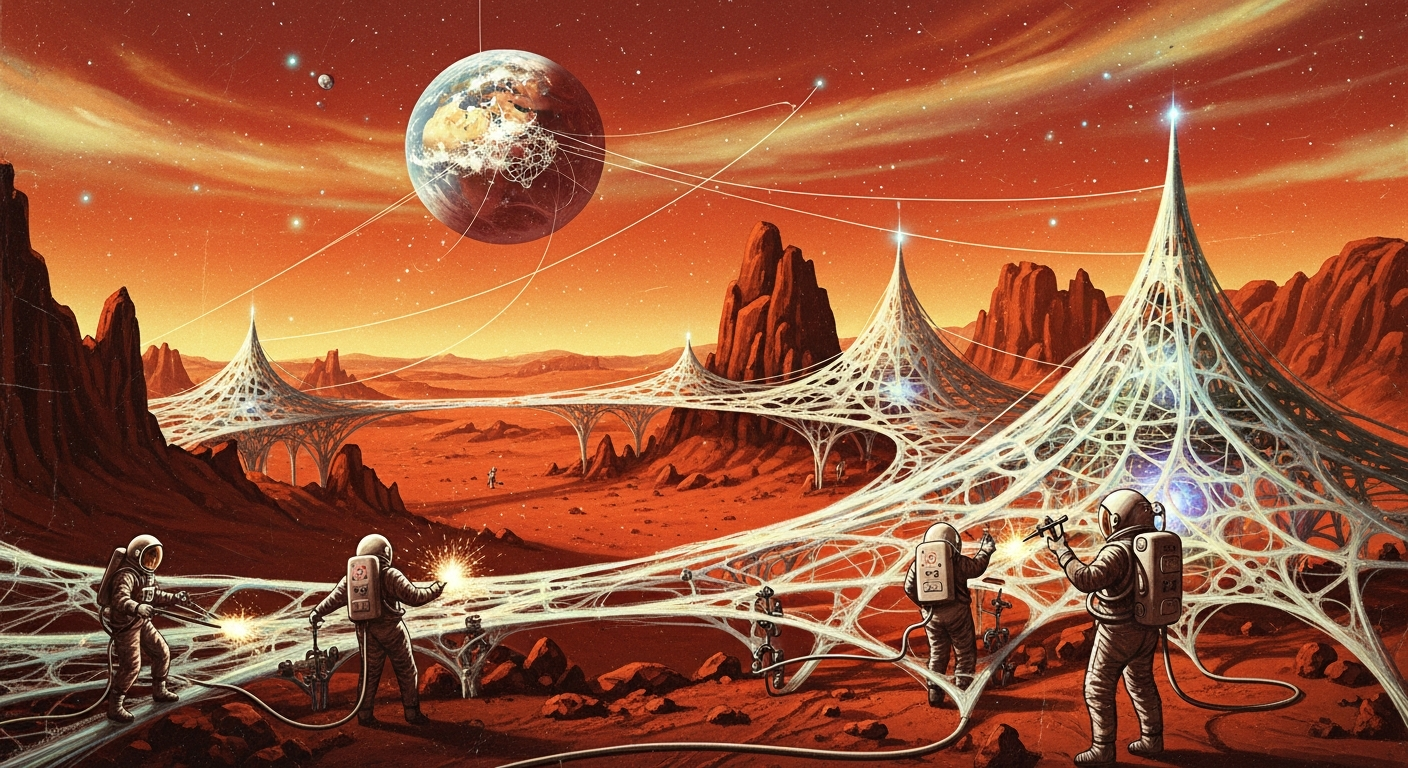
The Cosmic Web: How Spider Silk Could Help Astronauts Build Homes on Mars
Introduction: A Super-Powered Material for the Red Planet
Imagine you are an astronaut on a mission to Mars. After a long, bumpy ride through space, you finally land on the Red Planet. But wait—where are you going to live? You cannot exactly pack a house full of heavy bricks, wood, and steel into a rocket ship. Rockets need to be as light as possible to fly, and every extra pound costs a lot of money. So, what is the solution? The answer might be hiding right in your backyard: spider silk.
In the exciting world of space exploration, scientists are always looking for smart, lightweight ways to build Mars habitats. It turns out that spider silk—the exact same material garden spiders use to spin their webs—might be the ultimate space building material. Let’s dive into the amazing science of how astronauts could use a “cosmic web” to build safe and strong homes on Mars!
The Science Behind the Silk: Nature’s Strongest String
To understand why spider silk is so special, we have to look at it closely like a scientist. Spider silk is made of special natural proteins. Believe it or not, pound for pound, spider silk is up to five times stronger than steel and tougher than Kevlar (the super-strong material used to make bulletproof vests). Yet, it is incredibly lightweight and stretchy. If you had a piece of spider silk as thick as a pencil, it could catch a flying jet plane in mid-air!
Because it is so strong and light, it is the perfect material for building homes on Mars. But how do we get enough spider silk? We cannot send millions of spiders on a rocket ship—they would get very hungry, and spiders do not like working in teams! Instead, scientists have a brilliant trick up their sleeves.
Building on Mars: Growing a Cosmic Web
To make tons of spider silk without any spiders, scientists use an amazing process called bio-manufacturing. They take the DNA (the biological instruction manual) that tells a spider how to make silk, and they put that DNA into tiny living microbes, like yeast or bacteria.
These tiny microbes act like microscopic factories. When astronauts travel to Mars, they just need to bring a small test tube of these special microbes. Once they land, the astronauts can feed the microbes simple sugars and water. The microbes will read the spider DNA and start pumping out pure spider silk proteins! This means astronauts can literally “grow” their building materials right there on the planet.
Once the spider silk proteins are grown, they can be spun into thick, unbreakable ropes or woven into giant sheets of fabric. Astronauts could use these tough silk fabrics to create huge, inflatable tents. To protect themselves from dangerous space radiation and the freezing cold, they could cover these silk tents with Martian dirt, known as regolith. The spider silk acts like a super-strong skeleton, holding the dirt in place and keeping the astronauts safe inside.
Conclusion: A Web of Possibilities in Space
Building homes on Mars is one of the biggest challenges for the future of space exploration. By looking closely at nature, scientists have found a solution that is lighter, stronger, and smarter than almost anything humans have ever invented from scratch.
Using spider silk to build Mars habitats shows us that even the smallest bugs on Earth can inspire gigantic leaps for humanity in space. So, the next time you see a spider spinning its web in the corner of your garden, do not just see a simple bug. See a tiny, brilliant engineer, whose web design might one day help astronauts live among the stars!
Spiders may tend to be disliked, but they possess remarkable abilities that—if effectively harnessed—could help us live on Mars or elsewhere in space. So, please don’t hate the spiders in your attic or backyard; try to get along with them instead.


Reader Comments