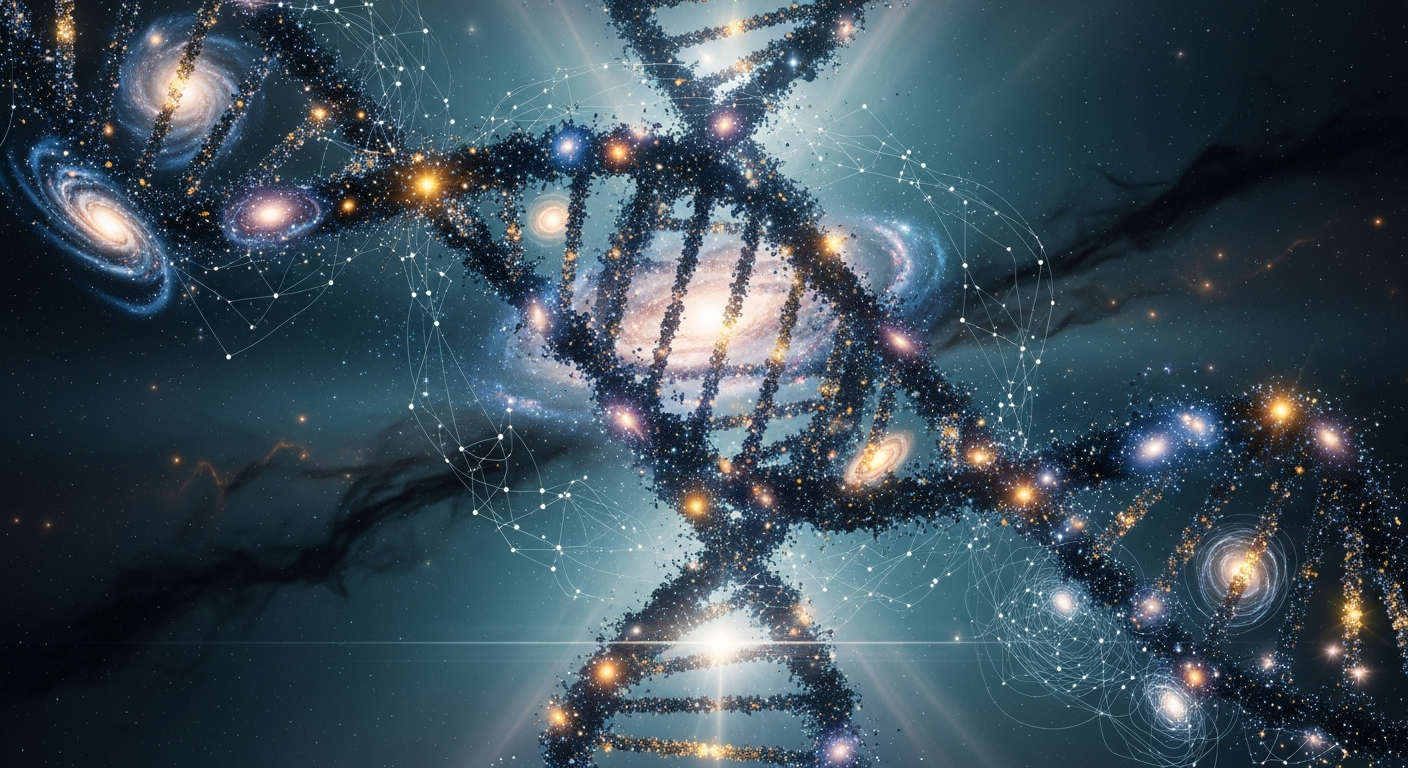
Introduction: The Universe as a Biological Canvas
For centuries, humanity has gazed at the stars and asked a singular, haunting question: Are we alone? Historically, biology and astronomy were treated as distinct realms. Biology was the study of the wet, dynamic, and fragile web of life on Earth, while astronomy belonged to the cold, sterile, and mathematical mechanics of the cosmos. However, the dawn of modern astrobiology has shattered this dichotomy. We are now beginning to understand that the universe is not a barren void, but rather a rich, complex biological canvas. This emerging paradigm introduces us to the concept of the “Cosmic Genome”—the idea that the fundamental chemical blueprints and evolutionary imperatives for life are deeply woven into the very fabric of the universe.
The “Cosmic Genome” does not imply a literal, physical strand of DNA floating in the interstellar medium. Rather, it represents the pervasive distribution of life’s building blocks: the organic molecules, amino acids, and nucleobases that predate our solar system. By unlocking the biological secrets of the universe, we are discovering that the genesis of life on Earth was likely not an isolated, miraculous anomaly, but the localized expression of a universal potential.
Detailed Scientific Explanation: Unraveling the Cosmic Genome
Astrochemistry: The Stellar Forges of Organic Matter
To understand the Cosmic Genome, we must first look to the vast, freezing expanses of interstellar molecular clouds. Advanced spectroscopy and observatories like the James Webb Space Telescope (JWST) have revealed that these regions are teeming with complex chemistry. Deep within these stellar nurseries, elements forged in the hearts of dying stars—carbon, nitrogen, oxygen, and phosphorus—interact under extreme conditions. Here, simple molecules are catalyzed into complex organics on the icy mantles of dust grains.
We have detected Polycyclic Aromatic Hydrocarbons (PAHs) swirling in protoplanetary disks, molecules that are ubiquitous in organic chemistry. Even more astonishing is the discovery of pre-biotic molecules like formamide, a critical precursor to both amino acids and nucleic acids, in the gas clouds of the interstellar medium. The universe is essentially a massive chemical laboratory, actively synthesizing the raw genetic vocabulary required for life long before planets even form.
Meteoritic Delivery: Seeding the Early Earth
If the interstellar medium acts as the laboratory, comets and meteorites serve as the delivery mechanisms. The theory of pseudo-panspermia suggests that while fully formed life may not travel between star systems, the intricate molecular precursors certainly do. The study of carbonaceous chondrites—primitive meteorites that have remained largely unchanged since the dawn of the solar system—provides concrete physical evidence of the Cosmic Genome.
The Murchison meteorite, which fell in Australia in 1969, is perhaps the most famous example. Rigorous chemical analysis has revealed that it contains over 70 distinct extraterrestrial amino acids, including those used by terrestrial life, as well as nucleobases like adenine and guanine—the very “letters” of our DNA and RNA. Furthermore, these meteoritic amino acids exhibit an excess of left-handed chirality (enantiomeric excess). This suggests that the homochirality of life on Earth—a profound biological mystery—may have been dictated by cosmic radiation in space before life even began, indicating that our terrestrial biology was fundamentally shaped by cosmic rules.
Universal Darwinism and Xenobiology
As we decode the Cosmic Genome, scientists are compelled to ask: If life arises elsewhere, will it use the same genetic code? The concept of Universal Darwinism posits that any complex life, regardless of its origin, must undergo natural selection. However, its underlying biochemistry might differ. Astrobiologists are actively researching “XNA” (Xeno-Nucleic Acids)—synthetic genetic polymers that can store and pass on information much like DNA, but use different sugar backbones.
While carbon and liquid water are recognized as the most versatile and likely mediums for life due to their universal abundance and unique chemical properties, the precise genetic architecture may vary depending on planetary conditions. Earth’s reliance on DNA and RNA represents just one successful combination drawn from the universal pool of chemical possibilities. By searching for biosignatures in the atmospheres of exoplanets and exploring the subsurface oceans of icy moons like Europa and Enceladus, we are actively searching for alternative expressions of the Cosmic Genome.
Conclusion: Reading the Book of the Cosmos
The concept of the Cosmic Genome profoundly redefines our understanding of existence. It bridges the gap between the infinitely large and the infinitesimally small, proving that the biochemical processes governing our cells are intimately linked to the astrophysical processes governing the galaxies. The universe is not indifferent to biology; rather, it is pre-loaded with the very ingredients necessary to spark it.
Unlocking the biological secrets of the universe is an ongoing, multi-generational endeavor that requires the synthesis of astronomy, chemistry, and evolutionary biology. As we continue to probe the depths of space, analyze ancient space rocks, and scan the atmospheres of distant worlds, we are not just looking for extraterrestrial life. We are uncovering our own deepest origins. We are the cosmos made conscious, and by reading the Cosmic Genome, we are finally beginning to understand the universal heritage that binds us to the stars.

Reader Comments