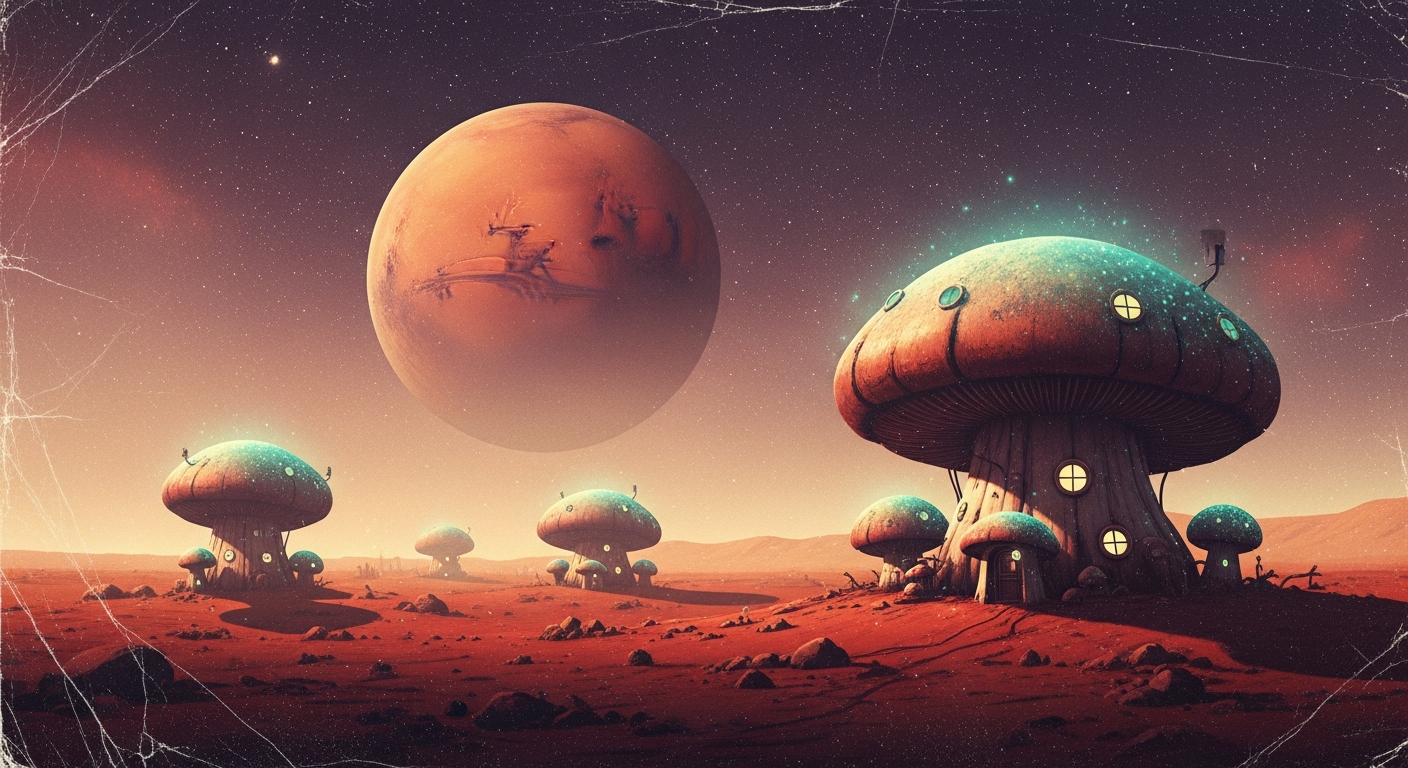
Can We Grow Houses on Mars? The Secret Biology of Space Mushrooms
Introduction: The Red Planet Real Estate Problem
Imagine you are an astronaut who has just landed on Mars. The sky is a dusty red, the temperature is freezing, and there is no air to breathe. You need a safe place to live, and you need it fast. But how do you build a house on another planet? You cannot simply drive out to a hardware store to buy wood, glass, and steel.
For a long time, NASA scientists have thought about packing metal and plastic on rockets to build Mars habitats. However, there is a massive problem: heavy things cost millions of dollars to launch into space! To solve this, scientists have come up with a brilliant, mind-boggling idea. Instead of building houses on Mars, what if we grow them?
Welcome to the weird and wonderful world of space mushrooms. Let’s dive into the secret biology of how tiny fungi might become the future of space architecture, allowing us to build safe, cozy homes millions of miles away from Earth.
The Science of Space Mushrooms: How Do We Grow a House?
The Heavy Problem with Space Travel
To understand why we want to use mushrooms, we first have to understand the rules of space travel. Rockets are like giant fuel tanks with a very small backpack on top for cargo. Every single pound you put in that backpack takes a massive amount of expensive rocket fuel to lift into space. Bringing heavy bricks or concrete to Mars is practically impossible.
Scientists realized they needed materials that are incredibly light to pack, but can get big and strong once they arrive. This concept is called In-Situ Resource Utilization (ISRU)—a fancy scientific term that simply means “using what you can find right where you are.” And nothing starts smaller and grows bigger than biology.
Meet Mycelium: Nature’s Super-Builder
When you think of a mushroom, you probably picture the little umbrella-shaped plant on top of a pizza or growing on a forest floor. But that is just the “fruit” of the fungus, much like an apple on a tree. The real magic happens underground, in the “roots” of the fungus.
These root-like threads are called mycelium. Mycelium looks like a giant, microscopic spider web made of millions of tiny white strings. On Earth, mycelium digests dead plants and turns them into soil. But in a laboratory, scientists discovered that if you feed mycelium the right food and put it in a mold, it will grow incredibly fast and pack itself together so tightly that it becomes stronger than concrete, lighter than wood, and fireproof!
This brand-new science is called myco-architecture (“myco” means fungus, and “architecture” means building).
Step-by-Step: Growing a Martian Fungi Fortress
So, how exactly will astronauts turn microscopic mushroom roots into a full-sized house on Mars? NASA scientists are currently working on a genius, three-step recipe:
- Step 1: The Plastic Bubble. Astronauts will land on Mars with a lightweight, deflated plastic tent. Once they pick a good spot, they will pump air into it so it puffs up into the shape of a house.
- Step 2: Adding the “Food”. The outside of this tent has hollow walls. Astronauts will pump water from Martian ice into these walls, along with special tiny green helpers called cyanobacteria (blue-green algae). These algae use sunlight and the carbon dioxide in the Martian air to create sugar.
- Step 3: Wake Up the Mushrooms! Astronauts will then add sleeping (dormant) fungi spores into the walls. The fungi will wake up, eat the sugar made by the algae, and grow! Within just a few weeks, the mycelium threads will completely fill the hollow walls, weaving together into a solid, thick, organic brick.
Once the house is fully grown, the astronauts will gently bake the walls using heat. This stops the mushrooms from growing any further, locking them into a super-strong, dry shell. Your Martian mushroom house is ready to move in!
The Secret Superpowers of Mycelium Architecture
You might be wondering: “Is a house made of dead mushrooms really safe?” The answer is yes, and it is actually much safer than metal or plastic! Mycelium has incredible superpowers designed perfectly for space survival.
First, Mars does not have a thick atmosphere or a magnetic field like Earth, which means dangerous, invisible space energy called radiation constantly hits the planet. If astronauts get hit by too much radiation, they can get very sick. Amazingly, some fungi contain melanin—the exact same chemical that gives human skin its color and protects us from sunburns. A thick wall of melanin-rich mycelium acts as a perfect shield, absorbing space radiation and keeping the astronauts inside safe.
Second, mycelium is an amazing insulator. Mars is freezing cold, with temperatures dropping to -225°F (-153°C). A mushroom wall traps heat inside, keeping the astronauts warm and saving precious electricity.
Conclusion: The Future is Fungi
Moving to another planet is one of the biggest challenges humanity will ever face. For decades, we thought the answer was to build bigger rockets and forge stronger metals. But sometimes, to solve the most futuristic problems, we have to look down at the dirt and ask Mother Nature for help.
The secret biology of space mushrooms teaches us an important lesson: we don’t need to conquer nature to explore the universe; we need to team up with it. Thanks to the incredible power of mycelium, the first houses on Mars won’t be built with hammers, nails, or cranes. Instead, they will be watered, fed, and grown.
So, the next time you see a tiny mushroom sprouting from the soil, give it a little nod of respect. You might just be looking at the foundation of the very first city on Mars!


Reader Comments