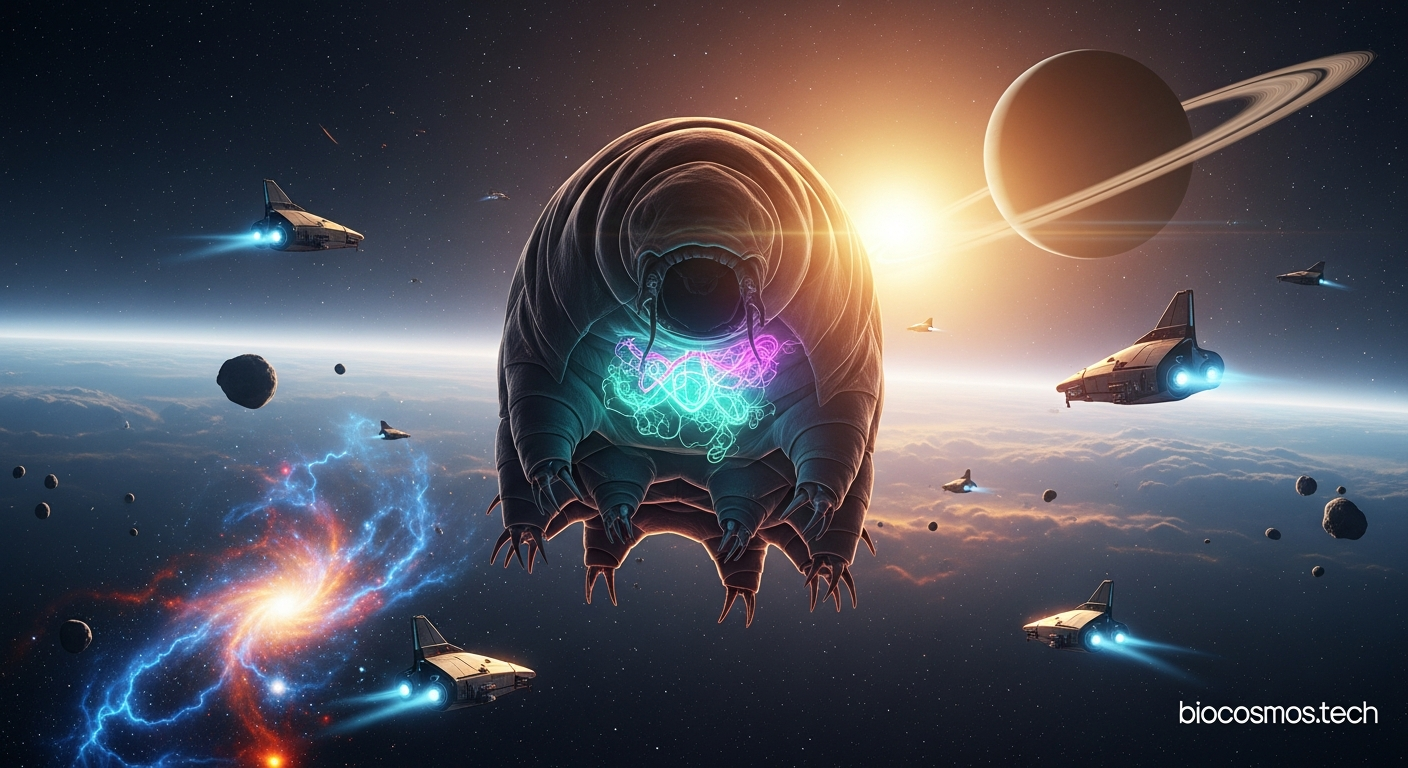
How Tardigrades Survive the Vacuum of Space: Unlocking the Biological Secrets of Earth’s Toughest Creature

How Tardigrades Survive the Vacuum of Space: Unlocking the Biological Secrets of Earth's Toughest Creature Introduction: Meet Earth's Indestructible Micro-Astronaut Imagine an organism so remarkably resilient that it can withstand boiling water, the crushing pressure of the Mariana Trench, and the freezing, irradiated void of outer space. Enter the tardigrade, affectionately known as the "water bear" or "moss piglet." Measuring barely half a millimeter in length, these microscopic, eight-legged invertebrates have captured the fascination of scientists and the public alike. But their most astonishing feat occurred in 2007 during the European Space Agency's FOTON-M3 mission, when tardigrades became the first animals to survive direct exposure to the vacuum of space. How do tardigrades survive the vacuum of space, where extreme temperatures, a complete lack of atmospheric pressure, and deadly cosmic radiation would instantly kill a human being? The answer lies in their unique evolutionary adaptations. By unlocking the biological secrets of Earth's toughest creature, researchers are not only redefining the limits of life but also discovering profound applications for human medicine, biotechnology, and deep-space exploration. The Science of Survival: How Tardigrades Defy the Vacuum of Space Surviving the harsh environment of space requires overcoming three primary threats: extreme dehydration (due to the vacuum), freezing temperatures, and lethal ionizing radiation. Tardigrades conquer these existential threats through a combination of extreme metabolic suspension and specialized molecular armor. The Magic of Cryptobiosis: Entering the "Tun" State In the vacuum of space, liquids boil and evaporate almost instantly, tearing standard biological cells apart. Tardigrades survive this desiccation through an extreme survival mechanism called cryptobiosis, specifically a form known as anhydrobiosis (life without water). When exposed to a drying environment, the tardigrade curls up into a dehydrated, seed-like ball called a "tun." During the tun state, the tardigrade's metabolism drops to less than 0.01% of its normal rate. It expels up to 95% of the water in its body. In standard organisms, losing this much water would cause cell membranes to permanently collapse and proteins to unfold and clump together. However, tardigrades possess biochemical tricks to preserve their cellular architecture even when totally dry, waiting in suspended animation until water is reintroduced. Glassy Armors: Trehalose and Intrinsically Disordered Proteins (TDPs) To prevent their cells from being crushed or ruptured during dehydration, tardigrades manufacture unique molecular protectants. One such protectant is a sugar called trehalose. Trehalose acts as a biological antifreeze and structural placeholder, forming a gel-like matrix that replaces water molecules in the cells. This prevents the crystallization of ice, which would otherwise puncture cell walls in the freezing temperatures of space. Even more remarkably, tardigrades utilize a unique class of proteins known as Tardigrade-specific Intrinsically Disordered Proteins (TDPs). Unlike normal proteins that have a rigid 3D structure, TDPs are floppy and lack a fixed shape. As the tardigrade dries out, these proteins undergo a process called vitrification. They transform the interior of the cell into a biological glass, encasing critical cellular machinery in a rigid, protective matrix. When the organism is eventually rehydrated, this biological glass melts away, leaving the cells undamaged and fully functional. Shielding the Genome: The Dsup Protein and Radiation Resistance While the tun state protects against the vacuum and extreme cold, the sheer volume of ultraviolet (UV) and cosmic radiation in space presents a different kind of threat. Ionizing radiation acts like microscopic shrapnel, slicing through DNA and causing catastrophic genetic mutations. Yet, tardigrades exposed to the unfiltered radiation of space managed to reproduce healthy offspring upon returning to Earth. The secret to this radiation resistance is a unique, tardigrade-exclusive protein known as Damage Suppressor (Dsup). Discovered by researchers studying the highly resilient Ramazzottius varieornatus species, the Dsup protein binds directly to the DNA inside the tardigrade's cell nucleus. It acts as a physical shield, neutralizing highly reactive hydroxyl radicals generated by radiation before they can sever the DNA strands. Incredibly, when human cells are genetically engineered in the laboratory to produce the Dsup protein, they show up to a 40% increase in radiation tolerance. Conclusion: What Tardigrades Teach Us About the Future of Astrobiology The fact that tardigrades survive the vacuum of space is not just a biological curiosity; it is a profound revelation about the tenacity of life. These microscopic extremophiles push the boundaries of what we consider habitable, forcing astrobiologists to expand their parameters when searching for extraterrestrial life on desolate planets and icy moons like Europa and Enceladus. Furthermore, unlocking the biological secrets of Earth's toughest creature holds incredible promise for our own future. The mechanisms tardigrades use to preserve their cells without water are already inspiring the development of "dry vaccines" that do not require cold-chain refrigeration, potentially saving millions of lives in developing nations. Similarly, the radiation-shielding properties of the Dsup protein could one day protect human astronauts from cosmic rays during long-duration missions to Mars, or improve the safety of radiation therapies for cancer patients. By studying the humble water bear, science has uncovered a masterclass in survival. The tardigrade stands as a microscopic testament to life's adaptability, proving that even in the lethal vacuum of outer space, nature finds a way to endure. General

How Tardigrades Survive the Vacuum of Space: Unlocking the Biological Secrets of Earth’s Toughest Creature

Introduction: Meet Earth’s Indestructible Micro-Astronaut

Imagine an organism so remarkably resilient that it can withstand boiling water, the crushing pressure of the Mariana Trench, and the freezing, irradiated void of outer space. Enter the tardigrade, affectionately known as the “water bear” or “moss piglet.” Measuring barely half a millimeter in length, these microscopic, eight-legged invertebrates have captured the fascination of scientists and the public alike. But their most astonishing feat occurred in 2007 during the European Space Agency’s FOTON-M3 mission, when tardigrades became the first animals to survive direct exposure to the vacuum of space.

How do tardigrades survive the vacuum of space, where extreme temperatures, a complete lack of atmospheric pressure, and deadly cosmic radiation would instantly kill a human being? The answer lies in their unique evolutionary adaptations. By unlocking the biological secrets of Earth’s toughest creature, researchers are not only redefining the limits of life but also discovering profound applications for human medicine, biotechnology, and deep-space exploration.

The Science of Survival: How Tardigrades Defy the Vacuum of Space

Surviving the harsh environment of space requires overcoming three primary threats: extreme dehydration (due to the vacuum), freezing temperatures, and lethal ionizing radiation. Tardigrades conquer these existential threats through a combination of extreme metabolic suspension and specialized molecular armor.

The Magic of Cryptobiosis: Entering the “Tun” State

In the vacuum of space, liquids boil and evaporate almost instantly, tearing standard biological cells apart. Tardigrades survive this desiccation through an extreme survival mechanism called cryptobiosis, specifically a form known as anhydrobiosis (life without water). When exposed to a drying environment, the tardigrade curls up into a dehydrated, seed-like ball called a “tun.”

During the tun state, the tardigrade’s metabolism drops to less than 0.01% of its normal rate. It expels up to 95% of the water in its body. In standard organisms, losing this much water would cause cell membranes to permanently collapse and proteins to unfold and clump together. However, tardigrades possess biochemical tricks to preserve their cellular architecture even when totally dry, waiting in suspended animation until water is reintroduced.

Glassy Armors: Trehalose and Intrinsically Disordered Proteins (TDPs)

To prevent their cells from being crushed or ruptured during dehydration, tardigrades manufacture unique molecular protectants. One such protectant is a sugar called trehalose. Trehalose acts as a biological antifreeze and structural placeholder, forming a gel-like matrix that replaces water molecules in the cells. This prevents the crystallization of ice, which would otherwise puncture cell walls in the freezing temperatures of space.

Even more remarkably, tardigrades utilize a unique class of proteins known as Tardigrade-specific Intrinsically Disordered Proteins (TDPs). Unlike normal proteins that have a rigid 3D structure, TDPs are floppy and lack a fixed shape. As the tardigrade dries out, these proteins undergo a process called vitrification. They transform the interior of the cell into a biological glass, encasing critical cellular machinery in a rigid, protective matrix. When the organism is eventually rehydrated, this biological glass melts away, leaving the cells undamaged and fully functional.

Shielding the Genome: The Dsup Protein and Radiation Resistance

While the tun state protects against the vacuum and extreme cold, the sheer volume of ultraviolet (UV) and cosmic radiation in space presents a different kind of threat. Ionizing radiation acts like microscopic shrapnel, slicing through DNA and causing catastrophic genetic mutations. Yet, tardigrades exposed to the unfiltered radiation of space managed to reproduce healthy offspring upon returning to Earth.

The secret to this radiation resistance is a unique, tardigrade-exclusive protein known as Damage Suppressor (Dsup). Discovered by researchers studying the highly resilient Ramazzottius varieornatus species, the Dsup protein binds directly to the DNA inside the tardigrade’s cell nucleus. It acts as a physical shield, neutralizing highly reactive hydroxyl radicals generated by radiation before they can sever the DNA strands. Incredibly, when human cells are genetically engineered in the laboratory to produce the Dsup protein, they show up to a 40% increase in radiation tolerance.

Conclusion: What Tardigrades Teach Us About the Future of Astrobiology

The fact that tardigrades survive the vacuum of space is not just a biological curiosity; it is a profound revelation about the tenacity of life. These microscopic extremophiles push the boundaries of what we consider habitable, forcing astrobiologists to expand their parameters when searching for extraterrestrial life on desolate planets and icy moons like Europa and Enceladus.

Furthermore, unlocking the biological secrets of Earth’s toughest creature holds incredible promise for our own future. The mechanisms tardigrades use to preserve their cells without water are already inspiring the development of “dry vaccines” that do not require cold-chain refrigeration, potentially saving millions of lives in developing nations. Similarly, the radiation-shielding properties of the Dsup protein could one day protect human astronauts from cosmic rays during long-duration missions to Mars, or improve the safety of radiation therapies for cancer patients.

By studying the humble water bear, science has uncovered a masterclass in survival. The tardigrade stands as a microscopic testament to life’s adaptability, proving that even in the lethal vacuum of outer space, nature finds a way to endure.

Reader Comments

Copied title and URL