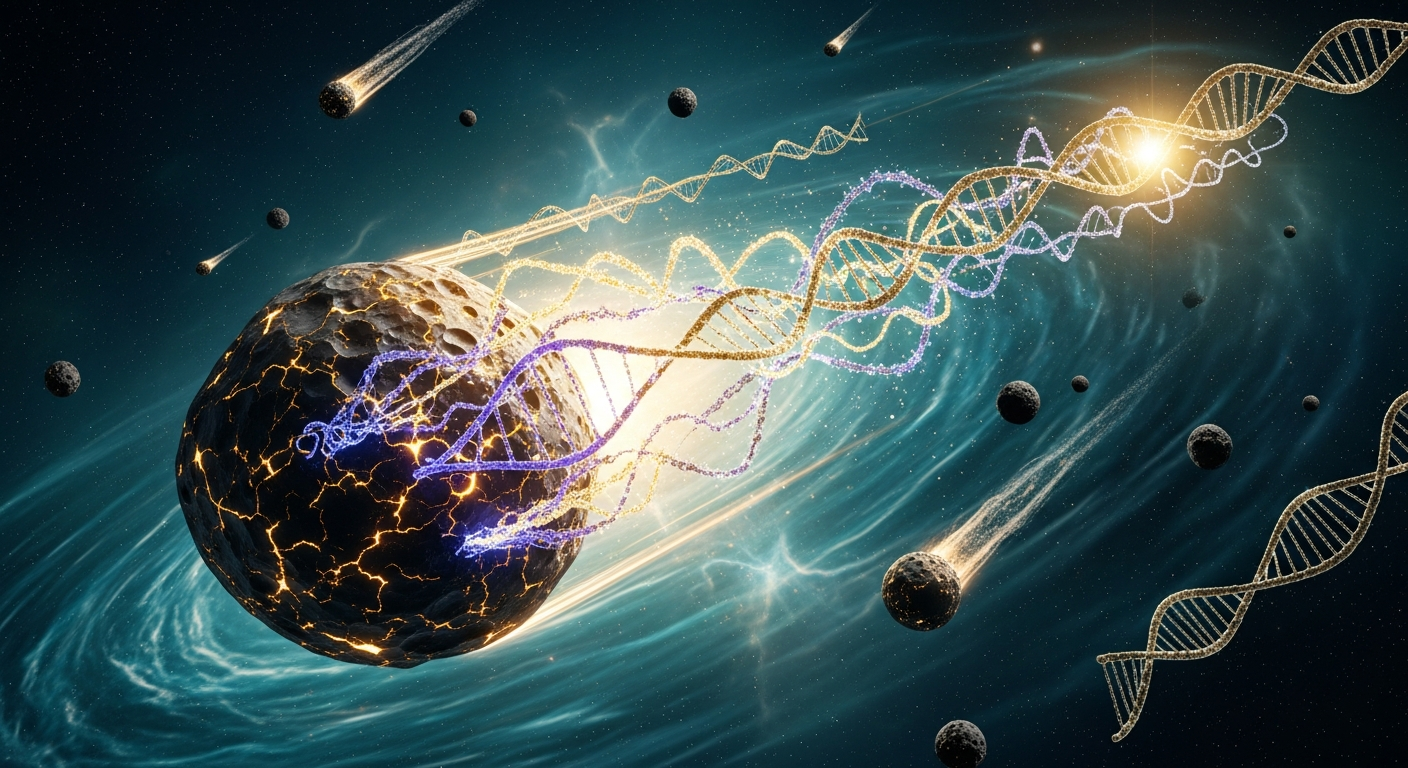
The Cosmic Origins of DNA: Did Meteorites Bring Life’s Building Blocks to Earth?

The Cosmic Origins of DNA: Did Meteorites Bring Life's Building Blocks to Earth? Introduction: The Extraterrestrial Blueprint of Life For decades, one of the most profound mysteries in science has been the genesis of life on our planet. How did the primordial soup of early Earth transform into complex, replicating organisms? While classical theories suggest that life's ingredients were synthesized in the volatile atmosphere of our young planet through lightning and geothermal energy, modern astrobiology points to a much more breathtaking hypothesis: the cosmic origins of DNA. Scientists are increasingly exploring the possibility that the fundamental building blocks of life—the very letters that make up our genetic code—were not exclusively forged on Earth, but were instead delivered from the depths of space. Through the relentless bombardment of meteorites and comets billions of years ago, the precursors to DNA and RNA may have been sown into Earth's ancient oceans. This article delves into the cutting-edge scientific evidence behind this theory, exploring how space rocks acting as cosmic vessels might have kickstarted biology as we know it. Detailed Scientific Explanation: Decoding the Stardust Carbonaceous Chondrites: The Solar System's Time Capsules To understand the extraterrestrial delivery hypothesis, scientists look to a specific class of meteorites known as carbonaceous chondrites. Making up only a small fraction of all meteorite falls, these primitive rocks are pristine time capsules from the formation of the solar system over 4.5 billion years ago. Famous examples, such as the Murchison meteorite that fell in Australia in 1969, are rich in organic carbon and have become the focal point of astrochemical research. Inside these dark, porous rocks, researchers have discovered a treasure trove of organic molecules, including amino acids (the building blocks of proteins), sugars, and lipids. However, the most groundbreaking discoveries have centered around nucleobases—the nitrogenous compounds that form the rungs of the DNA and RNA ladders. Finding the Complete Alphabet of Life DNA and RNA are constructed from five primary nucleobases: adenine (A), guanine (G), cytosine (C), thymine (T), and uracil (U). For years, scientists successfully identified the purine bases (adenine and guanine) and uracil within meteoritic samples. However, the pyrimidine bases—cytosine and thymine—remained elusive. This absence puzzled researchers and left a gap in the theory of the cosmic delivery of life's building blocks. That paradigm shifted in 2022. Utilizing ultra-sensitive, cutting-edge analytical techniques and cold-water extraction methods that prevented the delicate molecules from degrading, a team of international researchers finally detected cytosine and thymine in meteorite samples. With this monumental discovery, all five primary nucleobases necessary for the creation of DNA and RNA had officially been found in extraterrestrial rocks. The cosmic alphabet was complete. How Do DNA Precursors Form in Deep Space? The synthesis of complex organic molecules in the harsh environment of space seems counterintuitive, yet the cosmos is a highly active chemical laboratory. The creation of these nucleobases likely occurred in interstellar molecular clouds long before our solar system even formed. The process, driven by photochemistry, involves simple precursor molecules like water, carbon monoxide, ammonia, and methanol freezing onto the surfaces of microscopic dust grains. When these icy mantles are bombarded by high-energy cosmic rays and ultraviolet (UV) radiation from nearby stars, the resulting chemical reactions synthesize highly complex organic compounds. As the solar nebula collapsed to form our sun and planets, these organic-rich dust grains clumped together to form asteroids and comets, preserving the prebiotic chemistry within their frozen interiors. Furthermore, aqueous alteration—reactions occurring when ice melted inside warming asteroids—likely played a crucial role in forming more complex structures, utilizing simple precursors like hydrogen cyanide and formamide to construct purines and pyrimidines. Ruling Out Earthly Contamination: The Isotopic Proof A persistent question in meteoritic analysis is contamination: How can we be certain these DNA building blocks are truly extraterrestrial and not just earthly contaminants absorbed after the meteorite landed? The answer lies in isotope analysis. Atoms like carbon and nitrogen exist in different isotopic forms (e.g., Carbon-12 vs. Carbon-13). Organic matter formed on Earth possesses a distinct isotopic signature due to terrestrial biological processes. Meteoritic nucleobases, however, display a radically different ratio, being heavily enriched in heavier isotopes like Carbon-13 and Nitrogen-15. This unique isotopic fingerprint definitively proves that these molecules were forged in the frigid expanse of deep space, completely independent of terrestrial biology. Panspermia vs. Pseudo-Panspermia It is crucial to distinguish this chemical delivery from the classical theory of panspermia. Panspermia posits that actual, living microbes hitchhiked across the galaxy on asteroids. While highly debated, the evidence currently supports a more nuanced concept often referred to as pseudo-panspermia or precursor delivery. Meteorites did not bring life to Earth; rather, they delivered the prebiotic chemical toolkit required for life to eventually assemble itself in the nutrient-rich, warm environments of early Earth. Conclusion: The Universal Potential for Biology The realization that the cosmic origins of DNA are rooted in the icy depths of interstellar clouds dramatically reshapes our understanding of our place in the universe. The relentless bombardment of early Earth by meteorites and comets was not merely a destructive force; it was a cosmic fertilization process. By delivering the complete suite of nucleobases, amino acids, and sugars, meteorites provided the critical starting materials that ultimately led to the first self-replicating molecules. Recent sample-return missions, such as JAXA's Hayabusa2 mission to asteroid Ryugu and NASA's OSIRIS-REx mission to asteroid Bennu, are currently corroborating these findings by returning pristine, uncontaminated space rock directly to Earth. The organics found in these samples are reinforcing the theory that the chemistry of life is widespread. If the building blocks of life are universally synthesized in space and indiscriminately scattered across planetary systems, the implications for astrobiology are staggering. It suggests that the recipe for DNA is not a miraculous Earth-bound anomaly, but a standard feature of cosmic chemistry. As we gaze up at the stars, we are not just looking at cold, dead space; we are looking at the very laboratory that manufactured the blueprints of life. As Carl Sagan famously stated, we are literally made of star-stuff. General

The Cosmic Origins of DNA: Did Meteorites Bring Life’s Building Blocks to Earth?

Introduction: The Extraterrestrial Blueprint of Life

For decades, one of the most profound mysteries in science has been the genesis of life on our planet. How did the primordial soup of early Earth transform into complex, replicating organisms? While classical theories suggest that life’s ingredients were synthesized in the volatile atmosphere of our young planet through lightning and geothermal energy, modern astrobiology points to a much more breathtaking hypothesis: the cosmic origins of DNA.

Scientists are increasingly exploring the possibility that the fundamental building blocks of life—the very letters that make up our genetic code—were not exclusively forged on Earth, but were instead delivered from the depths of space. Through the relentless bombardment of meteorites and comets billions of years ago, the precursors to DNA and RNA may have been sown into Earth’s ancient oceans. This article delves into the cutting-edge scientific evidence behind this theory, exploring how space rocks acting as cosmic vessels might have kickstarted biology as we know it.

Detailed Scientific Explanation: Decoding the Stardust

Carbonaceous Chondrites: The Solar System’s Time Capsules

To understand the extraterrestrial delivery hypothesis, scientists look to a specific class of meteorites known as carbonaceous chondrites. Making up only a small fraction of all meteorite falls, these primitive rocks are pristine time capsules from the formation of the solar system over 4.5 billion years ago. Famous examples, such as the Murchison meteorite that fell in Australia in 1969, are rich in organic carbon and have become the focal point of astrochemical research.

Inside these dark, porous rocks, researchers have discovered a treasure trove of organic molecules, including amino acids (the building blocks of proteins), sugars, and lipids. However, the most groundbreaking discoveries have centered around nucleobases—the nitrogenous compounds that form the rungs of the DNA and RNA ladders.

Finding the Complete Alphabet of Life

DNA and RNA are constructed from five primary nucleobases: adenine (A), guanine (G), cytosine (C), thymine (T), and uracil (U). For years, scientists successfully identified the purine bases (adenine and guanine) and uracil within meteoritic samples. However, the pyrimidine bases—cytosine and thymine—remained elusive. This absence puzzled researchers and left a gap in the theory of the cosmic delivery of life’s building blocks.

That paradigm shifted in 2022. Utilizing ultra-sensitive, cutting-edge analytical techniques and cold-water extraction methods that prevented the delicate molecules from degrading, a team of international researchers finally detected cytosine and thymine in meteorite samples. With this monumental discovery, all five primary nucleobases necessary for the creation of DNA and RNA had officially been found in extraterrestrial rocks. The cosmic alphabet was complete.

How Do DNA Precursors Form in Deep Space?

The synthesis of complex organic molecules in the harsh environment of space seems counterintuitive, yet the cosmos is a highly active chemical laboratory. The creation of these nucleobases likely occurred in interstellar molecular clouds long before our solar system even formed.

The process, driven by photochemistry, involves simple precursor molecules like water, carbon monoxide, ammonia, and methanol freezing onto the surfaces of microscopic dust grains. When these icy mantles are bombarded by high-energy cosmic rays and ultraviolet (UV) radiation from nearby stars, the resulting chemical reactions synthesize highly complex organic compounds. As the solar nebula collapsed to form our sun and planets, these organic-rich dust grains clumped together to form asteroids and comets, preserving the prebiotic chemistry within their frozen interiors.

Furthermore, aqueous alteration—reactions occurring when ice melted inside warming asteroids—likely played a crucial role in forming more complex structures, utilizing simple precursors like hydrogen cyanide and formamide to construct purines and pyrimidines.

Ruling Out Earthly Contamination: The Isotopic Proof

A persistent question in meteoritic analysis is contamination: How can we be certain these DNA building blocks are truly extraterrestrial and not just earthly contaminants absorbed after the meteorite landed?

The answer lies in isotope analysis. Atoms like carbon and nitrogen exist in different isotopic forms (e.g., Carbon-12 vs. Carbon-13). Organic matter formed on Earth possesses a distinct isotopic signature due to terrestrial biological processes. Meteoritic nucleobases, however, display a radically different ratio, being heavily enriched in heavier isotopes like Carbon-13 and Nitrogen-15. This unique isotopic fingerprint definitively proves that these molecules were forged in the frigid expanse of deep space, completely independent of terrestrial biology.

Panspermia vs. Pseudo-Panspermia

It is crucial to distinguish this chemical delivery from the classical theory of panspermia. Panspermia posits that actual, living microbes hitchhiked across the galaxy on asteroids. While highly debated, the evidence currently supports a more nuanced concept often referred to as pseudo-panspermia or precursor delivery. Meteorites did not bring life to Earth; rather, they delivered the prebiotic chemical toolkit required for life to eventually assemble itself in the nutrient-rich, warm environments of early Earth.

Conclusion: The Universal Potential for Biology

The realization that the cosmic origins of DNA are rooted in the icy depths of interstellar clouds dramatically reshapes our understanding of our place in the universe. The relentless bombardment of early Earth by meteorites and comets was not merely a destructive force; it was a cosmic fertilization process. By delivering the complete suite of nucleobases, amino acids, and sugars, meteorites provided the critical starting materials that ultimately led to the first self-replicating molecules.

Recent sample-return missions, such as JAXA’s Hayabusa2 mission to asteroid Ryugu and NASA’s OSIRIS-REx mission to asteroid Bennu, are currently corroborating these findings by returning pristine, uncontaminated space rock directly to Earth. The organics found in these samples are reinforcing the theory that the chemistry of life is widespread.

If the building blocks of life are universally synthesized in space and indiscriminately scattered across planetary systems, the implications for astrobiology are staggering. It suggests that the recipe for DNA is not a miraculous Earth-bound anomaly, but a standard feature of cosmic chemistry. As we gaze up at the stars, we are not just looking at cold, dead space; we are looking at the very laboratory that manufactured the blueprints of life. As Carl Sagan famously stated, we are literally made of star-stuff.

Reader Comments

Copied title and URL