The Cosmic Web: Why the Human Brain Mirrors the Structure of the Universe
Introduction: The Microcosm and the Macrocosm
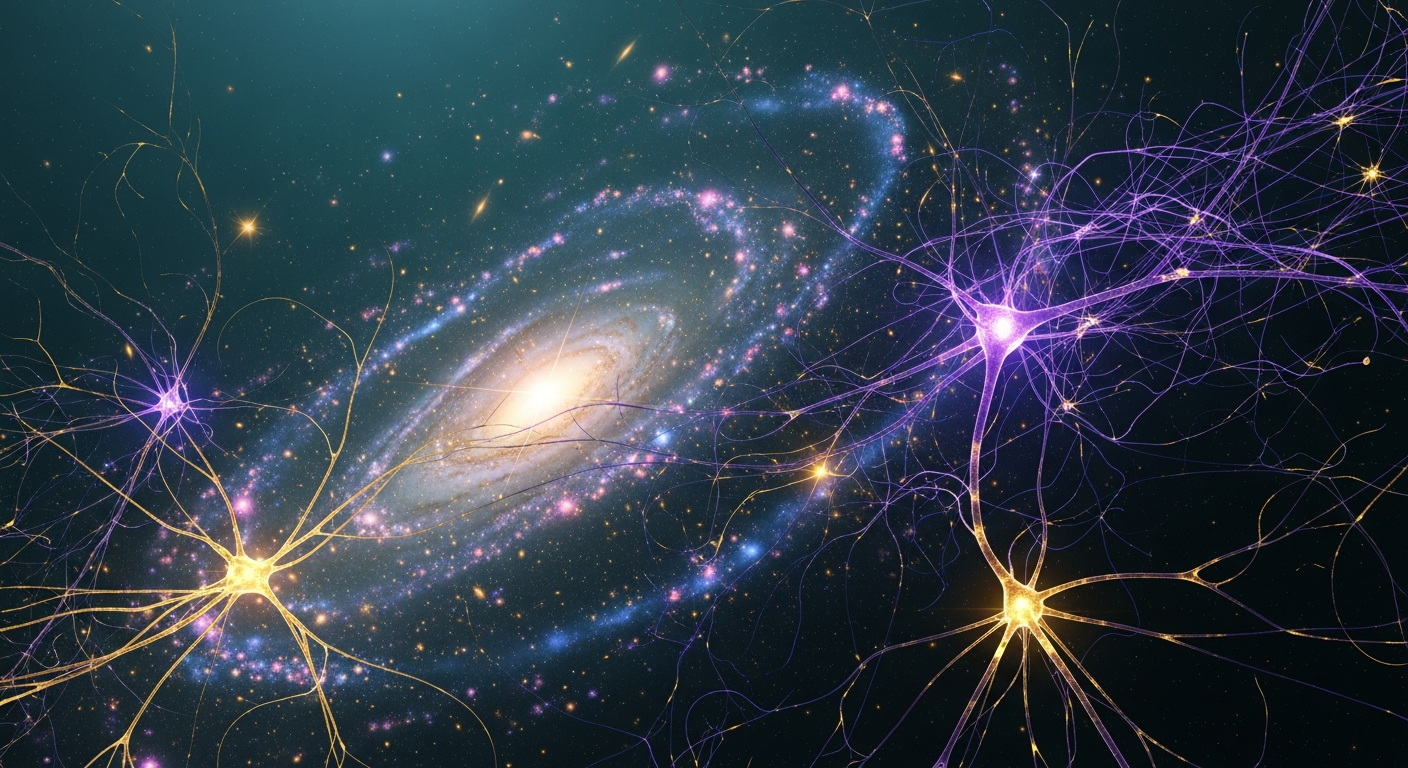
For centuries, philosophers and poets have proposed that the human mind is a microcosm of the universe. Today, modern astrophysics and neuroscience are proving that this poetic intuition is grounded in quantifiable scientific reality. When you place a highly magnified image of the human brain’s neuronal network side-by-side with a cosmological simulation of the Cosmic Web, the visual similarity is nothing short of breathtaking. Both feature highly connected nodes linked by delicate filaments, separated by vast, seemingly empty voids.
But is this striking resemblance merely a cosmic coincidence, or does it hint at a deeper underlying principle of nature? Recent interdisciplinary research suggests the latter. Despite an incomprehensible size difference of 27 orders of magnitude—the scale spanning from a microscopic brain cell to the edges of the observable cosmos—the human brain and the universe share profound structural, morphological, and topological similarities. This article explores the cutting-edge science explaining why the human brain mirrors the structure of the universe.
The Science of Scales: Bridging Neuroscience and Astrophysics
The Vazza and Feletti Study
The definitive quantitative comparison between these two complex systems was published in 2020 in the journal Frontiers in Physics. The groundbreaking study was co-authored by an unlikely duo: Dr. Franco Vazza, an astrophysicist from the University of Bologna, and Dr. Alberto Feletti, a neurosurgeon from the University of Verona. By combining their distinct fields of expertise, they set out to analyze the cosmic network of galaxies and the web of neurons in the human cortex and cerebellum.
Their research aimed to go beyond mere visual comparisons. By applying advanced statistical models generally used in cosmology to map galaxy distribution, the researchers proved that the self-organization of both systems is driven by fundamentally similar principles of network dynamics, despite the radically different physical forces at play (gravity and expanding space-time versus cellular biology and electrochemical gradients).
By the Numbers: Neurons and Galaxies
When examining the absolute numbers, the structural parallels become even more startling. The human brain contains approximately 86 billion neurons, with the cerebellum alone housing around 69 billion of these active nodes. If we cast our gaze upward to the observable universe, current astronomical estimates suggest it contains at least 100 billion galaxies. Thus, the sheer number of primary computational “nodes” in both the brain and the universe fall within the same incredibly tight mathematical ballpark.
The Composition: The 70/30 Rule
One of the most fascinating discoveries of the Vazza and Feletti study relates to the energy and mass composition of both systems. In both the human brain and the universe, the active networking components (neurons and galaxies) account for only a small fraction of the total mass.
- The Human Brain: Approximately 77% of the brain’s mass is composed of water. This fluid plays an indirect, passive role, providing the structural scaffolding and environment for the neuronal network to function.
- The Universe: In a stunning parallel, about 70% to 73% of the universe is made up of Dark Energy—an invisible, passive force that drives the expansion of the cosmos but does not actively participate in the gravitational clustering of the cosmic web.
In both realms, roughly 30% of the mass is dedicated to the actual tangible structure (galaxies and ordinary/dark matter in the universe, and biological tissue in the brain), while around 70% is a passive, structural medium.
Spectral Density and Network Morphology
To rigorously test the similarities, Vazza and Feletti utilized a technique called spectral density calculation—a staple in astrophysics for studying how matter fluctuates and scatters across space. They compared the density fluctuations of the cerebellum’s neuronal network (on a scale of 1 micrometer to 0.1 millimeters) against the cosmic web (on a scale of 5 million to 500 million light-years).
The results were paradigm-shifting. The progression of matter distribution in the brain perfectly followed the exact same power spectrum curve as the cosmic web. Furthermore, when calculating the network’s clustering coefficient—the average number of connections per node and how those central nodes cluster together—both systems exhibited nearly identical topological characteristics.
Interestingly, the researchers noted that these networks are not simply “fractals.” In fractal systems, such as tree branches or cloud formations, patterns repeat infinitely at smaller scales. The cosmic web and the neuronal network, however, are strictly scale-dependent. Their incredible structural complexity only emerges at their specific macroscopic scales, pointing toward a universal blueprint for how optimal, highly efficient networks self-organize.
Conclusion: The Universal Rhythm of Network Dynamics
The revelation that the human brain mirrors the structure of the universe fundamentally alters our perspective on complex systems. It demonstrates that radically different physical processes—whether they are the immense gravitational forces collapsing dark matter into galaxies, or the delicate biochemical instructions shaping dendrites and axons in a growing fetus—can yield the exact same complex network architecture.
While these findings have sparked fringe philosophical discussions about “cosmopsychism” (the idea that the universe itself might possess a form of consciousness), the hard science points to something equally profound but more grounded. It suggests that nature, when tasked with organizing massive amounts of information and matter efficiently, defaults to a singular, perfectly optimized geometric blueprint.
As we continue to map the synapses of the mind and the superclusters of the cosmos, we are left with a beautiful realization: to look deep into the universe is, in a very physical and mathematical sense, to look at a reflection of our own minds.


Reader Comments