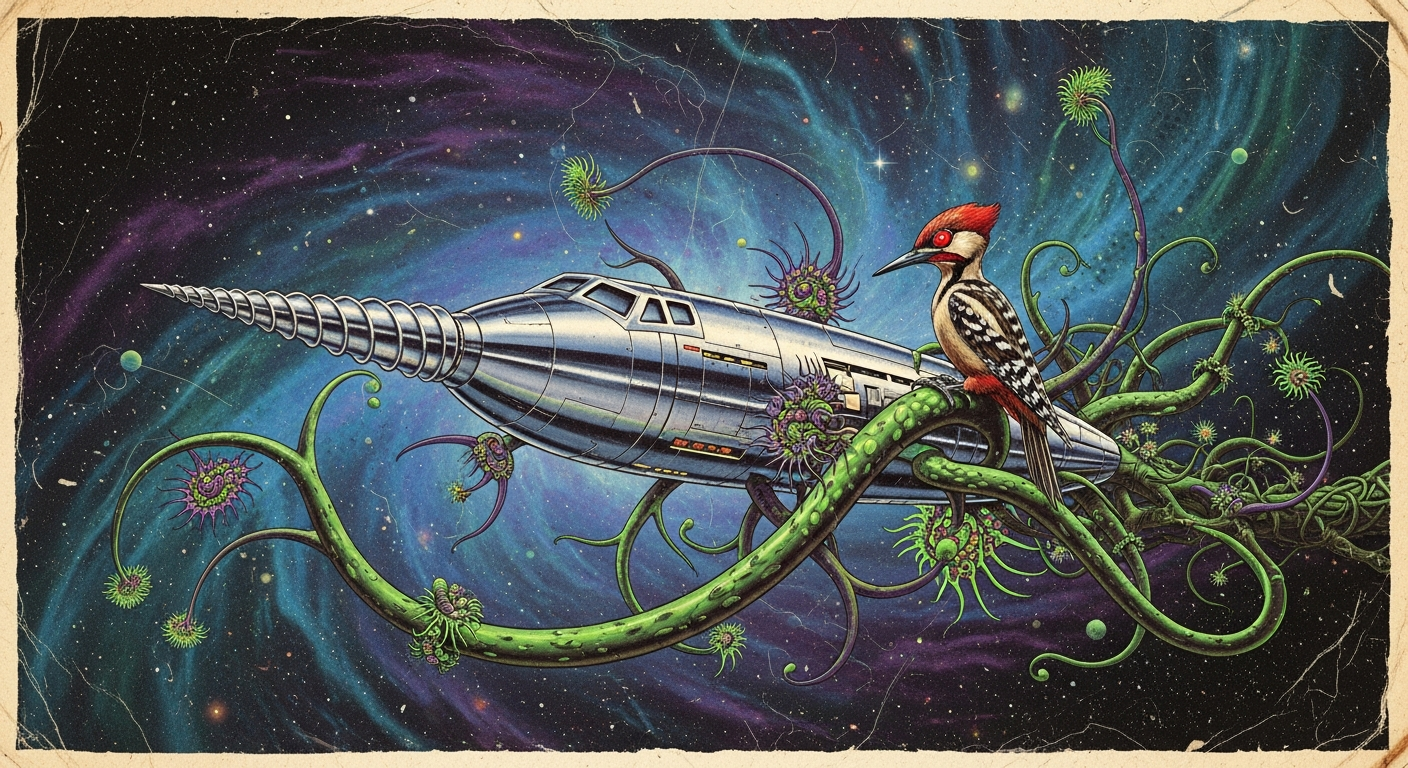
Can Woodpeckers Teach Us How to Build Safer Spaceships?
Introduction: The Bird with a Built-In Helmet
Have you ever accidentally bumped your head and felt a painful headache afterward? Human skulls are sensitive, but high up in the trees lives a small bird that bangs its head against hard wood all day long: the woodpecker. These amazing birds can peck at a tree up to 20 times per second, experiencing a force of up to 1,200 Gs (1,200 times the force of gravity). To put that into perspective, a human would get a serious brain injury at just 100 Gs!
You might be wondering, “What does a bird in a forest have to do with sending rockets into outer space?” The answer lies in a fascinating field of science called biomimicry—where scientists look at nature’s brilliant designs to solve complex human problems. Space travel is bumpy, fast, and dangerous. By studying how the woodpecker protects its brain from massive impacts, aerospace engineers are learning incredible new ways to build safer, tougher, and more resilient spaceships for our astronauts.
Detailed Science: From Bird Brains to Rocket Science
The Woodpecker’s Secret Anatomy
How does the woodpecker avoid a massive headache? Over millions of years of evolution, this bird has developed a four-part super defense system. Let’s break it down into simple pieces:
- The Uneven Beak: The top and bottom halves of a woodpecker’s beak are not exactly the same length. When the beak strikes a tree, this uneven design forces the shockwaves to travel down the bird’s lower jaw and away from its brain.
- Spongy Bone: Right at the front of the woodpecker’s skull is a special type of bone that looks like a sea sponge. It is full of tiny, microscopic holes. This acts exactly like a shock-absorbing foam cushion, soaking up the energy of the impact.
- The Built-In Seatbelt (Hyoid Bone): This is perhaps the coolest trick of all! The woodpecker has a special tongue bone called the hyoid. It is so incredibly long that it splits in two, wraps completely around the back of the bird’s skull, and anchors between the eyes. When the bird pecks, this bone tightens like a safety belt, holding the skull securely in place.
- A Snug Fit: Human brains float in a pool of liquid, which is why our brains can slosh around and get bruised if we get hit. A woodpecker’s brain fits very tightly inside its skull with almost no fluid, leaving no room for the brain to bounce around.
The Dangers of Space Travel
Now, let’s look at spaceships. When a massive rocket launches into space, it shakes violently. This intense vibration can damage sensitive computers and be very uncomfortable for astronauts. Furthermore, once a spaceship is floating in orbit, it faces another huge danger: space junk and micrometeoroids. These are tiny rocks and bits of old satellites flying through space at speeds up to 17,500 miles per hour! Even a rock the size of a grain of rice can hit a spaceship with the explosive force of a bowling ball dropping from a skyscraper.
Biomimicry: Engineering a Woodpecker Spaceship
To protect against these dangers, space scientists are copying the woodpecker’s shock-absorbing super-suit!
Engineers have designed new spaceship shields and shock absorbers using multiple layers, just like the bird’s head. First, they use a hard outer layer (like the beak) to block the initial hit. Underneath that, they use materials built with tiny microscopic spaces inside them, exactly like the woodpecker’s spongy bone. One popular design is an aluminum “honeycomb” structure. When a tiny piece of space rock hits the outer hull, the honeycomb layer crushes slightly, trapping the energy and stopping the rock before it can pierce the inside of the spaceship where the astronauts live.
Scientists are also studying the woodpecker’s “seatbelt” (the hyoid bone) to design safer, more protective helmets and seating systems for astronauts during the intense shaking of a rocket launch.
Conclusion: Nature’s Blueprint for the Stars
It is incredible to think that the secrets to exploring the vast, unknown universe might just be hiding in our own backyards. Nature is the ultimate engineer. The woodpecker spent millions of years perfecting the ultimate shock-absorbing technology, completely for free. By using biomimicry to copy the woodpecker’s beak, spongy bones, and clever anatomy, scientists are developing spacecraft that can withstand the violent shaking of a launch and the dangerous impacts of flying space rocks.
Next time you are taking a walk in the woods and hear the fast rat-a-tat-tat of a woodpecker high up in a tree, take a moment to look up. You aren’t just looking at a beautiful bird—you are looking at a living blueprint for the future of space exploration!


Reader Comments