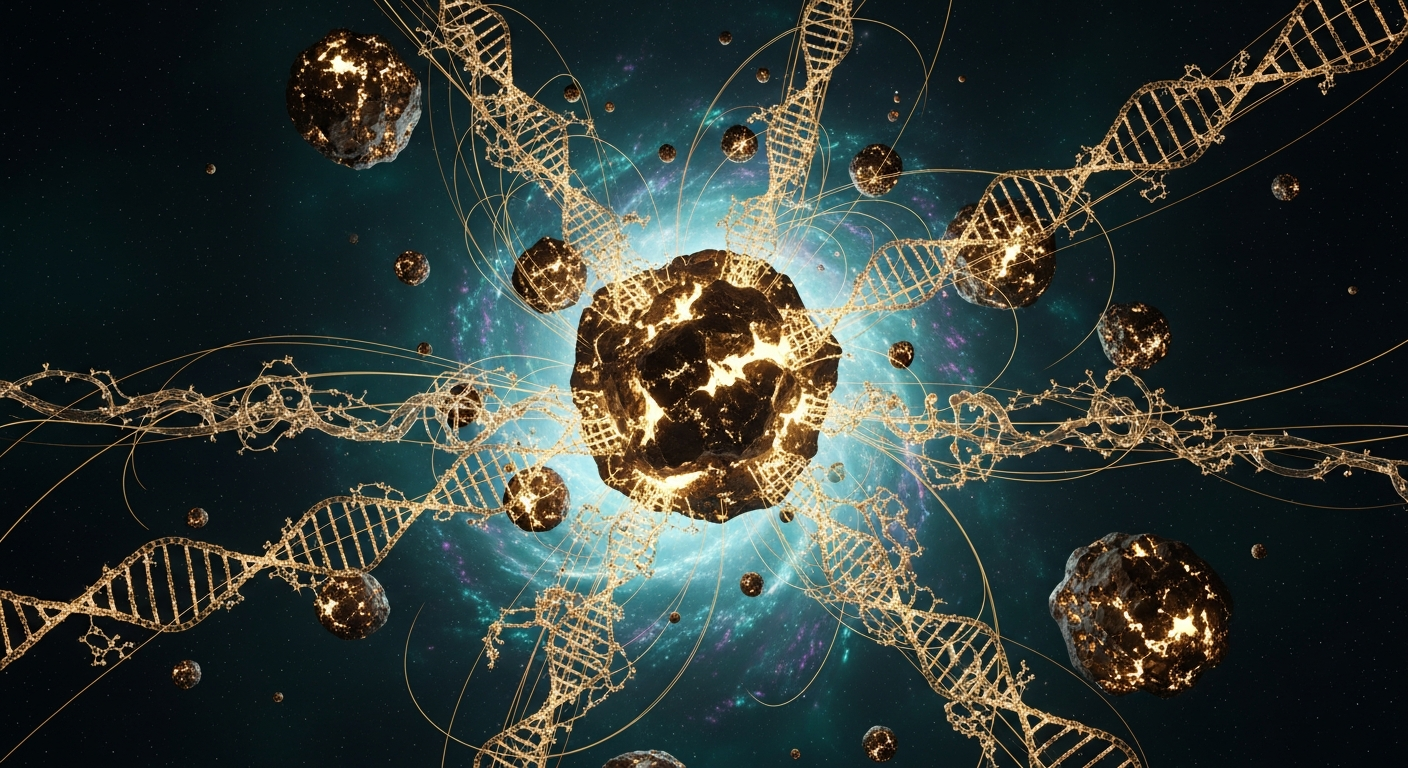
宇宙DNA:隕石が地球に生命の構成要素をもたらした
Introduction: The Extraterrestrial Origins of Life’s Ingredients
For decades, one of the most profound mysteries in science has been the origin of life on Earth. How did our planet transform from a barren, volcanic rock into a vibrant world teeming with biological diversity? While the “primordial soup” hypothesis suggests that life’s ingredients were cooked up in Earth’s early oceans through lightning and geothermal energy, modern astrobiology points to a much more stellar narrative. Mounting evidence suggests that the fundamental building blocks of life—the very components of our DNA—were delivered from the cosmos by meteorites.
This concept, a refined variation of panspermia known as pseudo-panspermia or molecular delivery, posits that the prebiotic molecules necessary for life were forged in the freezing vacuum of interstellar space, incorporated into asteroids, and subsequently rained down upon the early Earth. Through rigorous chemical analysis of ancient meteorites, scientists are now uncovering the “Cosmic DNA” that may have seeded life on our planet, fundamentally altering our understanding of our place in the universe.
Detailed Scientific Explanation: Decoding the Asteroidal Archives
Carbonaceous Chondrites: Time Capsules of the Solar System
To understand how the building blocks of life arrived on Earth, we must look at a specific class of meteorites known as carbonaceous chondrites. Making up only about 4% to 5% of all meteorite falls, these rare space rocks are pristine remnants from the birth of our solar system over 4.5 billion years ago. They have never undergone significant heating or planetary differentiation, meaning their chemical composition remains largely unchanged since the solar nebula coalesced.
The most famous of these is the Murchison meteorite, which fell in Australia in 1969. Upon its analysis, scientists were stunned to find a rich inventory of organic compounds, including over 70 distinct extraterrestrial amino acids. However, amino acids only form proteins. For life to truly begin, it requires the ability to store and transmit genetic information—it requires the components of DNA and RNA.
Discovering the “Cosmic Alphabet”: All Five Nucleobases Found in Space
DNA and RNA are constructed from an alphabet of molecules called nucleobases. These are categorized into two structural families: purines (adenine and guanine) and pyrimidines (cytosine, thymine, and uracil). For a long time, astrobiologists could only definitively identify purines and uracil in meteorite samples. The elusive pyrimidines, cytosine and thymine, remained undetected, leaving a gap in the theory of extraterrestrial delivery.
However, a landmark scientific breakthrough in 2022 completed the cosmic alphabet. Utilizing state-of-the-art analytical techniques optimized for small-scale, highly sensitive liquid chromatography coupled with high-resolution mass spectrometry, researchers successfully identified the missing pyrimidines in samples of the Murchison, Murray, and Tagish Lake meteorites. For the first time in history, all five primary nucleobases responsible for life’s genetic code (A, C, G, T, U) were confirmed to be of extraterrestrial origin.
Isotopic Fingerprinting: Proving It Came from the Stars
A critical challenge in astrobiology is ruling out terrestrial contamination. How do we know these nucleobases and amino acids weren’t simply absorbed by the meteorite after it landed on Earth? The answer lies in isotopic analysis.
Elements exist in different forms, or isotopes, based on the number of neutrons in their nucleus. Molecules formed in the extreme cold of interstellar space exhibit significantly different isotopic ratios compared to those formed on Earth. Meteoritic organics are highly enriched in heavy isotopes, such as Carbon-13 (¹³C) and Deuterium (²H). When scientists measure the molecular structures found within carbonaceous chondrites, the high concentrations of these heavy isotopes serve as an undeniable chemical fingerprint, proving beyond a doubt that these complex organics were forged in deep space.
The Interstellar Laboratory: How Does “Cosmic DNA” Form?
The realization that DNA nucleobases exist in meteorites begs the question: how do such complex organic molecules form in a harsh, radiation-filled vacuum? The formation process occurs long before asteroids even exist, deep within interstellar molecular clouds.
- Icy Dust Grains: In these incredibly cold and dense regions of space, simple molecules like water, carbon monoxide, ammonia, and methanol freeze onto the surface of microscopic silicate dust grains, forming icy mantles.
- Photochemical Reactions: As nearby young stars emit intense ultraviolet (UV) radiation, the photons bombard these icy grains. The energy from the UV light breaks molecular bonds, creating highly reactive free radicals.
- Complex Organic Synthesis: Even at temperatures hovering just above absolute zero, these radicals recombine into increasingly complex organic molecules, including hexamethylenetetramine (HMT), amino acids, and nucleobases.
When our solar system began to form, these organic-rich dust grains clumped together to form asteroids and comets. During the Late Heavy Bombardment period, roughly 4 to 3.8 billion years ago, countless numbers of these celestial bodies collided with early Earth, delivering billions of tons of this organic material into the primitive oceans, providing the crucial chemical spark necessary for the origin of life.
Conclusion: We Are Truly Made of Starstuff
The discovery of the complete set of DNA and RNA nucleobases within meteorites is a paradigm-shifting revelation in the field of astrobiology. It definitively proves that the complex chemical synthesis required for life is not a phenomenon unique to early Earth, but rather a universal process occurring throughout the cosmos. The meteorites that rained down upon our young planet acted as cosmic cargo ships, delivering a rich inventory of prebiotic building blocks that paved the way for the first biological cells.
As humanity continues to explore the solar system—with recent sample return missions like Japan’s Hayabusa2 (asteroid Ryugu) and NASA’s OSIRIS-REx (asteroid Bennu) bringing back pristine, uncontaminated cosmic dirt—our understanding of these extraterrestrial organics will only deepen. These missions have already confirmed the presence of uracil and amino acids directly from asteroids in space, beautifully corroborating decades of meteorite research.
Ultimately, the story of “Cosmic DNA” serves as a profound reminder of our deep, intrinsic connection to the universe. The carbon in our cells, the amino acids in our proteins, and the very nucleobases that encode our genetics were born in the stars, traveled through the frigid expanse of space, and found a home on Earth. In the truest scientific sense, we are the universe experiencing itself.
Reader Comments