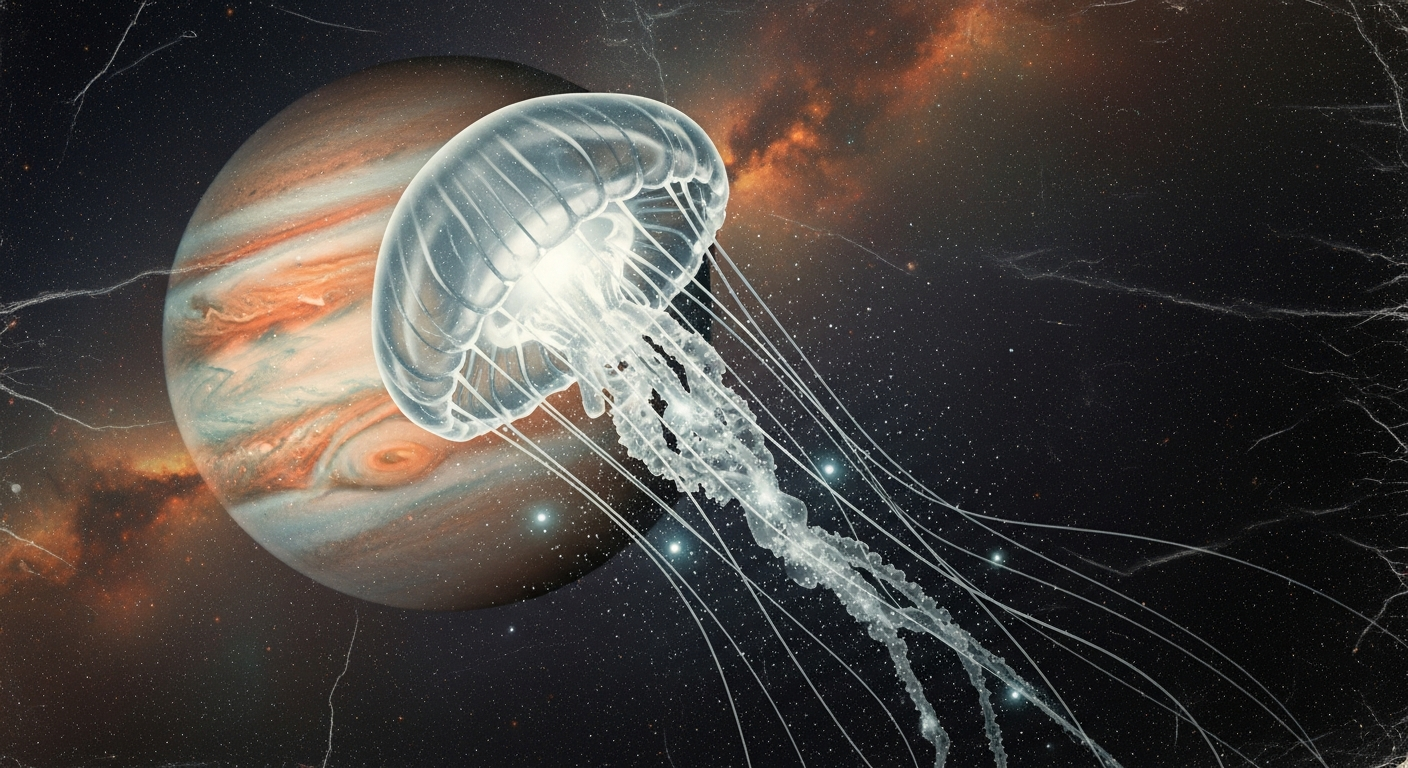
Introduction: Could a Deep-Sea Jellyfish Survive on Jupiter?
Have you ever looked up at the night sky and wondered, “Is there life out there in the universe?” When we think of aliens, we often imagine little green men or high-tech flying saucers. But what if extraterrestrial life looks a lot like something we already have on Earth? Specifically, what if it looks like a glowing, squishy, deep-sea jellyfish?
The title of our scientific mystery today is exactly that: Could a deep-sea jellyfish survive on Jupiter? This simple but amazing question unlocks one of the most exciting topics in modern science—the mystery of alien space oceans. Today, we are diving deep into the darkest waters of Earth and rocketing all the way to the largest planet in our solar system to find the answer!
The Science of Alien Space Oceans: Where Could Extraterrestrial Life Hide?
Why Not Jupiter Itself? The Gas Giant Problem
First, let’s look at Jupiter. If we dropped a deep-sea jellyfish directly onto Jupiter, would it survive? The short scientific answer is: No. Jupiter is what scientists call a “gas giant.” It doesn’t have a solid surface of rock or beautiful oceans of water like Earth. Instead, it is made mostly of swirling hydrogen and helium gases, featuring super-powerful storms (like the famous Great Red Spot) and crushing atmospheric pressure.
But don’t give up hope! When astrobiologists talk about finding life near Jupiter, they aren’t looking at the planet itself. They are looking at Jupiter’s moons—especially a magnificent, glowing ice world called Europa.
Europa: The True Alien Space Ocean
Europa is one of Jupiter’s largest moons, and it hides a massive, magical secret. The surface of Europa is covered in a thick shell of solid, freezing ice. But beneath that miles-thick ice crust, scientists are almost certain there is a gigantic, hidden alien space ocean full of liquid water! In fact, Europa’s hidden ocean might contain twice as much water as all of Earth’s oceans combined.
But how can an ocean stay liquid so far away from the warmth of the Sun? The answer is gravity. Jupiter’s incredibly strong gravity pulls and stretches Europa as it orbits. This constant stretching creates friction inside the moon, acting like a giant internal heater. Scientists call this tidal heating. This heat melts the bottom of the ice shell, keeping the hidden ocean flowing.
Deep-Sea Jellyfish: The Ultimate Space Survivors
Europa’s ocean is pitch black, incredibly cold, and under extreme pressure from the heavy ice above. It sounds like an impossible place for animals to live, right? But wait—there is an environment exactly like this right here on Earth!
Let’s travel down to the very bottom of Earth’s oceans. In the deep sea, known as the abyssal zone, there is absolutely no sunlight. The water is freezing, and the pressure is heavy enough to crush a metal submarine. Yet, life is booming! Deep-sea jellyfish, like the glowing Atolla jellyfish or strange comb jellies, thrive in these extreme conditions.
These creatures have squishy, flexible bodies made almost entirely of water, which stops the extreme pressure from crushing them. They don’t need sunlight at all. But what do they eat? On Earth, the bottom of the ocean features underwater volcanoes called hydrothermal vents. These vents shoot out hot water mixed with special chemicals from inside the Earth. Tiny bacteria eat these chemicals to make energy in a process called chemosynthesis (making food from chemicals instead of sunlight). Jellyfish and other creatures then feed on the animals that rely on these bacteria.
Scientists strongly believe that Europa’s alien space ocean might have these exact same hydrothermal vents at the bottom of its sea!
Conclusion: Unlocking the Mysteries of Astrobiology
So, to answer our big question: Could a deep-sea jellyfish survive in Jupiter’s neighborhood? Scientifically speaking, it is highly possible! While Jupiter itself is a stormy gas giant, its icy moon Europa holds a vast, dark, liquid ocean that perfectly matches the extreme home of Earth’s deep-sea jellyfish.
This incredible idea is at the very heart of astrobiology—the study of life in the universe. Space agencies like NASA are building amazing robotic spacecraft, such as the Europa Clipper, to fly to Jupiter and investigate these alien space oceans. They aren’t looking for cities or spaceships; they are scanning the ice for the basic chemical building blocks of life. They want to know if something might be swimming in the dark waters below.
The next time you see a picture of a weird, squishy, glowing jellyfish, remember: you might just be looking at the ultimate blueprint for extraterrestrial life. The universe is incredibly vast, and the deepest secrets of outer space might just be waiting to be discovered in the deepest parts of our own oceans!


Reader Comments