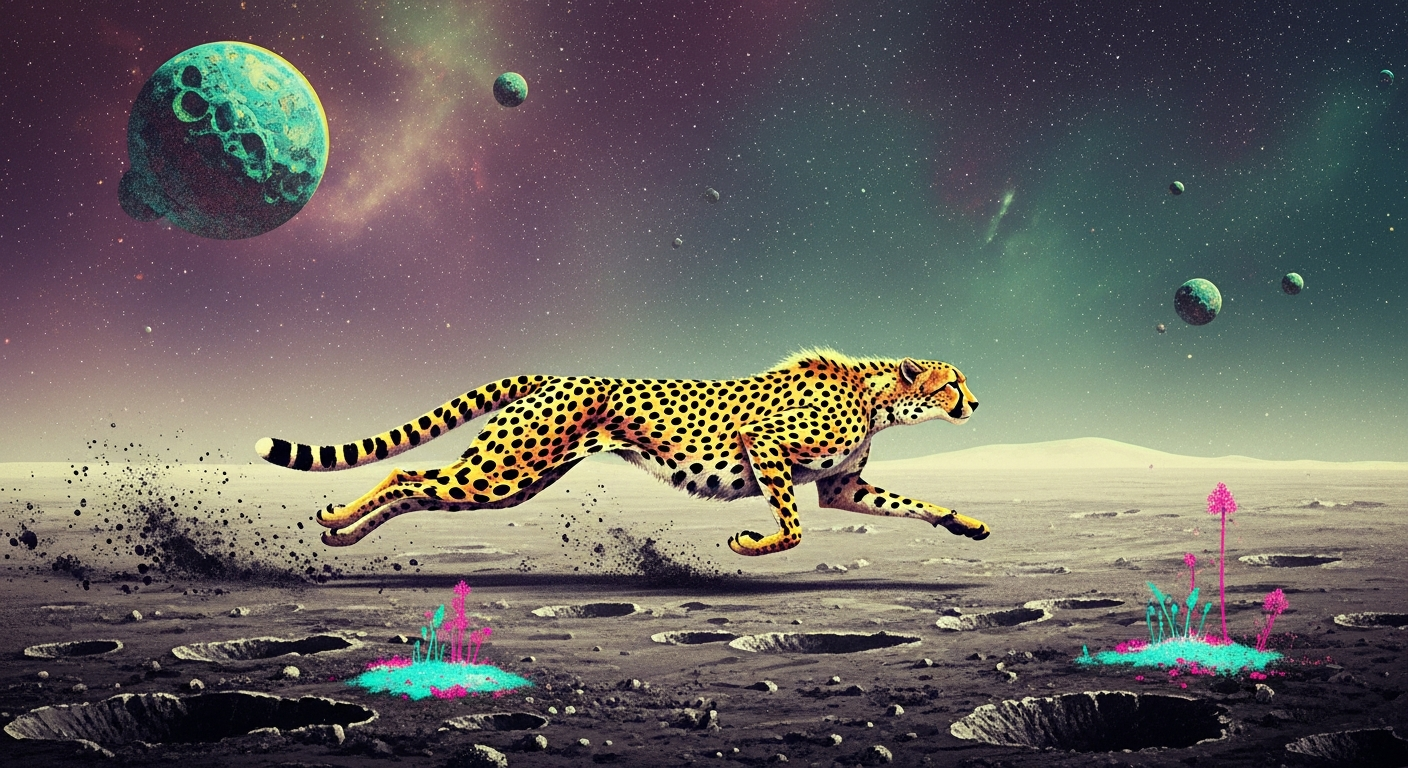
Would a Cheetah Run Faster on the Moon? The Weird Biology of Space Sports

Would a Cheetah Run Faster on the Moon? The Weird Biology of Space Sports Introduction: The Ultimate Cosmic Race Imagine the ultimate track and field event. At the starting line is Earth’s fastest land animal: the cheetah. But this race isn't happening on the African savanna. It’s happening on the dusty surface of the Moon! Because the Moon has much lower gravity than Earth, you might think a cheetah could leap farther and run much faster than its usual top speed of 70 miles per hour (112 km/h). But would a cheetah actually break its own speed record in space? Welcome to the weird and wonderful world of space sports! When we take biology and physics off of our home planet, the rules change completely. Let's dive into the science to find out how Earth's greatest sprinter would handle a lunar racetrack. Detailed Scientific Explanation: Why the Moon Changes Everything To understand what would happen to our furry athlete, we have to look closely at how a cheetah’s body works and compare it to the harsh environment of the Moon. Let's break down the science into three simple, fun pieces. 1. The Gravity Problem: Bouncing Instead of Sprinting On Earth, gravity acts like an invisible magnet, pulling everything down. A cheetah uses this downward pull to its advantage. Its special claws act like the spikes on a soccer player's cleats, digging into the dirt to get traction (or grip). When a cheetah pushes hard against the ground, the Earth's gravity gives it the friction it needs to shoot forward like a rocket. On the Moon, gravity is only about one-sixth (1/6) as strong as it is on Earth. If a cheetah tried to sprint on the Moon, it wouldn't have enough weight holding it down to grip the dirt. Instead of dashing forward, the cheetah’s incredibly powerful leg muscles would launch it high up into the air! It would look more like a slow-motion, bouncing kangaroo than a high-speed racer. Without strong gravity to hold its paws to the track, the cheetah would just slip and float. 2. The Oxygen Dilemma: You Can't Run While Holding Your Breath There is no air on the Moon. It is a complete vacuum in space. On Earth, a running cheetah takes massive, deep breaths—up to 150 breaths a minute! Its giant heart and lungs work together to pump huge amounts of oxygen to its muscles to keep them moving fast. Because there is no oxygen on the Moon, our lunar cheetah would have to wear a custom-made, pressurized spacesuit. Imagine trying to run your fastest while wearing a giant, puffy snowsuit and a heavy glass fishbowl on your head! A cheetah's secret weapon is its super-flexible spine, which bends and stretches like a giant spring to make its strides longer. A bulky spacesuit would completely freeze that flexible spine, slowing the cheetah down to a clumsy crawl. 3. The Slippery Lunar Track: Watch Out for Moon Dust! Finally, we have to think about the racetrack itself. The Moon isn't covered in nice, firm dirt or grass. It is covered in a thick layer of fine, powdery, jagged dust called regolith. Running on lunar regolith is a lot like trying to sprint on a beach made of loose, deep sand. Even if the cheetah could somehow overcome the low gravity and the heavy spacesuit, the soft Moon dust would absorb its energy. The cheetah's paws would sink right in, making it impossible to reach a fast speed. Conclusion: Earth is the Perfect Racetrack So, would a cheetah run faster on the Moon? The scientific answer is a giant no! While low gravity might sound like a cool superpower, a cheetah's biology is perfectly designed for planet Earth. It needs strong gravity to grip the ground, a thick atmosphere full of oxygen to feed its hard-working muscles, and a firm surface to push against. On the Moon, Earth’s fastest sprinter would become a slow, bouncing, clumsy astronaut. Exploring the science of space sports teaches us a beautiful lesson: animals are perfectly adapted to the specific planet they call home. For the cheetah, there is simply no place like Earth to show off its incredible speed! biological

Would a Cheetah Run Faster on the Moon? The Weird Biology of Space Sports

Introduction: The Ultimate Cosmic Race

Imagine the ultimate track and field event. At the starting line is Earth’s fastest land animal: the cheetah. But this race isn’t happening on the African savanna. It’s happening on the dusty surface of the Moon! Because the Moon has much lower gravity than Earth, you might think a cheetah could leap farther and run much faster than its usual top speed of 70 miles per hour (112 km/h). But would a cheetah actually break its own speed record in space?

Welcome to the weird and wonderful world of space sports! When we take biology and physics off of our home planet, the rules change completely. Let’s dive into the science to find out how Earth’s greatest sprinter would handle a lunar racetrack.

Detailed Scientific Explanation: Why the Moon Changes Everything

To understand what would happen to our furry athlete, we have to look closely at how a cheetah’s body works and compare it to the harsh environment of the Moon. Let’s break down the science into three simple, fun pieces.

1. The Gravity Problem: Bouncing Instead of Sprinting

On Earth, gravity acts like an invisible magnet, pulling everything down. A cheetah uses this downward pull to its advantage. Its special claws act like the spikes on a soccer player’s cleats, digging into the dirt to get traction (or grip). When a cheetah pushes hard against the ground, the Earth’s gravity gives it the friction it needs to shoot forward like a rocket.

On the Moon, gravity is only about one-sixth (1/6) as strong as it is on Earth. If a cheetah tried to sprint on the Moon, it wouldn’t have enough weight holding it down to grip the dirt. Instead of dashing forward, the cheetah’s incredibly powerful leg muscles would launch it high up into the air! It would look more like a slow-motion, bouncing kangaroo than a high-speed racer. Without strong gravity to hold its paws to the track, the cheetah would just slip and float.

2. The Oxygen Dilemma: You Can’t Run While Holding Your Breath

There is no air on the Moon. It is a complete vacuum in space. On Earth, a running cheetah takes massive, deep breaths—up to 150 breaths a minute! Its giant heart and lungs work together to pump huge amounts of oxygen to its muscles to keep them moving fast.

Because there is no oxygen on the Moon, our lunar cheetah would have to wear a custom-made, pressurized spacesuit. Imagine trying to run your fastest while wearing a giant, puffy snowsuit and a heavy glass fishbowl on your head! A cheetah’s secret weapon is its super-flexible spine, which bends and stretches like a giant spring to make its strides longer. A bulky spacesuit would completely freeze that flexible spine, slowing the cheetah down to a clumsy crawl.

3. The Slippery Lunar Track: Watch Out for Moon Dust!

Finally, we have to think about the racetrack itself. The Moon isn’t covered in nice, firm dirt or grass. It is covered in a thick layer of fine, powdery, jagged dust called regolith. Running on lunar regolith is a lot like trying to sprint on a beach made of loose, deep sand. Even if the cheetah could somehow overcome the low gravity and the heavy spacesuit, the soft Moon dust would absorb its energy. The cheetah’s paws would sink right in, making it impossible to reach a fast speed.

Conclusion: Earth is the Perfect Racetrack

So, would a cheetah run faster on the Moon? The scientific answer is a giant no! While low gravity might sound like a cool superpower, a cheetah’s biology is perfectly designed for planet Earth. It needs strong gravity to grip the ground, a thick atmosphere full of oxygen to feed its hard-working muscles, and a firm surface to push against.

On the Moon, Earth’s fastest sprinter would become a slow, bouncing, clumsy astronaut. Exploring the science of space sports teaches us a beautiful lesson: animals are perfectly adapted to the specific planet they call home. For the cheetah, there is simply no place like Earth to show off its incredible speed!


Reader Comments

タイトルとURLをコピーしました