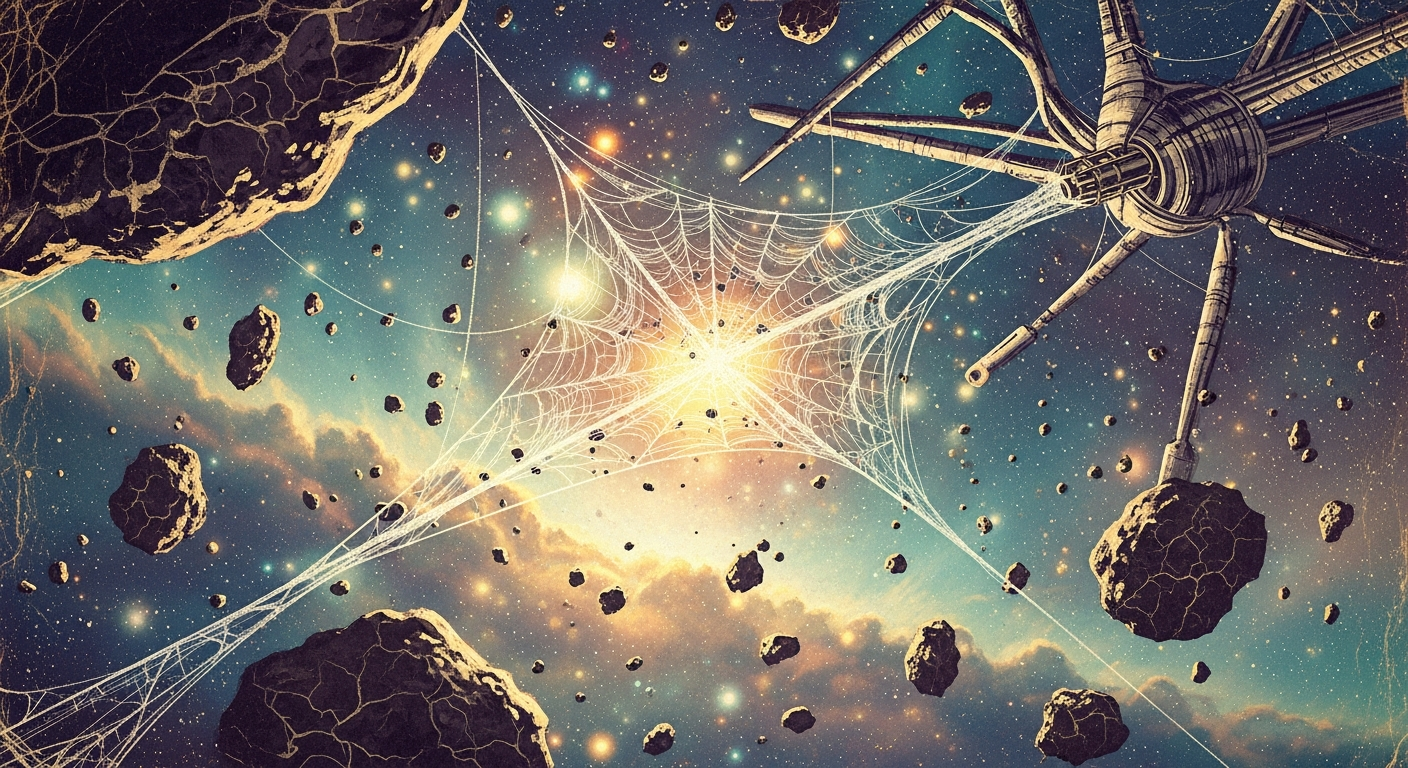
Can Spiders Spin Webs in Space? The Amazing Math and Biology of Zero Gravity

Can Spiders Spin Webs in Space? The Amazing Math and Biology of Zero Gravity Introduction: Eight-Legged Astronauts Have you ever looked at a spider web in your garden and wondered how such a tiny creature could build something so perfect? Spiders are like nature's little engineers, using a mix of biology and math to spin beautiful, sticky traps. But what happens if you take a spider out of the garden, put it in a rocket, and blast it into outer space? Can spiders spin webs in space? The short answer is: Yes, they can! Scientists have sent spiders to space several times, starting with two brave spiders named Arabella and Anita in 1973, and later to the International Space Station (ISS). What these eight-legged astronauts showed us about the math of spider webs and the biology of zero gravity (also called microgravity) is absolutely mind-blowing. Let’s dive into the amazing science of floating spiders! The Detailed Science: How Microgravity Changes the Web The Biology of Earth Webs: Knowing Which Way is "Up" To understand space webs, we first need to look at how spiders build webs here on Earth. On our planet, spiders rely heavily on a biological sense of gravity. Gravity tells the spider which way is "up" and which way is "down." Because of gravity, a spider builds an asymmetrical web. This is a fancy math word that means "not perfectly even." If you look closely at an orb-weaver spider's web, the center point (called the "hub") is not right in the middle. It is actually pushed closer to the top edge. Why? Because the spider sits at the hub facing downward. If a tasty fly gets caught in the bottom of the web, the spider can just let go and let gravity pull it down super fast to catch its dinner! Earth spiders use the physics of falling to their advantage. The Zero Gravity Challenge: Building in the Unknown Now, imagine you are a spider on the International Space Station. Suddenly, there is no gravity. You are floating. There is no "up" and no "down." How do you know where to put the center of your web? How do you know which way to face? When scientists first sent spiders to space, the spiders were very confused. Their first few webs were messy tangles of silk. But spiders are incredibly smart and adaptable. Within a few days, their biology adjusted to the zero gravity environment, and they started weaving beautifully structured webs again. But these new space webs had a surprising mathematical secret. The Amazing Math: Perfect Symmetry and the Power of Light When researchers looked at the webs built in zero gravity, they discovered something beautiful about the math of the webs. In space, when the lights were turned off, the spiders spun webs that were perfectly symmetrical. This means the hub was exactly in the mathematical dead-center of the web. Without gravity pulling them down, the spiders didn't need to build the hub near the top. They became perfect geometric artists! But the biology gets even cooler. Scientists noticed that when the lights on the space station were turned on, the spiders built asymmetrical webs again, just like on Earth! But instead of gravity telling them where the top was, the spiders used the light source. They placed the hub near the lights, pretending the light was the "sun" pointing "up." Their biology had a hidden backup system: If you can't feel gravity, follow the light! Conclusion: Nature's Ultimate Problem Solvers The experiments with spiders in space teach us incredible things about how life adapts to extreme environments. Even in the strange, floating world of zero gravity, spiders use highly complex math and biology to survive. By switching from gravity to light to figure out their geometry, these amazing eight-legged astronauts proved that nature is full of clever backup plans. So, the next time you see a simple spider web, remember: you aren't just looking at a bug catcher. You are looking at a brilliant mathematical structure created by a creature smart enough to conquer outer space! biological

Can Spiders Spin Webs in Space? The Amazing Math and Biology of Zero Gravity

Introduction: Eight-Legged Astronauts

Have you ever looked at a spider web in your garden and wondered how such a tiny creature could build something so perfect? Spiders are like nature’s little engineers, using a mix of biology and math to spin beautiful, sticky traps. But what happens if you take a spider out of the garden, put it in a rocket, and blast it into outer space? Can spiders spin webs in space?

The short answer is: Yes, they can! Scientists have sent spiders to space several times, starting with two brave spiders named Arabella and Anita in 1973, and later to the International Space Station (ISS). What these eight-legged astronauts showed us about the math of spider webs and the biology of zero gravity (also called microgravity) is absolutely mind-blowing. Let’s dive into the amazing science of floating spiders!

The Detailed Science: How Microgravity Changes the Web

The Biology of Earth Webs: Knowing Which Way is “Up”

To understand space webs, we first need to look at how spiders build webs here on Earth. On our planet, spiders rely heavily on a biological sense of gravity. Gravity tells the spider which way is “up” and which way is “down.”

Because of gravity, a spider builds an asymmetrical web. This is a fancy math word that means “not perfectly even.” If you look closely at an orb-weaver spider’s web, the center point (called the “hub”) is not right in the middle. It is actually pushed closer to the top edge. Why? Because the spider sits at the hub facing downward. If a tasty fly gets caught in the bottom of the web, the spider can just let go and let gravity pull it down super fast to catch its dinner! Earth spiders use the physics of falling to their advantage.

The Zero Gravity Challenge: Building in the Unknown

Now, imagine you are a spider on the International Space Station. Suddenly, there is no gravity. You are floating. There is no “up” and no “down.” How do you know where to put the center of your web? How do you know which way to face?

When scientists first sent spiders to space, the spiders were very confused. Their first few webs were messy tangles of silk. But spiders are incredibly smart and adaptable. Within a few days, their biology adjusted to the zero gravity environment, and they started weaving beautifully structured webs again. But these new space webs had a surprising mathematical secret.

The Amazing Math: Perfect Symmetry and the Power of Light

When researchers looked at the webs built in zero gravity, they discovered something beautiful about the math of the webs. In space, when the lights were turned off, the spiders spun webs that were perfectly symmetrical. This means the hub was exactly in the mathematical dead-center of the web. Without gravity pulling them down, the spiders didn’t need to build the hub near the top. They became perfect geometric artists!

But the biology gets even cooler. Scientists noticed that when the lights on the space station were turned on, the spiders built asymmetrical webs again, just like on Earth! But instead of gravity telling them where the top was, the spiders used the light source. They placed the hub near the lights, pretending the light was the “sun” pointing “up.” Their biology had a hidden backup system: If you can’t feel gravity, follow the light!

Conclusion: Nature’s Ultimate Problem Solvers

The experiments with spiders in space teach us incredible things about how life adapts to extreme environments. Even in the strange, floating world of zero gravity, spiders use highly complex math and biology to survive.

By switching from gravity to light to figure out their geometry, these amazing eight-legged astronauts proved that nature is full of clever backup plans. So, the next time you see a simple spider web, remember: you aren’t just looking at a bug catcher. You are looking at a brilliant mathematical structure created by a creature smart enough to conquer outer space!


Reader Comments

Copied title and URL