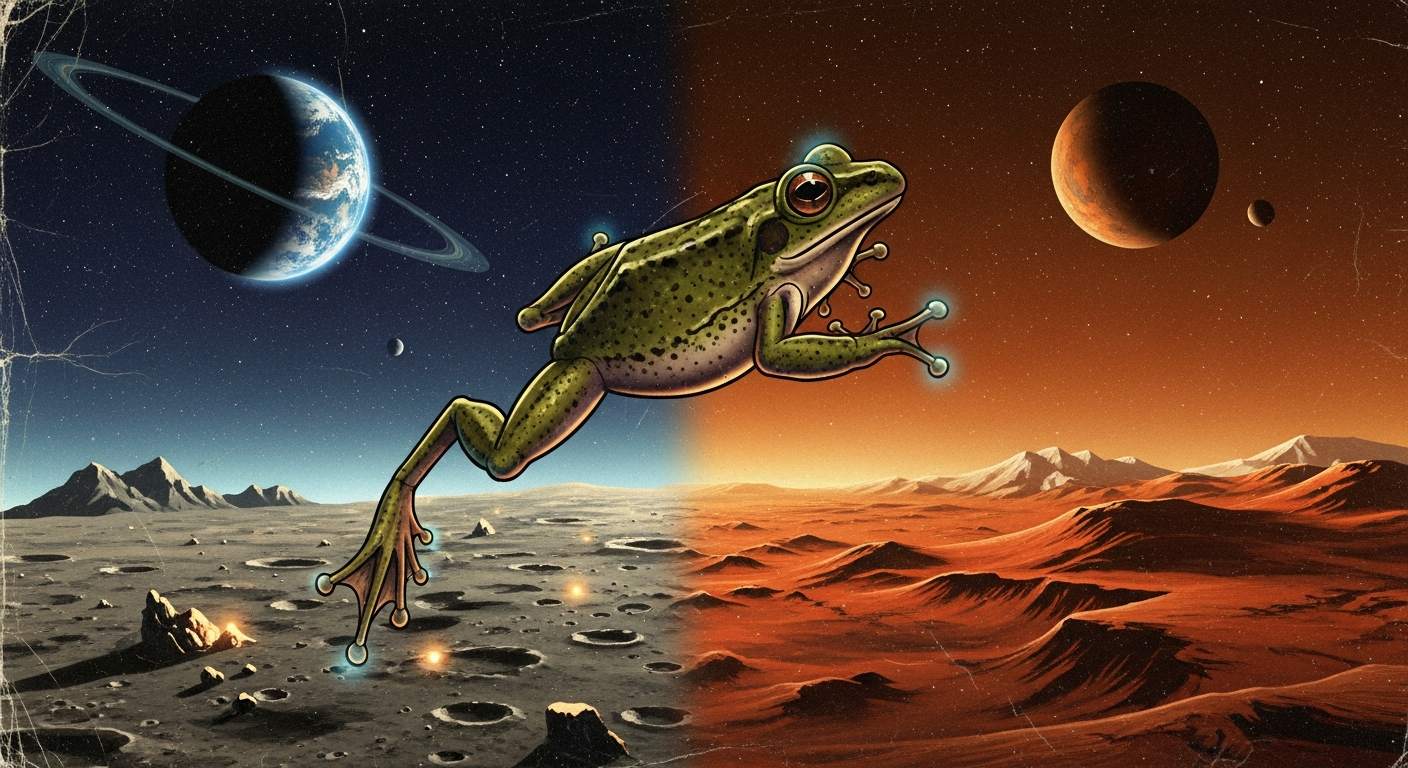
Would a Frog Jump Higher on the Moon or Mars? The Secret Biology of Space Gravity

Would a Frog Jump Higher on the Moon or Mars? The Secret Biology of Space Gravity Introduction: The Ultimate Space Jumping Contest Picture this: a little green frog wearing a tiny, custom-made spacesuit, standing on a spaceship launchpad. If we sent this frog into space, how high could it jump? More importantly, if we had an interplanetary jumping contest, would a frog jump higher on the Moon or Mars? For decades, space biology has fascinated scientists. By understanding how animals move and survive in space, we learn more about the universe and even our own human bodies! In this article, we are going to dive into the fun physics of space gravity and uncover the "secret biology" of what happens to muscles when they leave planet Earth. The Detailed Science: Gravity, Springs, and Space Biology 1. The Earth Jump: Built-in Rubber Bands To understand how a frog jumps in space, we first need to look at how it jumps on Earth. A frog’s back legs are like biological springs. Their leg muscles act like tightly stretched rubber bands. When a frog decides to leap, it releases that energy, pushing against Earth's gravity to fly into the air. On Earth, a good jumper like the American Bullfrog can leap over 6 feet (nearly 2 meters) in a single bound! 2. The Gravity Game: Moon vs. Mars Gravity is the invisible force that pulls us down to the ground. Every planet and moon has a different amount of gravity depending on how big and heavy it is. Because Earth is quite large, its gravity pulls down hard on our frog. The Moon's Gravity: The Moon is much smaller than Earth. Its gravity is only about 1/6th (16%) of Earth's gravity. Imagine taking off a really heavy backpack you’ve been wearing your whole life! Mars's Gravity: Mars is bigger than the Moon but smaller than Earth. Its gravity is about 3/8ths (38%) of Earth's gravity. It feels heavier than the Moon, but much lighter than Earth. So, the simple physics answer? The frog would jump much higher on the Moon! Because the Moon pulls down with the least amount of force, the frog's powerful rubber-band legs would send it soaring into the air. If a frog jumps 6 feet on Earth, it could theoretically jump over 36 feet on the Moon (as high as a 3-story building!), but only about 16 feet on Mars. 3. The Secret Biology of Space Gravity But wait—science is rarely just about simple math! Here is where the secret biology of space gravity comes in. Living things evolved to live with Earth's heavy gravity. Our muscles are constantly working just to keep us standing up. When astronauts (or frogs!) travel to places with low gravity, their bodies get confused. Because the frog doesn't need to push as hard to move around, its powerful leg muscles stop working so hard. In biology, there is a golden rule: "Use it or lose it." When muscles are not used, they begin to shrink and weaken. This is a scientific process called muscle atrophy. If our frog lived on the Moon for a few months, its muscles would become very weak because the low gravity makes jumping too easy. If it then traveled to Mars, it might barely be able to jump at all because it lost its super-spring strength! This is the exact same reason why human astronauts on the International Space Station have to exercise for two hours every single day. They have to trick their muscles into thinking they are still on Earth so their bodies stay strong. Conclusion: The Final Leap So, what is the final answer? If a frog just arrived from Earth in its tiny spacesuit and jumped immediately, it would jump much higher on the Moon because the Moon has less gravity than Mars. It would be the ultimate space trampoline! However, the secret biology of space tells us a different story over time. The less gravity there is, the faster muscles shrink. While the Moon offers the highest jump on day one, a long stay in space reminds us that Earth's strong gravity is actually what gives animals—and humans—our incredible strength. Next time you jump into the air, remember to thank Earth's gravity for keeping your muscles strong, and keep dreaming about the amazing science of the stars! biological

Would a Frog Jump Higher on the Moon or Mars? The Secret Biology of Space Gravity

Introduction: The Ultimate Space Jumping Contest

Picture this: a little green frog wearing a tiny, custom-made spacesuit, standing on a spaceship launchpad. If we sent this frog into space, how high could it jump? More importantly, if we had an interplanetary jumping contest, would a frog jump higher on the Moon or Mars?

For decades, space biology has fascinated scientists. By understanding how animals move and survive in space, we learn more about the universe and even our own human bodies! In this article, we are going to dive into the fun physics of space gravity and uncover the “secret biology” of what happens to muscles when they leave planet Earth.

The Detailed Science: Gravity, Springs, and Space Biology

1. The Earth Jump: Built-in Rubber Bands

To understand how a frog jumps in space, we first need to look at how it jumps on Earth. A frog’s back legs are like biological springs. Their leg muscles act like tightly stretched rubber bands. When a frog decides to leap, it releases that energy, pushing against Earth’s gravity to fly into the air. On Earth, a good jumper like the American Bullfrog can leap over 6 feet (nearly 2 meters) in a single bound!

2. The Gravity Game: Moon vs. Mars

Gravity is the invisible force that pulls us down to the ground. Every planet and moon has a different amount of gravity depending on how big and heavy it is. Because Earth is quite large, its gravity pulls down hard on our frog.

  • The Moon’s Gravity: The Moon is much smaller than Earth. Its gravity is only about 1/6th (16%) of Earth’s gravity. Imagine taking off a really heavy backpack you’ve been wearing your whole life!
  • Mars’s Gravity: Mars is bigger than the Moon but smaller than Earth. Its gravity is about 3/8ths (38%) of Earth’s gravity. It feels heavier than the Moon, but much lighter than Earth.

So, the simple physics answer? The frog would jump much higher on the Moon! Because the Moon pulls down with the least amount of force, the frog’s powerful rubber-band legs would send it soaring into the air. If a frog jumps 6 feet on Earth, it could theoretically jump over 36 feet on the Moon (as high as a 3-story building!), but only about 16 feet on Mars.

3. The Secret Biology of Space Gravity

But wait—science is rarely just about simple math! Here is where the secret biology of space gravity comes in.

Living things evolved to live with Earth’s heavy gravity. Our muscles are constantly working just to keep us standing up. When astronauts (or frogs!) travel to places with low gravity, their bodies get confused. Because the frog doesn’t need to push as hard to move around, its powerful leg muscles stop working so hard.

In biology, there is a golden rule: “Use it or lose it.” When muscles are not used, they begin to shrink and weaken. This is a scientific process called muscle atrophy. If our frog lived on the Moon for a few months, its muscles would become very weak because the low gravity makes jumping too easy. If it then traveled to Mars, it might barely be able to jump at all because it lost its super-spring strength!

This is the exact same reason why human astronauts on the International Space Station have to exercise for two hours every single day. They have to trick their muscles into thinking they are still on Earth so their bodies stay strong.

Conclusion: The Final Leap

So, what is the final answer? If a frog just arrived from Earth in its tiny spacesuit and jumped immediately, it would jump much higher on the Moon because the Moon has less gravity than Mars. It would be the ultimate space trampoline!

However, the secret biology of space tells us a different story over time. The less gravity there is, the faster muscles shrink. While the Moon offers the highest jump on day one, a long stay in space reminds us that Earth’s strong gravity is actually what gives animals—and humans—our incredible strength.

Next time you jump into the air, remember to thank Earth’s gravity for keeping your muscles strong, and keep dreaming about the amazing science of the stars!


Reader Comments

タイトルとURLをコピーしました